


Our Guiding Principles
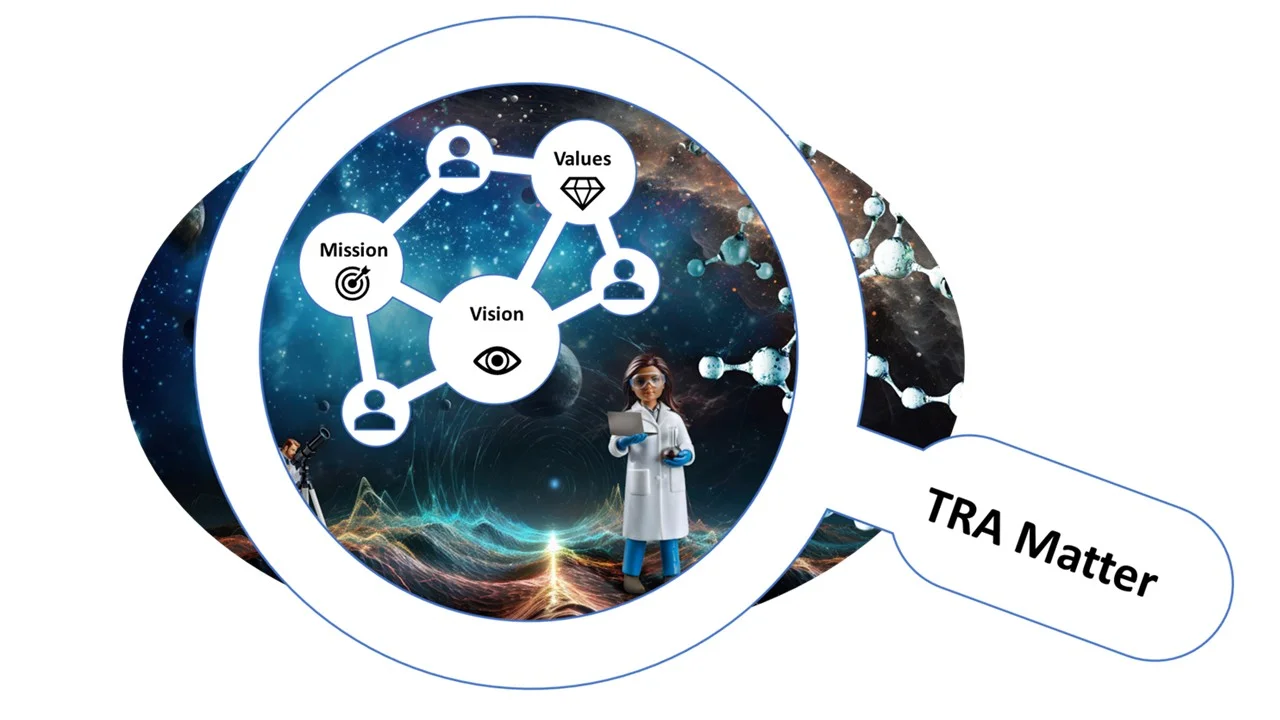

Vision
The Transdisciplinary Research Area "Building Blocks of Matter and Fundamental Interactions" (TRA Matter) foster open thinking and facilitates exchange and networks across conventional boundaries in exploration of the physical world. We inspire and train the next generation to excel in fundamental science and apply it to address global challenges.
Mission
To realize our vision, TRA Matter
- Provides a platform to support risky, idea-driven endeavours that bridge knowledge of nature at different time and length scales. The core of our mission is to bring together the diverse research and teaching cultures within the broad spectrum of natural sciences.
- Contributes to the evolution of university structures across the faculties by providing the perspective of natural science, by inspiring new hiring decisions, incubating collaborative projects, innovating joint teaching programs and promoting the perspective of young researchers.
- Promotes interactions of its members with researchers from disciplines beyond the natural sciences. We want to push the boundaries of traditional research alliances.
- Explores technological developments for research and application.
- Seeks interactions with society to explore the impact of fundamental science on our collective understanding of the world and the challenges we face.
- Grows our networks by partnering locally, nationally, and globally with other organizations and communities.
Values & Culture
In striving to achieve our mission, we place high value on:
Transdisciplinarity: Our understanding of science is transdisciplinary. Stemming from discipline-oriented science within the faculties, TRA Matter promotes multi-perspective and interdisciplinary research approaches. We value the diversity of research cultures that exist already within the natural sciences and its related fields, such as mathematics, computer science and the life-sciences. Striving for a shared understanding of differences and commonalities between research fields, their cultures, methodologies and languages will facilitate the discovery of new promising areas of investigation. True to our deep roots in evidence-based and quantitative research we seek links across faculties for forging new research paths. As scientists we appreciate our role in society and seek out interactions with institutions and the public, in order to engage in dialogues at the intersection of science and society.
Exploration: Curiosity to pursue new answers and elucidate previously unexplained phenomena is at the heart of science. While scientific investigation often has an uncertain outcome, which may be especially true for interdisciplinary initiatives, we embrace the risks involved and value the experience gained from these challenging endeavors, because we recognize that multiperspective approaches to complex problems can yield new and unanticipated solutions. We embrace the opportunities to acquire new skills and knowledge when venturing into new fields. We recognize that exploring new areas from unusual perspectives can increase the chance of serendipitous discovery. For these reasons we are committed to life-long learning beyond our already established areas of expertise.
Networks: We recognize that interdisciplinarity is a team effort. The communities and networks we build across faculties and disciplines are our most valuable asset. Developing common languages to work together productively across disciplines will be one of our most impactful achievements. Breaking down the cultural barriers between the sciences and humanities is a challenge we are addressing by joining forces with our colleagues from other TRAs across the faculties. Teaching the next generation how to establish connections with colleagues across
communities is critical to achieve our vision of a future where scientists are both experts and globally networked generalists.
Organization of TRA Matter
Organization of TRA Matter
The steering committee acts as the executive board of TRA Matter. Encompassing a total of 19 persons including the speakers, the Dean of the Faculty of Mathematics and Natural Science, professors, staff scientists, technical and administrative staff as well as student representatives of the University of Bonn, the steering committee directs all activities of TRA- Matter and signs responsible for its future strategic developments.
- Prof. Dr. Arne Lützen (Kekulé Institut für Organische Chemie und Biochemie, Speaker)
- Prof. Dr. Matthias Schott (Physikalisches Institut, Speaker)
- Prof. Dr. Walter Witke (Dean of the Faculty of Mathematics and Natural Science)
- Prof. Dr. Martin Weitz (Institut für Angewandte Physik)
- Prof. Dr. Dennis Lehmkuhl (Institut für Philosophie)
- Jun.-Prof. Dr. Patrycja Kielb (TRA Matter, Institut für Physikalische und Theoretische Chemie)
- Jun.-Prof. Dr. Lena Funcke (TRA Matter, Helmholtz-Institut für Strahlen und Kernphysik)
- Prof. Dr. Simon Stellmer (Physikalisches Institut)
- Prof. Dr. Thomas Reiprich (Argelander Institut für Astronomie)
- Prof. Dr. Carsten Urbach (Helmholtz-Institut für Strahlen und Kernphysik)
- Prof. Dr. Serena Viti (TRA Matter, Argelander Institute for Astronomy)
- Dr. Andreas Hansen (Representation of scientific staff)
- Dr. Saimé Gürbüz (Representation of the scientific staff )
- Tom Frömbgen (Representation of students)
- Henry Schumacher (Representation of students)
- Jens Mekelburger (Representation of the employees from technology and administration)
- Eugen Momper (Representation of employees from technology and administration)
Representing the collaborative research centers as spokespersons:
Prof. Dr. Corinna Kollath (Physikalisches Institut, OSCAR)
Prof. Dr. Arne Lützen and Prof. Dr. Matthias Schott are the speakers of TRA Matter. Both are supported by Dr. Birgit Westernströer, Manager of TRA-Matter.
Speaker of TRA Matter
Prof. Dr. Arne Lützen
Kekulé Institut für Organische Chemie und Biochemie
Why am I a spokesperson in the TRA?
"As the Bonn spokesperson of the Cologne-Bonn Research Training Group “Template-designed Organic Electronics,” I experience every day just how fruitful and inspiring it is to work across the boundaries of fields and disciplines. Having served on the TRA steering committee for some time now, I am delighted to take on the role of the speaker to further promote the TRA as a hub for inter- and transdisciplinary exchange and to develop new formats that encourage researchers at all career stages to look beyond the boundaries of their own fields and to be captivated by the fascination and joy of engaging with exciting overarching questions. I am particularly excited to bring this mindset into the joint discussion with the faculties and the rectorate to advance ideas for the structural development of our university. This will enable the university to further strengthen its status as an attractive and successful institution that addresses the challenges of the future, and continues to make significant contributions to their solution."
Speaker of TRA Matter
Prof. Dr. Matthias Schott
Physikalisches Institut
Why am I a spokesperson in the TRA?
"What excites me most about the role of spokesperson is the opportunity to bridge interfaces that are often hidden in day-to-day research. My own work is driven by a passion for exploring the intersections between different areas of physics and computer science—places where innovation frequently arises through the transfer of methods. As a spokesperson, I aim to foster this interdisciplinary spirit and remove barriers so that researchers from diverse fields can collaborate more easily. Supporting early-career researchers is particularly important to me: I want to inspire young scientists to think beyond disciplinary boundaries and provide them with the platforms they need to do so. At the same time, I value the direct connection to the rectorate, which allows me to drive structural initiatives that make our university more modern, collaborative, and appealing to future generations."
Manager of TRA Matter
Dr. Birgit Westernströer
Stabsstelle für strategische Entwicklung und Qualitätssicherung
Tel.: +49 (0) 15152560751
E-Mail: tra2-matter@uni-bonn.de
As part of the Excellence Strategy of the federal and state governments, TRA Matter is funded by the Federal Ministry of Education and Research (BMBF) and the Ministry of Culture and Science of the State of North Rhine-Westphalia (MWK).
For the legal framework governing our activities, see the statute of TRA Matter
Members and Network
Member Directory
Directory of our members and their research focus areas.
Search within our network of over 100 scientists for new cooperation partners. We are happy to support you in new joint projects or events!
Our partners


The other TRAs at the University of Bonn
In addition to the TRA Matter, there are five other transdisciplinary research areas at the University of Bonn. The TRA management is happy to support you in establishing contact with the researchers of the five other TRAs and in developing innovative collaborations.
Transfer Center enaCom
To transfer research results, we work closely with the University of Bonn's Transfer Center, enaCom. Innovation scouts identify transfer potential within the TRAs, inform researchers specifically about technology transfer and entrepreneurship topics, and establish the connection to enaCom.
Non-university partners
Valuable exchanges take place with non-university research institutes/centers in the region, such as the Max Planck Institute for Radio Astronomy.
Contact for further information

Dr. Birgit Westernströer
Read more about TRA Matter...
Research
Areas, topics, collaborative research & awards
SYNERGY BUBBLES
Concept and information on calls for proposals
Pinnboard
Articles, videos and announcements from past years