


Research profile
Our world is full of relationships that can be described as complex systems consisting of many interacting components, and researchers from various disciplines are eager to understand and model them. While experimental observations and theoretical considerations on individual interactions have created a wealth of data that is growing rapidly in today's data-intensive scientific world, it has also created one of the biggest challenges of our time: describing the interaction of numerous individual factors in complex systems with accurate models, predicting complex systems in simulations and, ultimately, yielding a real understanding of how those complex systems actually work. This comprehensive understanding can only be achieved through inter- and transdisciplinary collaboration.
The Transdisciplinary Research Area "Mathematics, Modelling and Simulation of Complex Systems" (TRA Modelling) was launched in early 2020 to meet the challenges in our understanding of complex systems and bridge the boundaries between disciplines. To this end, scientists in TRA Modelling address a range of transdisciplinary topics that is deliberately broad and open-ended.
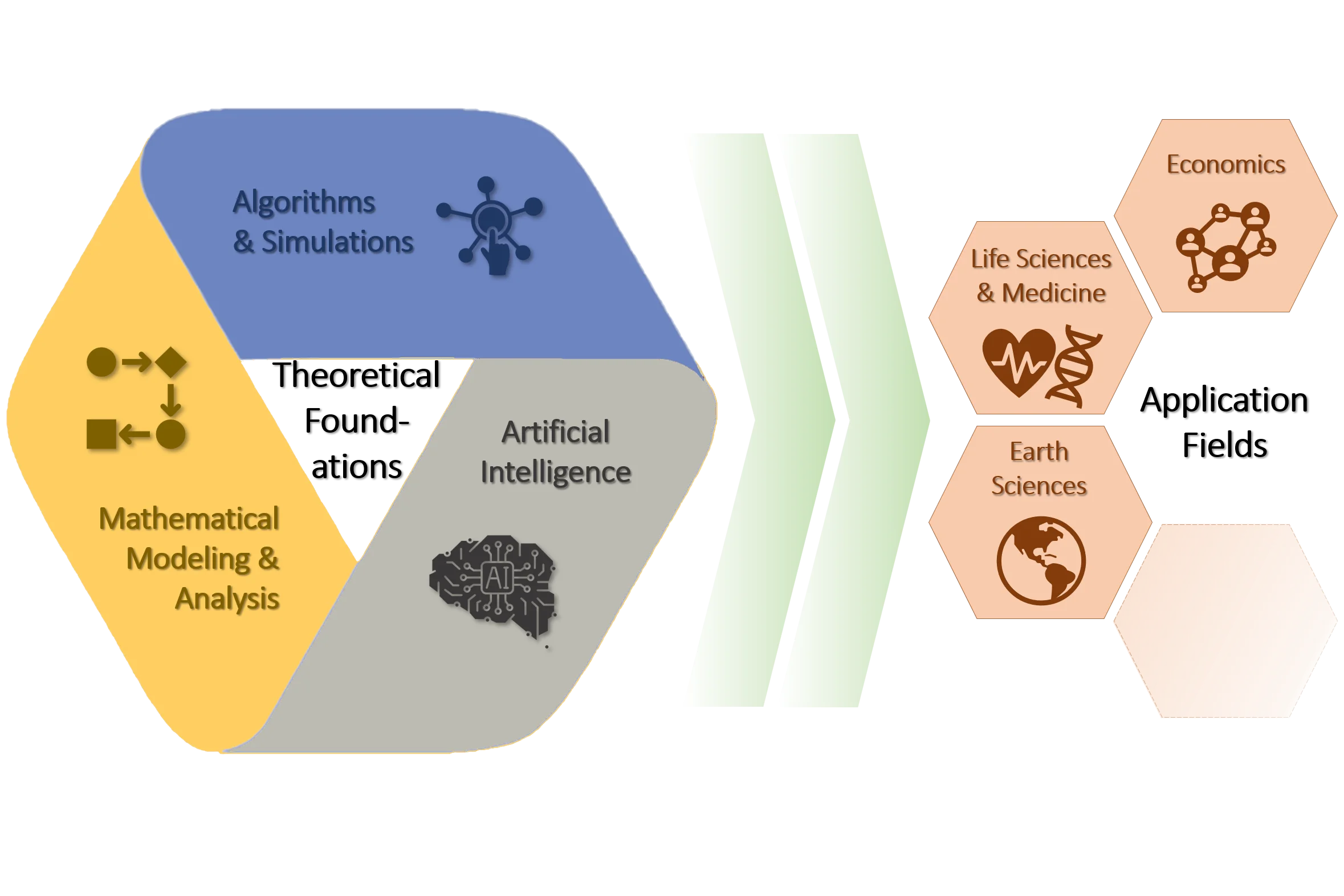
Based on a theoretical foundation in Mathematics and Computer Science, scientific questions are addressed with an innovative toolbox of methods in Algorithms & Simulations, Artificial Intelligence, and Mathematical Modeling & Analysis, among others.
We strive to apply these theoretical foundations and methods in inter- and transdisciplinary collaborations by promoting exchange on modeling across scientific disciplines (see events) and supporting modeling-based projects (see below).
The resulting innovations and findings are applied in various fields, in particular those Application Fields we defines as Life Sciences & Medicine, Economics, and Earth Sciences. However, our open research profile allows for new fields to be explored.
TRA funded projects
More than 40 grants were made possible by TRA Modelling via many calls since 2020, with the aim of supporting new cooperation, expanding existing scientific networks and fostering upcoming consortia. Our deliberately open research profile enabled us to support transdisciplinary projects leading to new insights and improvements within our Theoretical Foundations of Mathematics and Computer Science, as well as application-oriented projects that are clearly assigned to one defined Application Field.
Advancing our Theoretical Foundations
Current developments in Mathematics and Computer Science are an universal enrichment for various sciences and are actively supported by TRA Modelling. The projects listed below aim to establish new methods or achieve innovative improvements and find efficient solutions to long-standing problems.
With the extension of funding for the EXC 2047 HCM until 2032, Bonn is maintaining its leading position in mathematics. The granting of CRC 1720 in May 2025 marks another major achievement for mathematics in Bonn, enabling researchers to explore the many facets of criticality from a mathematical perspective.
Ongoing:
"Historic Newspaper Segmentation" & "Transcription of historical newspaper-pages" by Dr. Moritz Wolter in collaboration with Dr. Felix Selgert (Department of Constitutional, Social and Economic History). The project aims at the recognition of characters in historical newspaper pages with Natural Language Processing (NLP) and machine learning. A rich dataset of 801 annotated newspaper pages and a processing pipeline creates a starting point for future research in the field of digital history and historic German language newspaper processing. Results and dataset have already been published. The project is embedded into BNTrAinee and is financially supported by TRA Modelling since 2021.
"AI in dietary assessment: development of a Machine Learning based recommender system for recipe simulation to facilitate the product-based collection of dietary intake data (AI-diet)" by Prof. Rafet Sifa and Prof. Ute Nöthlings - Winner of the "TRA incubator grant 2024" of TRA Modelling and TRA Sustainable Futures.
"Human-Robot Interactions Through a Lab Supermarket Self-Checkout System" by Prof. Maren Bennewitz in collaboration with Prof. Dominic Lemken (Institute for Food and Resource Economics, ILR). The project provides an interdisciplinary platform for innovative research at the intersection of robotics and consumer behaviour.
Finalized:
"Novel Paradigms for Matching Problems in Shape Analysis" by Prof. Florian Bernard. The project produced published results and was an asset to the ERC Starting Grant project "HARMONY" starting in 2024. Seed funding was granted by TRA Modelling in 2022.
"Practical Characterization of Self-Assembling Optical Systems by Joint Forward and Inverse Modelling" by Prof. Matthias Hullin. The goal of the project was to achieve high-precision geometric calibration of self-assembled soft lenslet arrays for imaging purposes. Project was funded by TRA Modelling from 2022 - 2023.
"CiliaQ – Digitalization of software applications, Acronym CiliaQ" by Prof. Dagmar Wachten. The project aimed to provide an extensive wiki and a video tutorial for the CiliaQ software, so the scientific community could use it more effective in times of the COVID-19 pandemic (and beyond). Project was funded by TRA Modelling in 2021.
"MaxCut & Binary Quadratic Programming" by Dr. Sven Mallach. The project aimed to find integer programming formulations for the maximum cut problem. The corresponding results has been published and presented at the International Symposium on Combinatorial Optimization (ISCO) 2024. Project was funded by TRA Modelling from 2021 - 2023.
"NAPROCHE - NAtural PROof CHEcking: studying the language of mathematics and designing a natural proof checking system with natural language interfaces" by Prof. Peter Koepke in collaboration with Linguistics. Software is available with optional support for Isabelle Prover IDE. Project was supported by TRA Modelling from 2020 - 2023.
Applications in Life Sciences & Medicine
The combination of Mathematics/Computer Science and Life Sciences & Medicine brings together a growing community of scientists in Bonn. This fruitful interdisciplinary field of research is often supported together with TRA Life and Health, for example through the joint Modelling for Life and Health Research Prize.
In addition to particular research projects of our members listed below, we fostered the establishment of the Bonn Center for Mathematical Life Sciences (BCML) through a preparatory symposium (2021). We also support international conferences on this topic (2023 and 2026). The MaLiS Club meets regularly to discuss ongoing projects around mathematical questions in Medicine and Life Sciences.
Ongoing:
"Automatic structure detection on particles" by Dr. Elena Trunz in cooperation with Dr. Annika Rautenberg (Institute for pharmaceutical technology). Project is embedded into BNTrAinee and is financially supported by TRA Modelling since July 2025
"Modelling behavioral loops using multiple interacting attractors" by Prof. Tatjana Tchumatchenko - funded with Open Call 2025
"Deriving homogenized reaction-diffusion PDEs and coupled Fokker-Planck equations for large-scale simulations of tumor-immune interactions" by Prof. Kevin Thurley - funded with Open Call 2025
"ANNE++: Graph-based and AI-driven Modeling of Eye Movement Patterns in Epilepsy Patients" by Prof. Björn Krüger and PD Randi von Wrede (Department of Epileptology) - funded with Open Call 2025
"Random walks or directed paths? – Harvesting the potential of 3D modeling to uncover the impact of ontogeny on alveolar macrophage dynamics" by Prof. Ana Ivonne Vazquez-Armendariz (LIMES) and Prof. Jan Hasenauer (LIMES) - Winner of Transdisciplinary Research Prize - Modelling for Life and Health 2025
"Amortized Short-term SUb-frame REsolution Tracking (ASSURET)" by Prof. Ulrike Endesfelder with Prof. Jan Hasenauer - funded with Open Call 2024
"Parcellation-free modeling of brain networks for presurgical evaluation of people with epilepsy" by Prof. Thomas Schultz (Computer Science) and Dr. Theodor Rüber (University Hospital Bonn, UKB) - Winner of Transdisciplinary Research Prize - Modelling for Life and Health 2023
Finalized:
"Automatic construction of gene regulatory networks from scientific literature with LLMs" by Prof. Lucie Flek. The project seeks to extract data from existing literature in cancer research. Project was seed funded from 2024 - 2025.
Support for international symposium "Microfluencers: From small organisms to large impact" organized by Prof. Ulrike Endesfelder in 2022. Interdisciplinary speakers from biology and physics shed light on various important aspects of how microbial influencers shape our world.
"Assessing the separate and synergistic effects of amyloid and tau on human brain activity using a computational model of brain oscillations" by Prof. Xenia Kobeleva (Ruhr-Universität Bochum since 2023). Results have been part of this publication. Project was seed funded from 2021 - 2023.
"Establishment of computational methods for spatially-resolved deep profiling of biological tissues" by Prof. Jan Hasenauer (LIMES) with Prof. Michael Hölzel (UKB) and Prof. Marieta Toma (UKB) - Project was funded from from 2020 - 2021.
Applications in Economics
The traditional collaboration between Economics and Mathematics in Bonn is increasingly being expanded to focus on problems at the interface between Economics and Computer Science. The development of this interdisciplinary field of research is actively supported by TRA Modelling by seedfunding of several projects (see list below).
In addition, a particular incentive was created by the appointment of our Hertz Chair László Végh, whose research group combines methods from discrete and continuous optimization, computer science, game theory, and economics to develop efficient and exact approximation algorithms.
Finalized:
"Facilitating work with computational models: Software for economics and beyond" by Prof. Hans-Martin von Gaudecker. The project developed a software library with the name estimagic, designed for nonlinear optimization with or without constraints. It is particularly suited to solving difficult nonlinear estimation problems. Please visit project page for more information. Project was funded from 2022 - 2023.
"OpenSourceEconomics" by Prof. Philipp Eisenhauer. Open Source Economics (OSE) is a platform for economists and computational scientists to facilitate the transdisciplinary collaboration in the development, analysis, and application of computational economic models. Please visit project page for more information. Project was funded from 2020 - 2022.
Applications in Earth Sciences
Artificial intelligence, algorithms, and simulation have become the key tools in Earth science, and Bonn has established an excellent environment for interdisciplinary teams to advance this field. TRA Modelling has actively supported this development by supporting several projects like RU 5361 AlgoForGe and CRC 1502 DETECT (see list below).
In addition, TRA Modelling supports an annual workshop series on Machine Learning for Earth System Modelling where leading scientists discuss in Bonn the advancements and future of large-scale neural networks for weather and climate modeling.
Finalized:
"From remote sensing to species composition modelling of European permanent grassland systems under drought and heat stress (Clever Grass)" by Dr. Bahareh Kamali with the aim to mathematically model agroecological systems. Project was seed funded from 2023 - 2024.
In 2022 TRA Modelling and CRC 1502 DETECT jointly launched the "Collaborative Research Award "Mathematics, Modelling, and Simulation for the Investigation of Climate Change". The winning project "Statistical Testing and stochastic processes for the Analysis of Modeled and observed Earth system Data (STAMPED)" by Dr.-Ing. Jan Martin Brockmann was funded from 2023 - 2024 with the aim of integrating him into the DETECT community as a young scientist and including him in the DFG application for a second funding phase of the CRC.
"Development of Continuous Spatio-Temporal Finite Element Based Models for Sea Surface Approximation" by Dr.-Ing. Jan Martin Brockmann. This TRA funding between 2021 and 2023 enabled an interdisciplinary project of the young researchers Jan Martin Brockmann and Moritz Borlinghaus. Innovative methods were developed at the interface between computation and Geodesy, which were successfully published and presented at conferences.
"FOR "Algorithmic Data Analysis for Geodesy (AlgForGe)" by Prof. Petra Mutzel with Prof. Jan Hendrik Haunert. Seed funding by TRA Modelling between 2020 and 2021 facilitated the application for a research unit at DFG, wich turned out sucessful in June 2022. It is based at the Institutes of Computer Science and Geodesy and Geoinformation and is complemented by researchers from the Universities of Cologne and Düsseldorf. Ever since AlgForGe also strengthens the Center for Earth System Observation and Computational Analytics (CESOC). The supportive role of TRA Modelling for the integration of Algorithmics and Geodesy is highly appreciated by Petra Mutzel in her statement.
Collaborative Research Projects related to TRA Modelling
Scientists at the University of Bonn and the TRA Modelling play a leading role in a large number of collaborative research projects in the field of “Mathematics, Modelling and Simulation of Complex Systems”, which you will find listed below.
Please also have a look at the detailed information on all Collaborative Research Projects and all mayor Awards for Researchers at the University of Bonn. We are proud that many of these outstanding scientists are members of TRA Modelling.
- EXC 2047 - Hausdorff Center for Mathematics (HCM)
- EXC 2151 - ImmunoSensation² - the immune sensory system
- EXC 2070 - Robotics and Phenotyping for Sustainable Crop Production
- CRC 1720 - Analysis of criticality: from complex phenomena to models and estimates
- CRC 1639 - Numerical Methods for Dynamics and Structure Formation in Quantum Systems (NuMeriQS)
- CRC 1502 - Regional Climate Change: Disentangling the Role of Land Use and Water Management (DETECT)
- TRR 224 - Economic Perspectives on Societal Challenges (EPoS): Equality of Opportunity, Market Regulation, and Financial Stability
- RU 5361 - KI-FOR Algorithmic Data Analytics for Geodesy (AlgoForGe)
- RU 5351 - KI-FOR Automation and Artificial Intelligence for Monitoring and Decision Making of Horticultural Crops (AID4Crops)
Completed
- CRC 1060 - The Mathematics of Emergent Effects (2017 - 2024)
- TRR 110 - Symmetries and the Emergence of Structure in Quantum Chromodynamics (QCD) (2012 - 2024)
- RU 2535 - Anticipating Human Behavior (2017 - 2024)
- Advanced Cyber-Security Framework for AI-Supported, Multimodal, Real-Time Detection of Medical Seizure Events (SecureNeuroAI)
- Robotics Institute Germany (RIG)
- Lamarr Institute for Machine Learning and Artificial Intelligence (LAMARR)
- Advancing Cardiovascular Risk Identification with Structured Clinical Documentation and Biosignal Derived Phenotypes Synthesis (ACRIBiS)
- Data-driven, multiscale modeling of the tumor microenvironment through interpretable machine learning (InterpretTME)
- WestAI: Service Center for Artificial Intelligence
- BNTrAInee: Bonn Transdisziplinäre Ausbildung in Künstlicher Intelligenz
- RAINA: A statistically robust AI foundation model of the atmosphere for better short-term forecasts of extreme events (Coordinated at Forschungszentrum Jülich)
- NRW-Netzwerke - iBehave: Algorithms of Adaptive Behavior and their Neuronal Implementation in Health and Disease
- NRW-Profilbildung - InVirtuo 4.0: Experimentelle Forschung in virtuellen Umgebungen
- NRW Spitzencluster - zertifizierte KI
- Exzellenz Startup Initiative.NRW - Visual Computing Incubator (VCI)
Completed:
- Volkswagen Stiftung - Integrating Epidemiological and Economic Modeling while accounting for Uncertainty (2021 - 2023; reference no. 99 450)
More about TRA Modelling
Offers
- Funding opportunities for members of TRA Modelling
- Central services of the University of Bonn