


Going beyond borders of disciplines
The main objectives of TRA Modelling are to strengthen inter- and transdisciplinary cooperation within mathematics, computer science, and their areas of application, as well as to support the establishment of new collaborations and joint research projects.
TRA Modelling offers networking opportunities by organizing or supporting events. Scientists can also apply for funding through TRA's own funding opportunities.
The research profile of TRA Modelling deliberately addresses a broad, open spectrum of transdisciplinary topics. There are numerous connections to the Clusters of Excellence, consortia, and research networks, as well as individual groups of researchers that we count among our network.
Membership in TRA Modelling
The TRA Modelling is a contentual research alliance at the interface of applied mathematics and computer science, as well as their application disciplines such as Economics, Life Sciences & Medicine, and Earth Sciences. Membership in TRA Modelling is possible regardless of faculty affiliation and is established through formal admission as a member.
Get involved in the TRA - Your membership application
In TRA Modelling, researchers from a wide range of disciplines create models that can not only describe complex systems, but also analyze them.
The TRA is open to all scientists who conduct independent research at the University of Bonn or a cooperating research institution and whose work is related to our research profile.
Directory of our members and their research priorities
Search for new cooperation partners within our network of over 160 scientists - we will be happy to support you with new joint projects or events.
The Opportunity for more Intensive Cooperation
Since our founding in 2020, we bring together an increasingly diverse scientific community. Today, 67% of our members are habilitated, 21% are female, and 39% are based outside the Faculty of Mathematics and Natural Sciences, which is already home to a broad spectrum of departments.
This versatility offers the opportunity for more intensive cooperation on interdisciplinary research topics. This diversity of topics is further enhanced by working together with other TRAs on overlapping topics, in particular with TRA Life and Health, TRA Sustainable Futures, and TRA Matter.
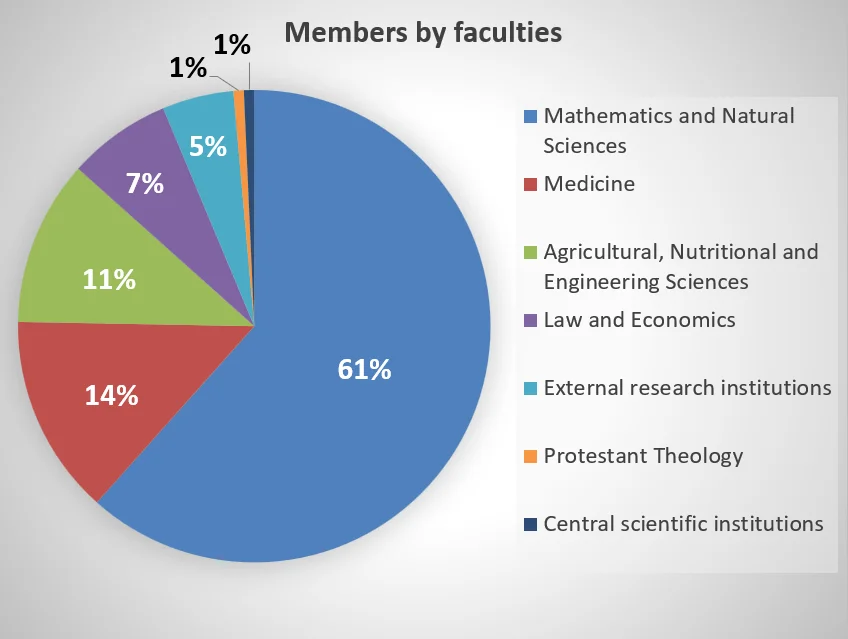
Organizational structure of the TRA, Spokespersons and committees
The Steering Committee of the TRA acts as the executive board and decides, among other things, on the allocation of funding. The TRA Spokespersons lead the Steering Committee and coordinate strategic decisions with the Rectorate of the University of Bonn. Spokespersons and the Steering Committee are elected every two years by all TRA members at a meeting. Ex officio members of the Steering Committee are excluded from the election.
Spokespersons TRA Modelling:
Prof. Alexander Effland (Institute for Applied Mathematics)
Prof. Jürgen Gall (Institute of Computer Science)
Professorial ex officio members:
Prof. Martin Rumpf (Spokesperson of Hausdorff Center for Mathematics, HCM)
Prof. László Végh (Hertz Chair of TRA Modelling)
Prof. Sven Rady (Head of the Department of Economics)
Prof. Walter Witke (Dean of the Faculty of Mathematics and Natural Sciences)
Professorial members:
Prof. Anton Bovier (Institute for Applied Mathematics)
Prof. Jürgen Dölz (Institute for Numerical Simulation)
Prof. Anne Driemel (Institute of Computer Science)
Prof. Ulrike Endesfelder (Institute for Microbiology and Biotechnology)
Prof. Lucie Flek (Institute of Computer Science)
Prof. Joachim Freyberger (Institute of Finance and Statistics)
Prof. Philipp Hieronymi (Mathematical Institute)
Prof. Matthias B. Hullin (Institute of Computer Science)
Prof. Petra Mutzel (Institute of Computer Science)
Prof. Heiko Röglin (Institute of Computer Science)
Prof. Catharina Stroppel (Mathematical Institute)
Prof. Kevin Thurley (Institute of Experimental Oncology)
Status Group Representative:
Scientific Staff:
Dr. Magdalena Balcerak Jackson (Managing Director HCM)
Dr. Sven Mallach (Institute of Computer Science)
deputy position Dr.-Ing. Jan Martin Brockmann (Institute of Geodesy and Geoinformation)
Technical and Administrative Staff:
Anna Kessler (Mathematics)
deputy position Daniela Schürheck (Computer Science)
Students:
Aron Brendel (Student Council Mathematics; deputy position: Yannick Sprenger)
Christoph Geron (Student Council Computer Science; deputy position: Felix Roth)
- All important information about the structure, objectives and legal basis of TRA 'Modelling' can be found in our statute (in German).
- TRA Modelling is funded since 2019 within the framework of the Excellence Strategy of the German Federal and State Governments.
- Management: Dr. Daniel Minge (tra-modelling@uni-bonn.de / +49 (0)175 1038957)
Network of our institutional partners
The Cluster of Excellence Hausdorff Center for Mathematics (HCM) cluster of excellence covers a broad spectrum of research, ranging from pure and applied mathematics to economic issues and interdisciplinary work with departments such as materials research and life sciences.

The Cluster of Excellence ImmunoSensation³ has done much to advance our understanding of the immune system. Over 80 research groups from the fields of immunology, neuroscience, systems biology, bioinformatics, mathematics, and clinical research working closely together.

The Cluster of Excellence PhenoRob stands for sustainable and technology-driven transformation of agriculture, focusing on the development of innovative and sustainable cropping systems and new technologies such as robotics, AI, and sensor-based phenotyping.
The BCML is a cross-faculty center at the University of Bonn that conduct interdisciplinary research at the interface of mathematics and life sciences and focuses on the development and application of mathematical models to analyze complex data from biological and biomedical research, medicine, and epidemiology.

LAMARR is one of Germany’s major AI competence centers, shaping a new generation of AI that is high performing, sustainable, trustworthy and secure to contribute to solving fundamental challenges in business and society. It stands for value-based, internationally competitive and application-oriented excellent research.
CESOC is a research partnership of the Universities Bonn and Cologne as well as the Forschungszentrum Jülich, working closely together with the European Centre for Medium-Range Weather Forecasts (ECMWF). All together, they bundle expertise and tackle the current challenges of global environmental changes.
Non-university partners
There is ongoing exchange with non-university research institutions in the Bonn region that belong to the Bonn Research Alliance (BORA). Researchers at BORA member institutions are welcome to participate in the TRAs and apply for membership. The TRA Modelling is thematically linked primarily with the Max Planck Institute for Mathematics (MPIM), the Fraunhofer Institute for Algorithms and Scientific Computing SCAI, the Fraunhofer Institute for Intelligent Analysis and Information Systems IAIS, and the Fraunhofer Institute for Communication, Information Processing and Ergonomics FKIE.
More from TRA Modelling
Offers
- Funding opportunities for members of TRA Modelling
- Central services of the University of Bonn