


Many people are familiar with this from everyday life: the paint on a garden fence needs to be repainted after a few years—“the weather has taken its toll.” But even larger structures, from the Eiffel Tower to the Golden Gate Bridge, must be time-consuming repainted to maintain them. Until now, two main causes were considered the driving forces behind such damage to coatings: first, mechanical stress—that is, a kind of friction between droplets and the surface that gradually wears down the coating or causes it to flake off; and second, chemical factors, particularly when droplets contain acids or salts.
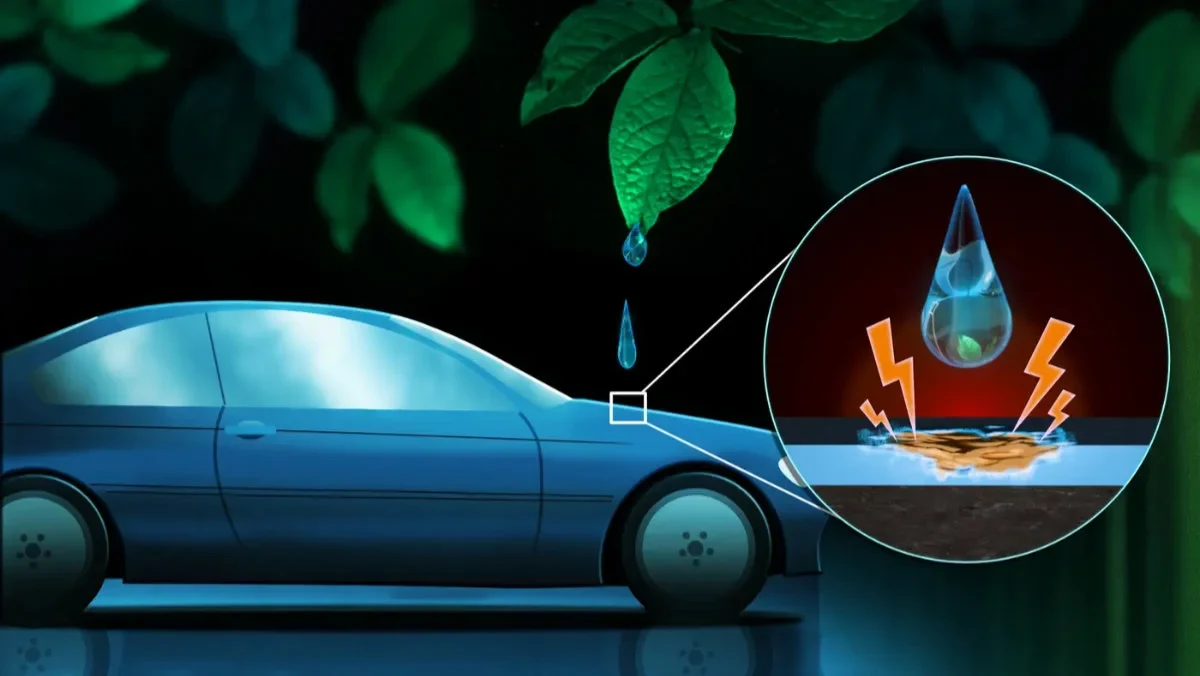
Researchers led by Hans-Jürgen Butt, director at the Max Planck Institute for Polymer Research (MPIP), have now identified another, previously unknown factor in collaboration with partners from the University of Bonn, South China University of Technology, MIT, and Johannes Gutenberg University Mainz: the electrical charge of droplets. When water droplets slide across surfaces, ‘friction electricity’ is generated. “When such charged droplets strike a coating, they discharge locally and can puncture the layer in specific spots like a small flash of lightning—with consequences for the coating’s durability”, says Rüdiger Berger, group leader in the MPIP “Physics at Interfaces” department.
To demonstrate the damage caused by such electrical breakdowns, the researchers first dropped droplets specifically onto a surface uniformly coated with Teflon—a material commonly found on frying pans. With uncharged droplets, no changes to the coating were visible under the microscope even after 3,000 impacts.
They then had the droplets roll across various everyday surfaces before impact—including a houseplant leaf, PVC, and polystyrene, such as that found in plastic windows. As they slid across these materials, the droplets became charged and subsequently fell onto the Teflon coating. After 3,000 droplets, distinct changes to the surface and the underlying metal were visible under the microscope.
“The charge a droplet acquires as it slides depends heavily on the specific surface—we measured differences of up to a factor of ten,” explains Zhongyuan Ni, the study’s first author. “Regardless of this, we were able to detect changes in the coating in all experiments.”
Shuai Chen from the Institute of Inorganic Chemistry at the University of Bonn contributed to this study through powder X-ray diffraction (PXRD) measurements and data analysis. PXRD provides a characteristic “fingerprint” of crystalline materials, and it was used to identify the products formed on the copper surface after repeated impacts of charged water droplets. The measurements showed the formation of cuprous oxide and basic copper chloride. These results provided chemical evidence that charged water droplets can damage the protective coating and cause corrosion of the underlying copper.
The researchers hope that their findings, published in the journal Nature, will pave the way for new, more efficient coatings that can protect cultural heritage, cars, or even the garden fence at home for longer and more effectively.