


WHAT’S THE RESEARCH ABOUT?
A team of researchers from the University of Bonn, Heidelberg University and the National Autonomous University of Mexico has studied the critical behavior of light particles (photons) close to a phase transition. This critical scaling behavior, which sees thermodynamic quantities grow extremely large or diverge shortly prior to Bose-Einstein condensation, had never before been seen in photon gases until the researchers successfully secured precisely this proof. They measured the spatial correlations of a nearly non-interacting 2D photon gas trapped in a mirror box at the moment of condensation, determining the critical exponent - a quantity describing the rapid increase in the correlation length as the temperature changes near the phase transition
HOW DID THE RESEARCHERS GO ABOUT IT?
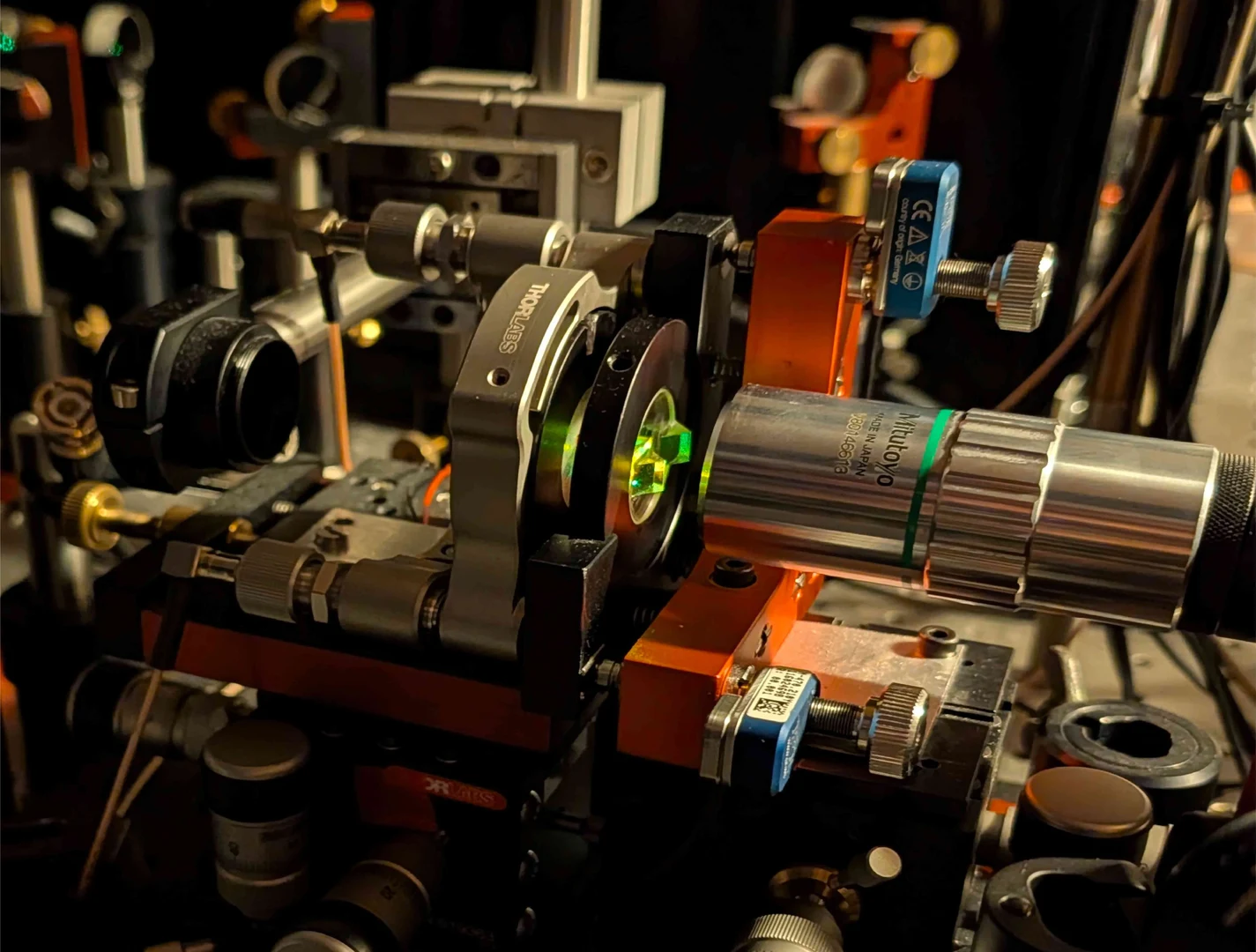
They trapped light particles inside an optical microresonator filled with a dye solution. Through processes of absorption and emission as the light particles came into contact with the dye molecules, the photons effectively cooled down (“thermalized”) until the quantum phase of condensation began. One of the resonator mirrors had also been structured at the nanometer scale beforehand by means of laser writing to create a box-like potential. The angular distribution of the light emitted was then measured with a camera and analyzed via Fourier transform to determine the spatial correlations.
WHAT’S THE KEY FINDING?
This was the first-ever experiment that demonstrated that photon gases constitute a distinct, overarching universality class of physical systems in nature. Much like water, which at the critical point suddenly turns cloudy due to opalescence, the photon gas in this case exhibits a rapidly increasing and diverging correlation length. This research finding thus fills a key gap in the physics of phase transitions and has the potential to open up exciting new avenues for basic research into systems that lie well outside thermal equilibrium as well as for future applications in optics.