

A University team led by Rector Professor Michael Hoch and Vice Rector for International Affairs Professor Birgit Ulrike Münch promoted Bonn as somewhere young researchers will find strong research environments, international networks and genuine support. Delegates were particularly interested in asking about opportunities in the neurosciences, biology and mathematics.
Conversations that launch careers
Every year, GAIN brings early-career researchers from North America together with German higher-education and research institutions, funding organizations and figures from the worlds of science, academia and politics. Over 500 researchers and experts and some 80 higher-education and research institutions and other organizations took part in the event in San Francisco. For the University of Bonn, the talent fair played host to a great many conversations: about ideas for research, about the next steps in people’s careers and about how they might take these in Germany.
Rector Hoch said: “GAIN shows just how interested international early-career researchers are in pursuing a career in Germany and how well positioned the University of Bonn is in this regard. We offer young researchers tangible prospects for doing their research in an inter- and transdisciplinary environment that boasts a strong infrastructure. My time in San Fransisco made it abundantly clear to me that Bonn can be the next key career step for many of these highly talented individuals.”
Showcasing what research needs
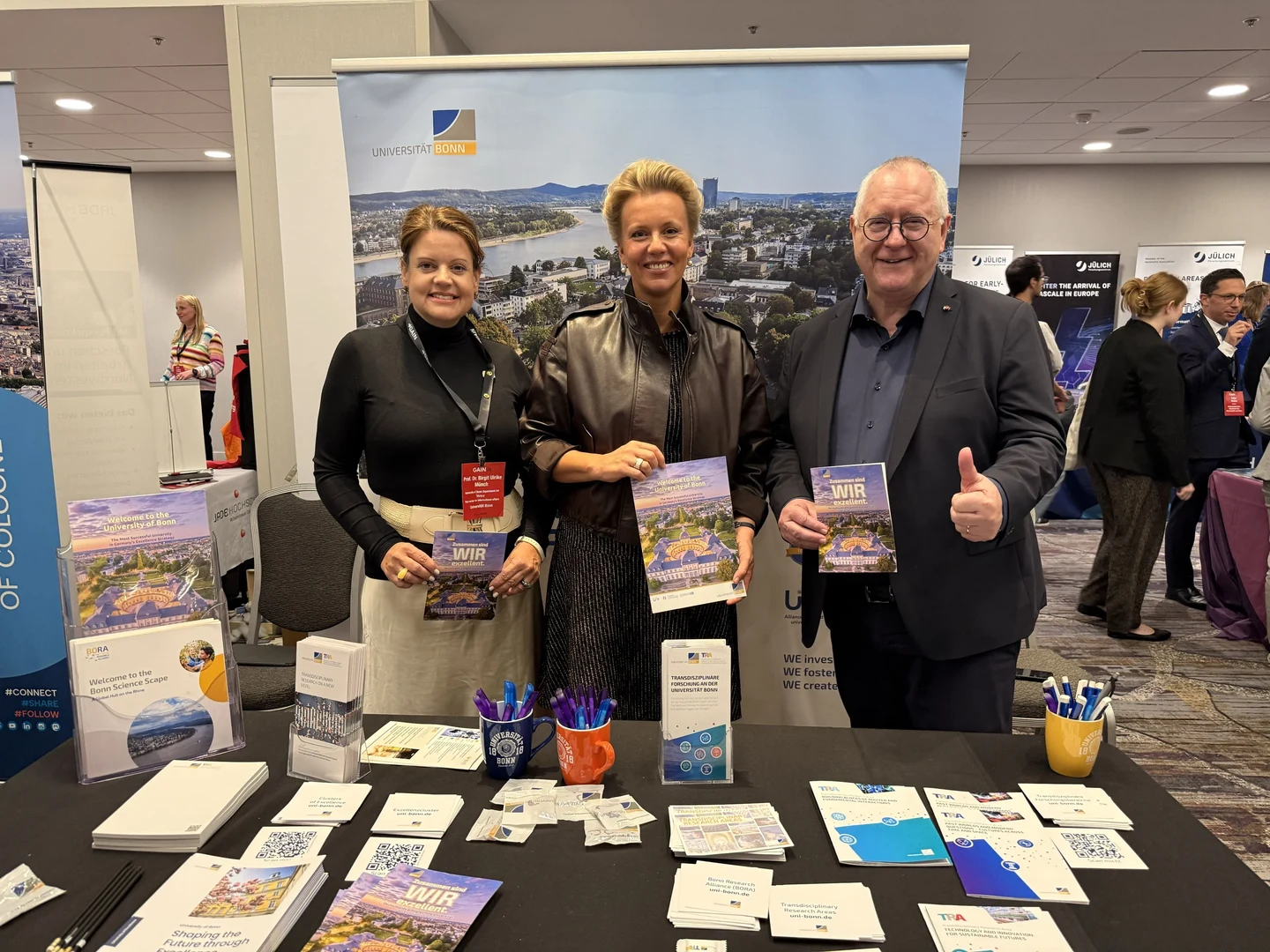
The University of Bonn’s booth welcomed a steady stream of young researchers with specific questions: Which working groups would match my profile? What potential funding options are there? How does the University support international researchers in their first few days and weeks? Staff from the Welcome Center for International Researchers were on hand to provide the answers. For mathematicians, the team from Bonn focused on the Hausdorff Center for Mathematics Cluster of Excellence, among other things. A great many conversations revealed that young researchers see Bonn as somewhere that combines academic strength with an open and cosmopolitan outlook.
Vice Rector Münch held numerous conversations with international early-career researchers and led two workshops that explained individual career paths and funding available at the University of Bonn. She also joined a panel convened by the German Research Foundation, where she shared the opportunities presented by the eight Clusters of Excellence that the University of Bonn had successfully secured. Thus the conference provided a vivid illustration of something that is hard to convey in brochures, namely that academic careers are often launched by two people talking to each other. “At GAIN perhaps more than anywhere else, it’s becoming obvious just how effective it is to talk face to face,” Münch said. “It turns an academic career into something tangible and proves that the University supports young researchers and gives them attractive prospects.”
Academia and politics in dialogue
GAIN also hosted a number of panels, workshops and other dialogue formats that explored how Germany can hold its own in the international competition for research talent. Representatives from the federal and state governments, the Bundestag, the academic and scientific community and higher education discussed what framework postdocs need in order to flourish and how centers of research can attract or entice back highly skilled researchers.
Hoch wore two hats while contributing to this debate: Besides being Rector of the University of Bonn, he is also Chair of the German U15 alliance of universities. It was in this capacity that he spoke to a number of political figures at a fringe event, including three members of the Bundestag—Adrian Grasse, Joachim Ebmeyer and Ayşe Asar—and Hamburg’s Senator for Science Maryam Blumenthal. Hoch also represented the German Academic Scholarship Foundation at and around GAIN26 in his role as its President.
The University of Bonn’s booth hosted several discussions with prominent politicians over the course of the conference. For instance, Ina Brandes, Minister of Science of the state of North Rhine-Westphalia (NRW) and a member of its state parliament, engaged in deep conversation with Hoch and Münch, as did State Secretary Dr. Marcus Pleyer from the Federal Ministry of Research, Technology and Space and Professor Karl Lauterbach, a member of the Bundestag.
Meeting talent from Bonn in Silicon Valley
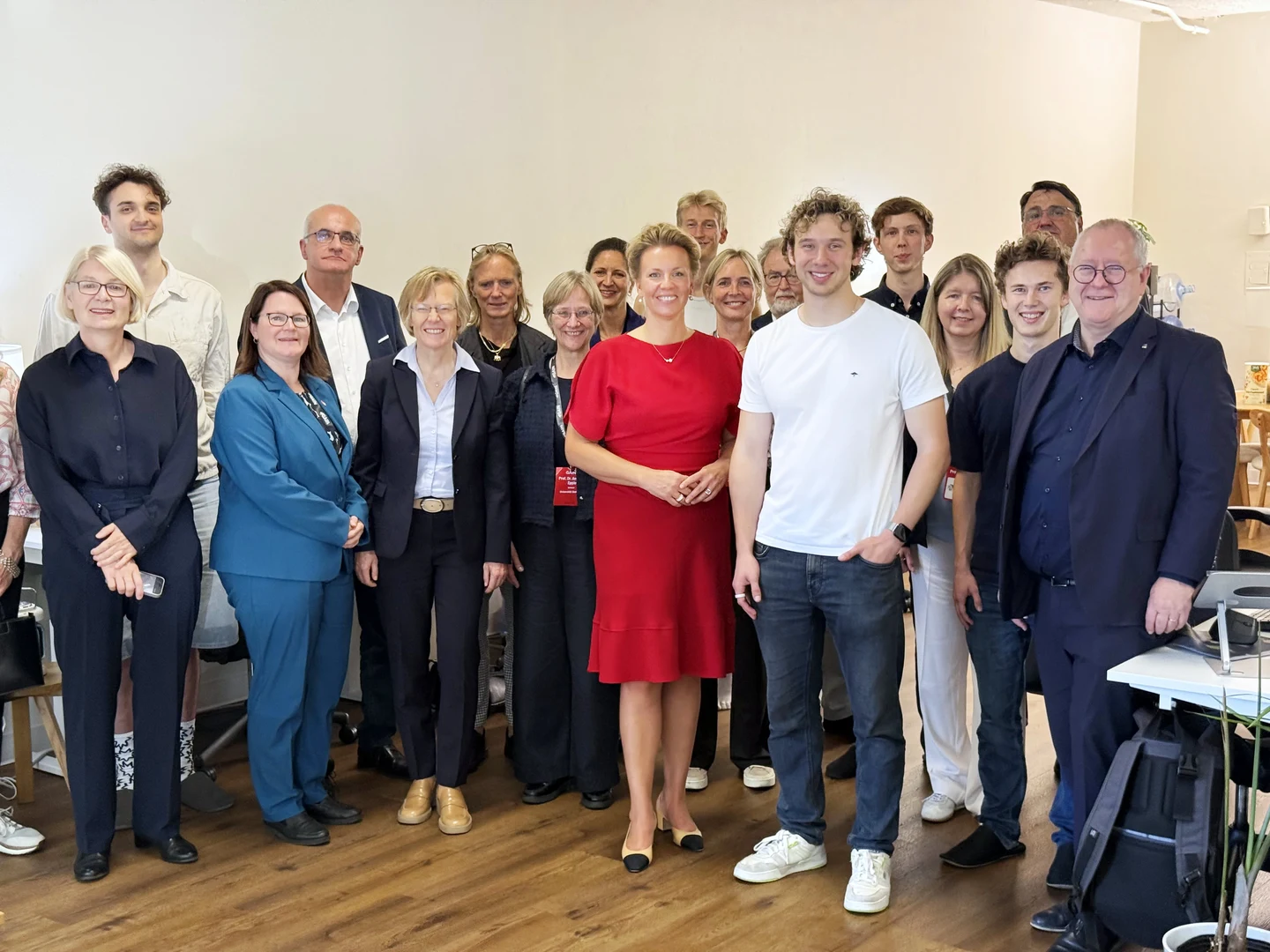
Once GAIN was over for another year, the delegation from Bonn continued its US trip with a visit to Stanford University and several other stop-offs in the Silicon Valley ecosystem. Here too, the focus was on how to attract international talent for research, transfer and innovation and support them on their career journey. The visit to the Palo Alto-based start-up Attention Engineering threw up a bona fide link to Bonn in the shape of Founding Engineer Johann Gaulke, who studied mathematics at the University and now works at the interface between AI, innovation and entrepreneurship.
The University of Bonn’s overall impression from its three days in San Francisco and its subsequent meetings in Silicon Valley is a thoroughly positive one. This is because its strong presence on the ground demonstrated how important face-to-face dialogue is when young researchers are planning their next steps and a university makes it clear that it does not just want to attract talent but support them in their future careers as well.
Media contact:
Prof. Dr. Birgit Ulrike Münch
Vice Rectorate for International Affairs