

The German Research Foundation (Deutsche Forschungsgemeinschaft, DFG) has approved the funding as part of the “Global Minds in DFG Consortia” initiative, which comes under the Global Minds Initiative Germany (1.000-Köpfe-Plus-Programm) supported by the Federal Ministry of Research, Technology and Space. The program is designed to open up new avenues in the German academic system for researchers who are currently working abroad. The DFG is providing total funding of some €69 million for 15 professorships and 12 Mercator Fellows across Germany in this first round.
“The fact that no fewer than three proposals from alliances involving the University of Bonn were accepted is confirmation of how attractive we are internationally as a place to do research,” says Professor Ilona Grunwald Kadow, Vice Rector for Research and Career Development. “The Global Minds program has helped our research alliances secure the services of some exceptional researchers, whose expertise will not only enrich their particular fields but will also inject fresh momentum into the collaboration already under way in the Bonn/Cologne science region.”
Vascular biology and chronic inflammation
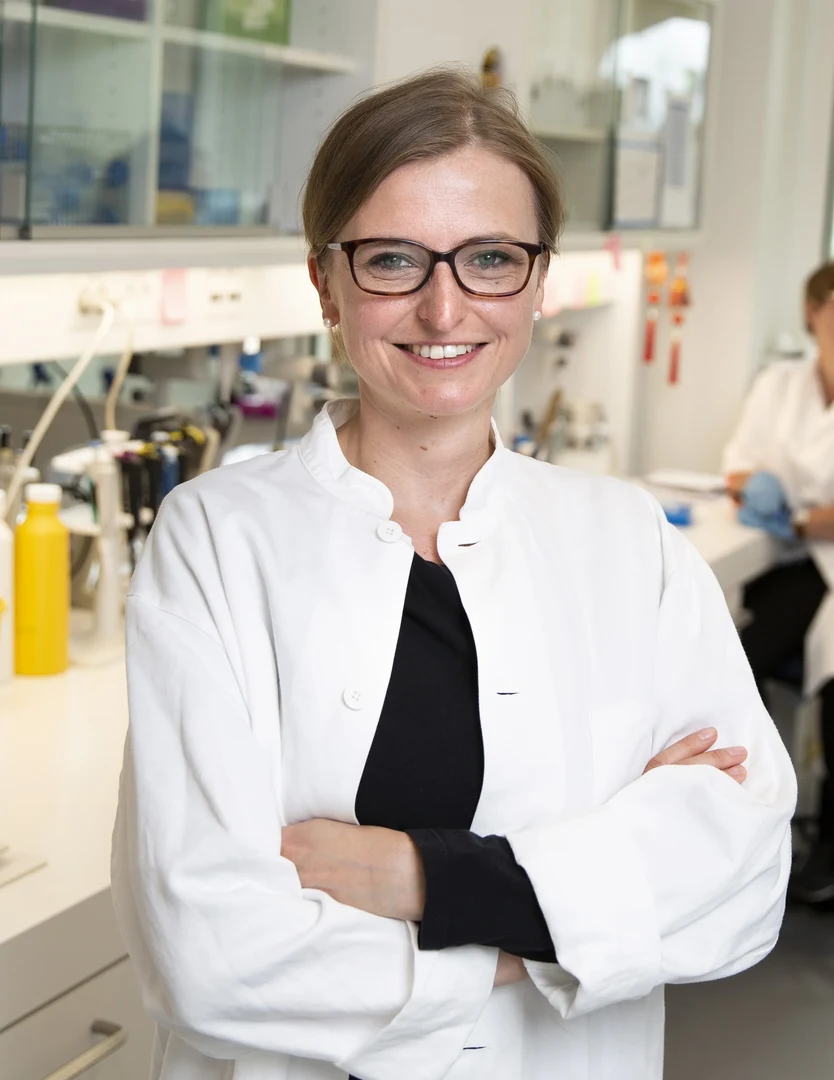
Professor Joanna Kalucka is an associate professor in Aarhus University’s Department of Biomedicine, where she heads up the Laboratory of Angiogenesis and Inflammation. Her research looks at the biology of blood vessels in healthy and sick people, focusing particularly on how endothelial cells—which form the innermost layer of our blood vessels—change in the event of inflammation, obesity and cancer and how their metabolism responds.
Her role as “Mercator Fellow Global” will make Kalucka a long-term part of the work being done by Collaborative Research Center 1454, Metaflammation and Cellular Programming,” at the University of Bonn and the University Hospital Bonn and will see her make several lengthy research visits. Led by Professor Dagmar Wachten, the alliance is investigating how an unhealthy lifestyle can misprogram the immune system and trigger chronic inflammation. This “metaflammation” can contribute to the emergence of various conditions, including cardiovascular diseases, neurodegenerative diseases and metabolic syndrome.
Molecules in space
A professorship at the “DYNAVERSE – Our Dynamic Universe” Cluster of Excellence will be established at the University of Cologne. It combines astronomical observations and innovative instruments with theoretical research, simulations, data science and laboratory astrophysics in order to improve our understanding of the dynamic growth of our Universe and its material and energy flows over some very different timescales.
Markets walking a tightrope
The new professorship in the ECONtribute: Markets & Public Policy Cluster of Excellence, which is likewise based at the Universities of Bonn and Cologne, will study markets caught between the conflicting demands of the economy, politics and society. The focus will be on challenges such as digitalization, inequality, political polarization and climate change.
Funding for “Global Minds”
The “Global Minds Professorship” module enables outstanding researchers to be recruited from abroad, making up to €3.5 million available for each professorship over a five-year term. Meanwhile, the “Mercator Fellow Global” module allows world-leading researchers who are not currently seeking a permanent move to Germany to be closely involved in a research alliance by spending prolonged periods working there in person. Funding of up to €650,000 is available for this purpose.
Further information:
Global Minds Initiative Germany: https://www.dfg.de/de/foerderung/foerderinitiativen/global-minds-initiative-germany
ECONtribute: https://econtribute.de/de/
SFB/CRC 1454 „Metaflammation and Cellular Programming“: https://www.sfb1454-metaflammation.de/
DYNAVERSE: https://www.uni-bonn.de/de/forschung-lehre/early-career/eine-promotion-planen/spps/dynaverse