


What is the focus of this research?
We investigated how agricultural landscapes respond to extreme drought events. Our goal was to determine the impact of crop species diversity and the proportion of green infrastructure—such as small trees and orchards—on the drought tolerance of grasslands.
How did you go about this?
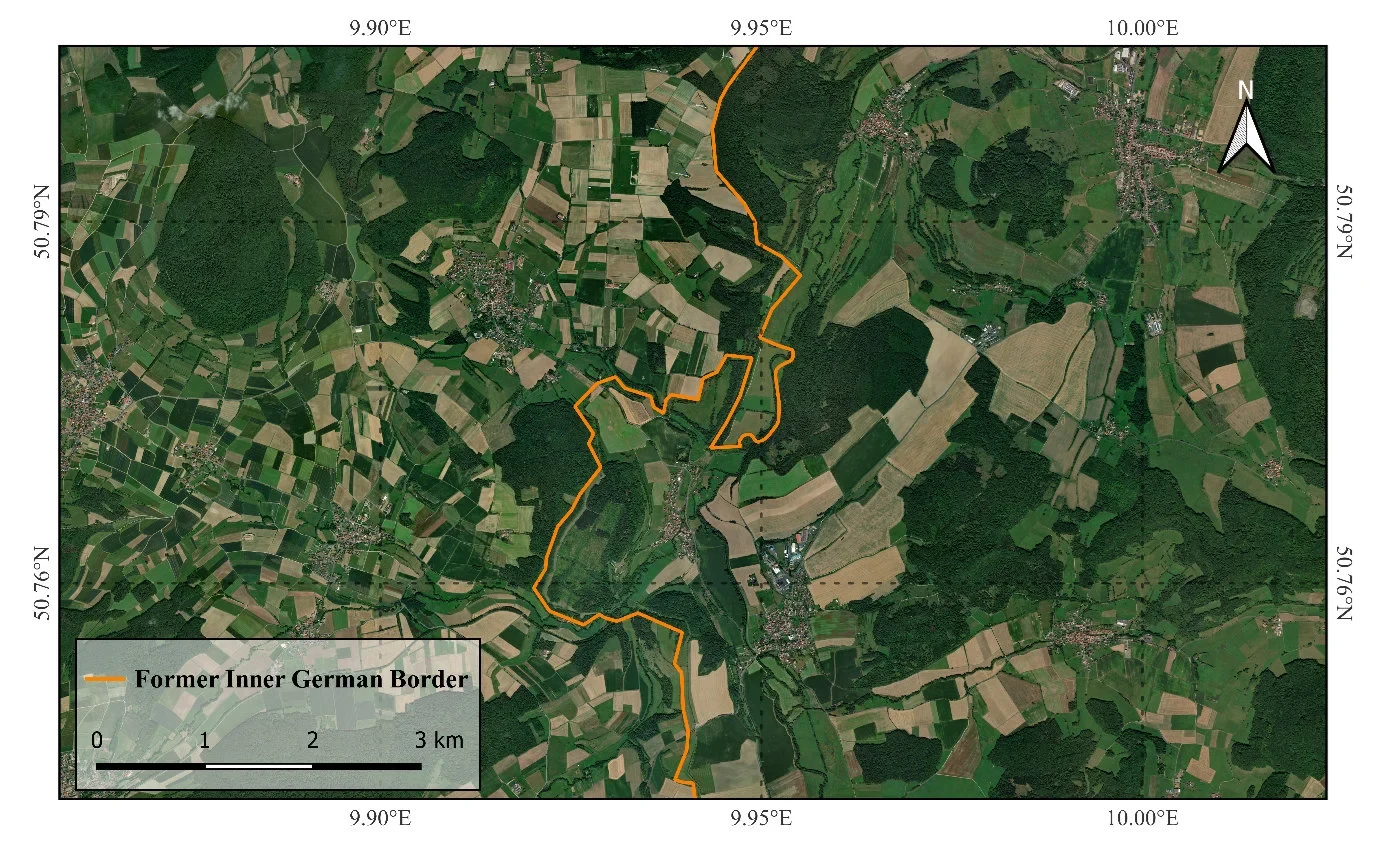
We compared landscapes in eastern and western Germany. In the east, due to agricultural restructuring after 1945, there are many large farms and large, contiguous areas that are used in similar ways. In western Germany, farms are generally smaller, and the land is used in a more diverse range of ways.
What is the most important finding?
We found that the more uniform use of agricultural land in eastern Germany meant that, during the drought, more green spaces could no longer be utilized effectively. Plant biomass yields also declined. One reason for this is that landscapes with less diverse land uses are less able to store water during a drought.
What was your research approach?
We investigated how droughts affect green spaces and what role landscape structure plays in this process. To do this, we used satellite and other remote sensing data and applied a method that allows for a clearer distinction between cause and effect. This enabled us to examine whether monotonous landscape structures actually cause more green spaces to become unproductive during a drought—and not just whether both phenomena occur simultaneously. To better assess what these results mean for farms, we also used a model that calculates plant growth under various conditions. This allowed us to estimate how much plant biomass could be lost due to drought if the landscape is less diverse and varied.
What was the biggest challenge?
The biggest challenge was determining the direct impact of a less diverse agricultural landscape on the consequences of droughts. To do this, we first had to gain a precise understanding of the processes involved and then translate that knowledge into a mathematical model. The main focus was on determining the influence of landscape structure as accurately as possible while simultaneously accounting for other factors that can also affect the severity of a drought’s impact.
Are there practical applications?
Yes, overall, this study shows that increased diversity at the landscape level can improve ecosystem function and the resilience of farms to extreme events, as well as help ensure agricultural yields.
What do you recommend based on the results?
A more diverse landscape can not only have positive effects on the environment but may also be better equipped to cope with extreme weather events such as droughts. This means that if agricultural land is designed and used in a more diverse way, it can help make the landscape more resilient to extreme weather conditions.
What’s next?
Several important questions remain for future research. For example, it is unclear whether the disadvantages of large, less diverse farms during severe droughts can be offset by their advantages in normal years. Large farms, for instance, can operate more efficiently due to their size. Given the increasing frequency and severity of droughts and heat waves, this question is becoming increasingly important. Further studies on which landscape characteristics make them more resilient to droughts could help us better understand these relationships. This would allow us to determine, with even greater certainty, how agricultural lands can be made more sustainable and resilient in the face of climate change.
What is the source?
Marco Ferro, Jan Börner, Silke Hüttel, Katja Kowalski, Patrick Hostert, Krisztina Kis-Katos: The causal effect of agricultural landscape simplification on Germany’s grasslands during a compound drought and heatwave in 2018, American Journal of Agricultural Economics, DOI: https://doi.org/10.1002/ajae.70096
Where can I find out more?
Marco Ferro, Institute for Food and Resource Economics, Tel. ++49 228-732324, Email: marco.ferro@ilr.uni-bonn.de; Prof. Dr. Jan Börner, member of the Transdisciplinary Research Area “Sustainable Futures” and the Cluster of Excellence “PhenoRob” at the University of Bonn, Tel. ++49 228-733548, Email: jborner@uni-bonn.de, URL: https://onlinelibrary.wiley.com/doi/10.1002/ajae.70096