


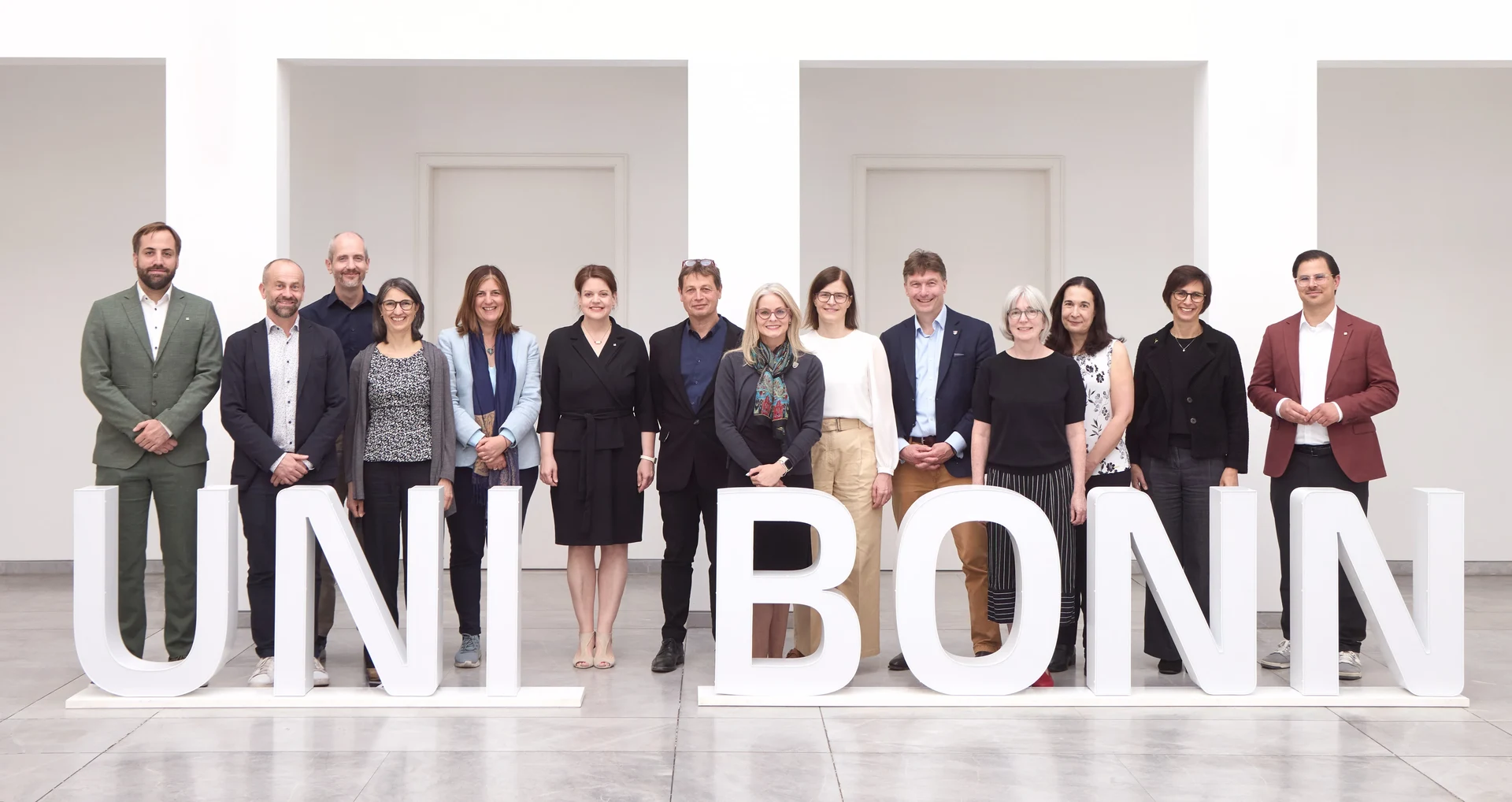
This year’s summit provided an opportunity for the GUSI network to continue its cooperation where scientific excellence meets societal responsibility. All five partner universities share the same aims, namely to tackle global challenges together and learn from one another. “Artificial intelligence is transforming higher-education institutions all over the world, making it all the more important to pool our experiences, views and potential solutions across national borders,” said Professor Birgit Ulrike Münch, Vice Rector for International Affairs. “The GUSI network provides a unique framework for this, and our discussions in Bonn have shown how beneficial dialogue can be between different academic cultures and education systems.”
International expertise on AI in higher education
Alongside the University of Bonn itself, delegations from Emory University in the US, the Hebrew University of Jerusalem in Israel, the University of St Andrews in Scotland and Waseda University in Japan also attended the summit. Top of the agenda were the network’s annual board meeting and the first topic-specific GUSI workshop entitled “AI Education,” which brought together experts from all the member universities. The researchers explored the use of AI in teaching and learning from a variety of angles. Experts from Hebrew University, for example, introduced an institutional model for integrating generative AI into university teaching, while the team from St Andrews used their “SimPatient” platform to demonstrate how simulated, AI-assisted consultations with patients can be used in medical training. Their “AnthroAI” project also shone a spotlight on the issue of engaging critically with AI in the humanities and social sciences. Researchers from Waseda University presented ways of using AI to gauge understanding and performance in language lessons and outlined the prospects for more comprehensive AI education. Meanwhile, experts from Emory University asked how higher-education institutions can ignore all the hype and uncertainty surrounding AI and succeed in using it responsibly.
Researchers from the University of Bonn also helped to shape the program, offering up several contributions and discussion formats. Among other things, they considered the use of AI in medical training and in improving academic writing skills as well as applications in linguistics.
“The future of teaching and learning will hinge not only on the technology itself but also, and in particular, on how we use it in a way that’s both responsible and makes good teaching sense,” emphasized Professor Klaus Sandmann, Vice Rector for Teaching, Learning and University Development at the University of Bonn. As he explained: “AI will only be able to unleash its potential in higher education if it is used in a scientifically considered manner and this use is accompanied by clear guidelines and ongoing dialogue. The GUSI network has made it clear how important it is to share experiences among countries and universities to give everyone a bit more guidance in keeping up with the lightning-fast developments.”
Bonn: a center of international dialogue
Besides taking in the expert presentations, the partner universities also used the summit to plan the network’s next steps. In various sessions of the board meeting they agreed on new cooperation formats in research and teaching and on a number of joint projects for the next few years.
The working groups also presented their latest results, illustrating in the process just how closely the partner universities have been collaborating so far. Joint projects are increasingly being worked on at multiple sites simultaneously, and synergy effects are being harnessed in a targeted way. Among other things, talks centered around GUSI’s strategic orientation. The network is working on several projects designed to raise its profile further, including on a more defined online presence that is intended to bring all its activities and services together in one place.
The delegations also discussed how joint research initiatives can be expanded over the long term. One example of successful cooperation is an international program to develop the intercultural skills of doctoral students, which sees early-career researchers from different cultural and institutional backgrounds engage in dialogue. The plan is to keep the program going and expand it further.
GUSI: a global network taking responsibility for society
The Global Universities for Societal Impact (GUSI) network was established in 2023 by the University of Bonn, Emory University, the Hebrew University of Jerusalem, the University of St Andrews and Waseda University. Its aims are to expand international research and teaching partnerships, put up a united front against global challenges and strengthen societal responsibility as a core mission of higher-education institutions.
Between 2024 and 2027, the network will be focusing primarily on artificial intelligence, and the first topic-specific workshop held in Bonn marked a landmark moment in this collaboration. Within GUSI’s organizational structure, the chairs of its board and operations committee change every year, with the University of Bonn set to assume the network’s rotating presidency in the 2026/27 academic year, taking the reins from Emory University.
Contact for media inquiries
Vice Rectorate for International Affairs
University of Bonn
prorektorat.internationales@uni-bonn.de