


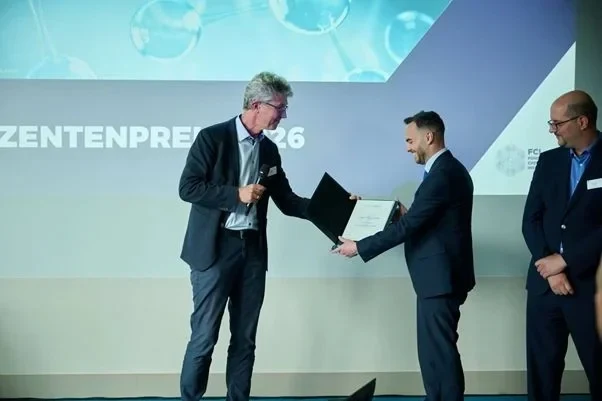
The researcher from the University of Bonn is being honored for his innovative work developing light-dependent reactions in main-group-element chemistry. His research combines the chemistry of heavy pnictogens such as antimony and bismuth with modern concepts of photochemistry and catalysis, thus opening up new possibilities for sustainable and efficient chemical syntheses.
Bismuto studied chemistry in Naples before embarking on a doctorate at the University of Edinburgh under the supervision of Stephen Thomas and Michael Cowley, working on the development of new catalytic applications of aluminum hydrides in main-group catalysis.
After obtaining his doctorate, he spent time researching at the University of California, Berkeley, working with John F. Hartwig on a Royal Society of Chemistry Mobility Fellowship. He then took up a postdoc position at ETH Zurich under Bill Morandi, where he worked on mechanistic aspects of transition-metal chemistry, focusing especially on palladium-, nickel-, ruthenium- and iridium-catalyzed reactions. In 2021, he received a Liebig Fellowship and set up his first independent research group in Göttingen, before being appointed to a tenure track professorship at the University of Bonn two years later. Bismuto has won several awards besides his Liebig Fellowship, including the JSP Fellowship (entitling him to attend the Bürgenstock Conference) and the Thieme Chemistry Journal Award.
The Lecturer’s Prize is worth €25,000 plus €50,000 to cover material resources and travel expenses.