

Combining the very best of lecture hall and Carnival soapbox, the session kicked off bang on time at 7:11 pm, moderated by Dr. Lemmens from the University Alliance Ruhr and Professor Andreas Archut, Press Officer at the University of Bonn. Guiding the audience through the evening with humor and wit, they ensured a fantastic atmosphere right from the get-go, prompting not only rapturous applause from the stalls but also the first stamps* and whistles of the night.
Politicians flying high as a kite
The highlight of the “Jeckcellence Initiative” was provided by Rector Professor Michael Hoch and his team—Dr. Martina Krechel, personal assistant Jonas Fehres and advisor Niklas Almasi. Their piece, “Completely Detached. A Ministry Takes Off!”, showcased their hitherto unrevealed acting talent, as the Rector and the Rectorate’s managing director slipped into the illustrious roles of Bavaria’s state premier Markus Söder and Federal Research Minister Dorothee Bär. A conspiracy orchestrated at her ministry’s Bonn office saw the two political heavyweights suddenly sitting inside a rocket that was in orbit with no way of getting back to Earth—a vicious satire on current research policy at the federal and state governments.
They were followed by Dr. Insa Thiele-Eich, who confirmed that reaching for the stars was, in fact, very much a realistic prospect for the University of Bonn: The researcher and astronaut-in-training assumed the mantle of the Universe itself to cast a critical eye over the University of Excellence in her “Observations from Outer Space.” Despite some tongue-in-cheek barbs directed at the state of its buildings, the University was ultimately given the much-coveted “green light” for its suitability for space travel.
Big cheeses and red tape from Berlin
Nicola Kuhrt, Editor-in Chief Research at Table.Media, offered a keen-eyed outsider’s perspective on the political machinations going on in the German capital, comparing the state of play on the Rhine and the Spree in her “Report from Berlin.” While people in the Rhineland are building carnival floats, she said, they are assembling “work packages” in Berlin, where applying for third-party funding has long since evolved into an art form in its own right.
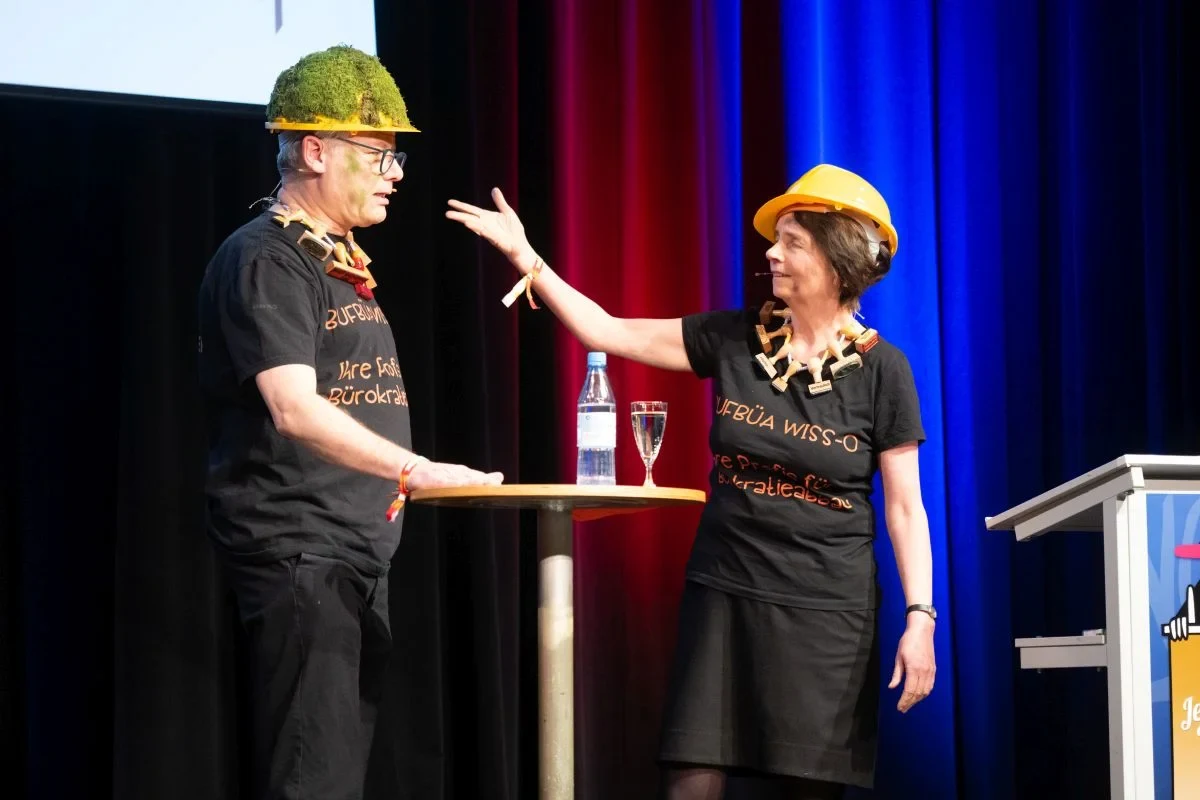
Also taking the same line were Dr. Annette Julius from the German Academic Scholarship Foundation and Dr. Roman Luckscheiter from the German Commission for UNESCO. As representatives from the fictitious “Federal Office for Reducing Bureaucracy in Research Organizations” (whose German abbreviation, “BufBüAWissO,” is something of a mouthful in itself), they skewered the worst excesses of red tape in the academic world with some well-placed punchlines. The “janitors of excellence” then brought things a bit more down to earth: Andreas Archut formed a double act with Georg Scholl, press officer for the German Council of Science and Humanities, to demonstrate that the true success of a University of Excellence often lies in the hands of its facility management team.
International sounds and acrobatic tours de force
Next up was the University of Bonn’s International Choir: some 50 students and doctoral candidates from 17 countries took to the Forschologicum stage for the first time and gave everyone in the audience goosebumps with their performance. Conducted by Martin Kirchharz, a Rhinelander well versed in the local dialect, the choir sang the Carnival classic “Wenn et Trömmelche jeht” (“When the Little Drum Sounds”) in Rhenish, Dutch, French and Norwegian. It was a powerful symbol of international understanding in academia that had the whole theater singing along.
The first dance performance of the evening came from Staicy Stadtler and the University of Bonn’s University Sports hip-hop group with their lively beats. Later on, “Headlights”—a showdance group from Oberbreisig led by Maren Kraus, a project manager at the PhenoRob Cluster of Excellence—wowed the audience with their acrobatic lifts in a routine entitled “Viva Las Vegas!”
Pigs, senior citizens and a few tenors
In thematic terms, the evening covered all possible bases. In its sketch entitled “Schwein gehabt!” (meaning literally “Had a Pig!” but figuratively “Had Good Luck!”), the Faculty of Agricultural, Nutritional, and Engineering Sciences tackled a practical breeding problem that could only be solved with the intervention of a mysterious “excellence magician.” Dr. Stephan Eisel, a stalwart of the Forschologicum and Bonn’s very own “Mr. Beethoven,” used music to express the pain of leaving his alma mater, while Dr. Christian Bode—former secretary general of the German Academic Exchange Service (DAAD) and “grand old man of research”—shone a light on the plight of retired senior managers suffering from post-traumatic stress disorder, complete with the realization that even courses in ironing are not really that much help.
The grand finale came courtesy of the Haus der Springmaus’s very own Christoph Scheeben and Andreas Etienne. The former’s rendition of the Carnival song “Heidewitzka, Herr Kapitän” (“Off We Go, Mr. Captain”) to the tune of Puccini’s aria “Nessun Dorma” brought the house down.
The event concluded with Managing Director Berit Baumhoff and Andreas Archut thanking everyone involved. Among the guests was Mayor of Bonn Guido Déus. The message that remained at the end of the evening was clear: Now that one Forschologicum has been safely put to bed, it is high time to start preparing for the next one. On January 25, 2027, “Wissenschaft alaaf!” (“Science above all else!”) will once again be the order of the day in Endenich.
* Nothing to do with postage stamps. Rather, this refers to the collective stamping of revelers’ feet that forms the second stage of a “Rakete,” a way of expressing approval that is unique to Carnival and that starts with clapping and ends with whistling.