


The concept of Transdisciplinary Research Areas (TRAs)
Research for and with society: At the University of Bonn, researchers from different disciplines work together to find answers to the pressing questions of tomorrow. After all, the world is not divided into scientific disciplines. Global challenges such as the climate crisis, food security, and social division can only be overcome by pursuing new avenues of cooperation. That is why the University of Bonn has established six Transdisciplinary Research Areas (TRAs) as one of the cornerstones of its excellence strategy.
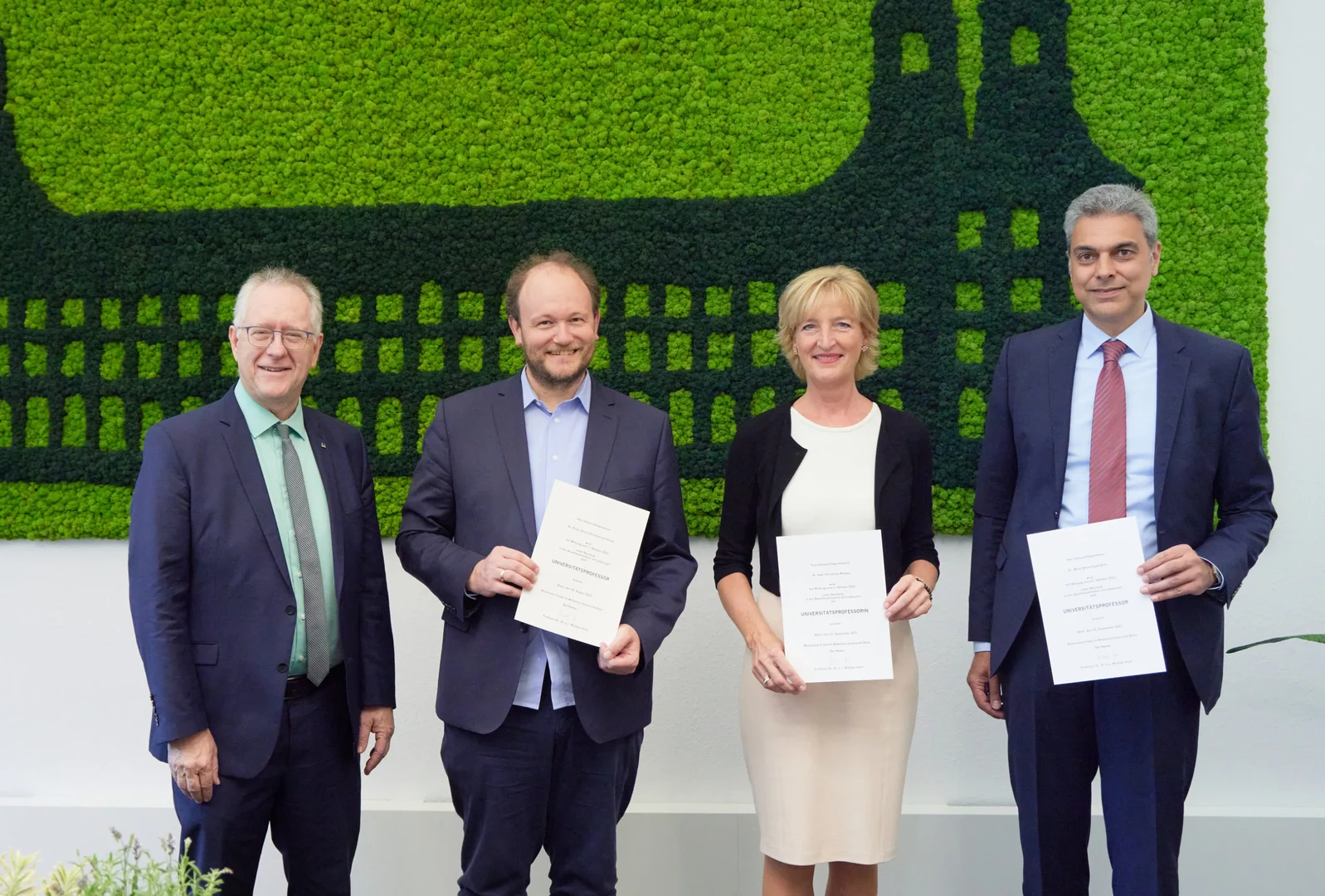
High Profile Professorships
Hertz Professorships
Hertz Professorships advance current research topics and innovative methods. They enhance the visibility and excellence of research, particularly in the areas of the six Transdisciplinary Research Areas (TRAs) that are considered to have potential. The Hertz Professorships come with a highly attractive start-up package that ensures maximum freedom and flexibility in developing their field of research.
The first Hertz Professorship was filled by medical ethicist Christiane Woopen, who is based in the Transdisciplinary Research Area Individuals & Societies. At the Center for Life Ethics, Woopen's research, teaching, and consulting focus on life and the conditions for its development and success.
Clausius Professorship
The Clausius Professorship was established to mark the 200th birthday of Bonn physicist Rudolph Clausius (1822-1888). This professorship was awarded to the particularly outstanding junior researcher Jun. Prof. Dr. Lena Funcke in the Transdisciplinary Research Area "Matter". Lena Funcke and her team are developing new models beyond the standard model of particle physics, as well as new computer-aided methods for calculating model predictions for future experiments.
Argelander tenure-track professorships
Argelander tenure-track professorships are intended to specifically expand and strengthen the research profile of TRAs at the interfaces between disciplines (e.g., mathematics/life sciences) and also increase the attractiveness of the University of Bonn for international early-career researchers. These professorships are established at the request of a TRA. They enable young researchers up to four years after completing their doctorates to establish their own independent research at the boundaries of disciplines.
Elena Reckzeh, for example, uses mini-organs, known as organoids, to identify new drug candidates. Ana Ivonne Vazquez-Armendariz wants to use organoids to better understand lung diseases. As Argelander professors in the Transdisciplinary Research Area (TRA) “Life & Health,” the two researchers work at the interface of various disciplines, building bridges between chemistry, biology, and medicine.
How can people act collectively to pursue sustainable development paths in harmony with the environment in a complex system? This question is being explored by Jun.-Prof. Dr. Wolfram Barfuss, Argelander Professor in the Transdisciplinary Research Area “Sustainable Futures.” He develops mathematical models of collective learning and combines various research areas – from complex systems to artificial intelligence to social ecology.
Schlegel professorships
Schlegel professorships are particularly well-endowed professorships at W3 level. They are filled by the faculties in subjects that belong to research-intensive development areas and are established by the Rectorate in accordance with a development concept of the respective faculty. Schlegel professorships develop thematic links to the TRAs and provide impetus for new third-party funding initiatives.
With Matin Qaim as Schlegel Professor for Economic and Technological Change, the Faculty of Agriculture has gained an internationally renowned agricultural economist. At the same time, he took over as director of the Center for Development Research (ZEF) at the University of Bonn. His interdisciplinary research focuses on issues of global food supply and sustainable agriculture against the backdrop of limited natural resources.
Another Schlegel professorship is held by Klaus von Stosch, a globally recognized expert in comparative theology with a focus on Islam. He is considered one of the leading voices in international Catholic systematic theology. As an academic “bridge builder,” Klaus von Stosch addresses major ethical, social, and political issues in interreligious and intercultural discourse.
Distinguished Professors Emeriti
To further internationalize research, teaching, and studies, the Rectorate has advertised positions for Distinguished Professors Emeriti. They contribute to strengthening the international diversity of the professorial staff at the University of Bonn and are thematically aligned with a TRA.
For example, Prof. Dr. Huw Price, who was Bertrand Russell Professor of Philosophy at the University of Cambridge until 2020, supports the profile area “Digitalization/Artificial Intelligence” in the transdisciplinary research area “Individuals & Societies” as Distinguished Professor Emeritus. Prof. Dr. Ann R. David, formerly at the University of Roehampton (London), is Distinguished Professor Emeritus at the Bonn Center for Dependency and Slavery Studies Cluster of Excellence.
The University of Bonn's Excellence Strategy
The University of Bonn's Excellence Strategy won the competition and is now one of eleven universities and university networks of excellence in Germany. The focus is on a strong “WE”: We invest in people – with high-profile professorships at all qualification levels. We foster networks – through transdisciplinary research areas that promote interdisciplinary insights through scientific cooperation. We create impact – through knowledge transfer and science communication.