


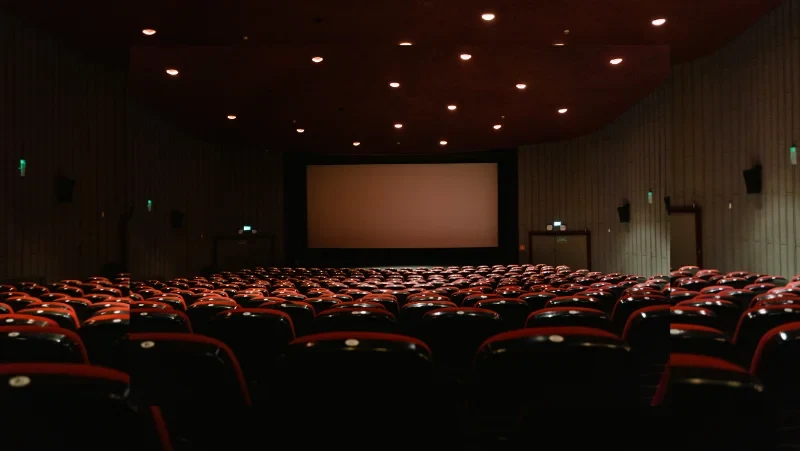
The new GreenScreen series of film screenings was launched in 2024 as part of the “Fairer Februar” campaign month. The event was developed by Team N at the University of Bonn together with the Bonner Kinemathek and the Brotfabrik Bonn cultural center and is held six times a year in the Brotfabrik’s cinema.
GreenScreen combines science and cinema in a unique way by inviting a researcher to every screening to provide an introduction to the particular topic and establish the scientific context. The audience are actively involved in the process and have the opportunity to share their thoughts and impressions in a relaxed atmosphere following the screening.
The series kicked off on February 14 with one of the most successful films of 2023, “Roter Himmel” (“Afire”). In his introduction, Professor Jakob Rhyner encouraged the audience to think about how humans behave in a crisis. Despite being ever-present in the movie, the forest fire is largely ignored by the main characters, a situation that can also be applied to society’s attitude toward the climate catastrophe. “How near does the danger have to get before we act?” Rhyner asked the audience.
The 1973 film “Soylent Green” was shown in March, when Dr. Simon Ebert brought a historical perspective to the debate. The eco-thriller explores the potential consequences of the overuse of finite resources, environmental pollution, climate change and overpopulation—themes that remain highly topical even 50 or so years after its release. The movie urged the audience to take a look at the past, reflect on sustainability issues and come up with ideas for solutions.
Another highlight was April’s screening of “How to Blow Up a Pipeline” from 2022. In her introduction, Assistant Professor Anna Maria Riedl spoke about the conflicts that many young people in particular feel confronted by as a result of global crises. How far should activism be allowed to go for the sake of climate action? The discussion that followed centered mainly around what might give young people hope in order to find constructive ways of getting involved without resorting to criminal activity.
After taking a break for the summer, GreenScreen returned in September with 2014’s “The Salt of the Earth,” where Professor Eva Nöthen and Gabriel Bohn discussed the key role that images play in conveying information about disasters. The movie itself explores the personal journey taken by the photographer Sebastião Salgado, who undergoes a profound change after years spent documenting the very worst excesses of human existence and the destruction of the environment. How extreme can or must images be in order to get people to act more sustainably? The audience were invited to help find a “happy medium” that could strike a balance between sending a stirring message and spurring people on to act.
On the program for October was “WALL-E” (2008), an animated film that explores various aspects of sustainability. The movie depicts an Earth that has become uninhabitable due to human activity, with people now living isolated lives on board a spaceship, sitting motionless in floating chairs with their eyes fixed on screens. The result is bodily deterioration, social isolation and the loss of social interaction. Dr. Manuela Preuß drew parallels with the reality of our own lives and shared a number of practical ideas for counteracting isolation and a lack of exercise in our daily routines.
The final screening of the year was “Moon” (2009) in November. Professor Hendrik Hakenes opened the evening by analyzing the environmental footprint of a film before going on to ask the audience to carefully consider how much impact on the environment a visit to the cinema might have. The film itself is about the exploitation of natural and human resources and encourages us to think about using resources responsibly and the responsibility that we ourselves have toward society to prevent exploitation, both globally and in our everyday lives.
With a diverse program and stimulating rounds of discussions, the GreenScreen series not only opened up new angles on sustainability but also highlighted the importance of dialogue and commitment for a sustainable future.