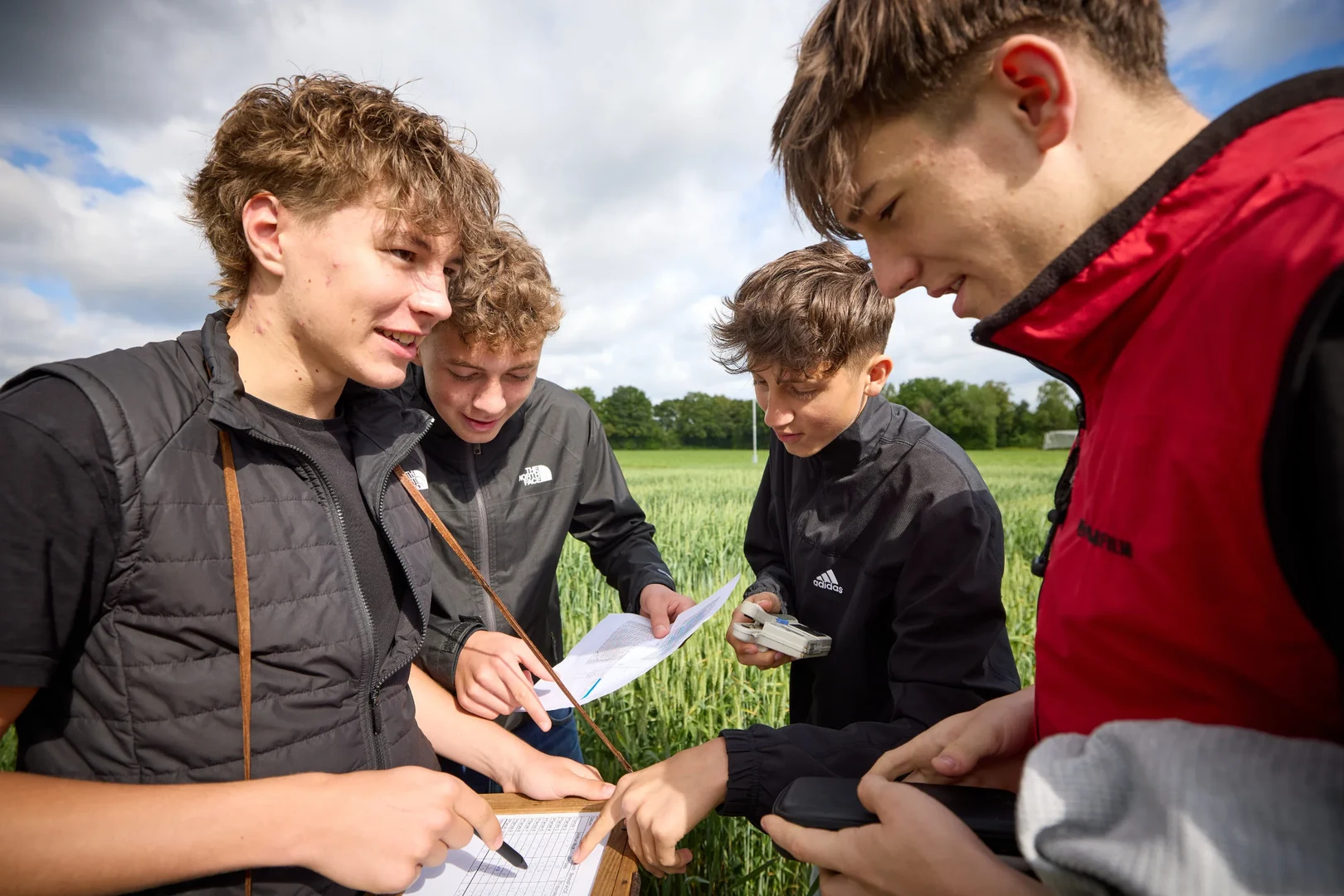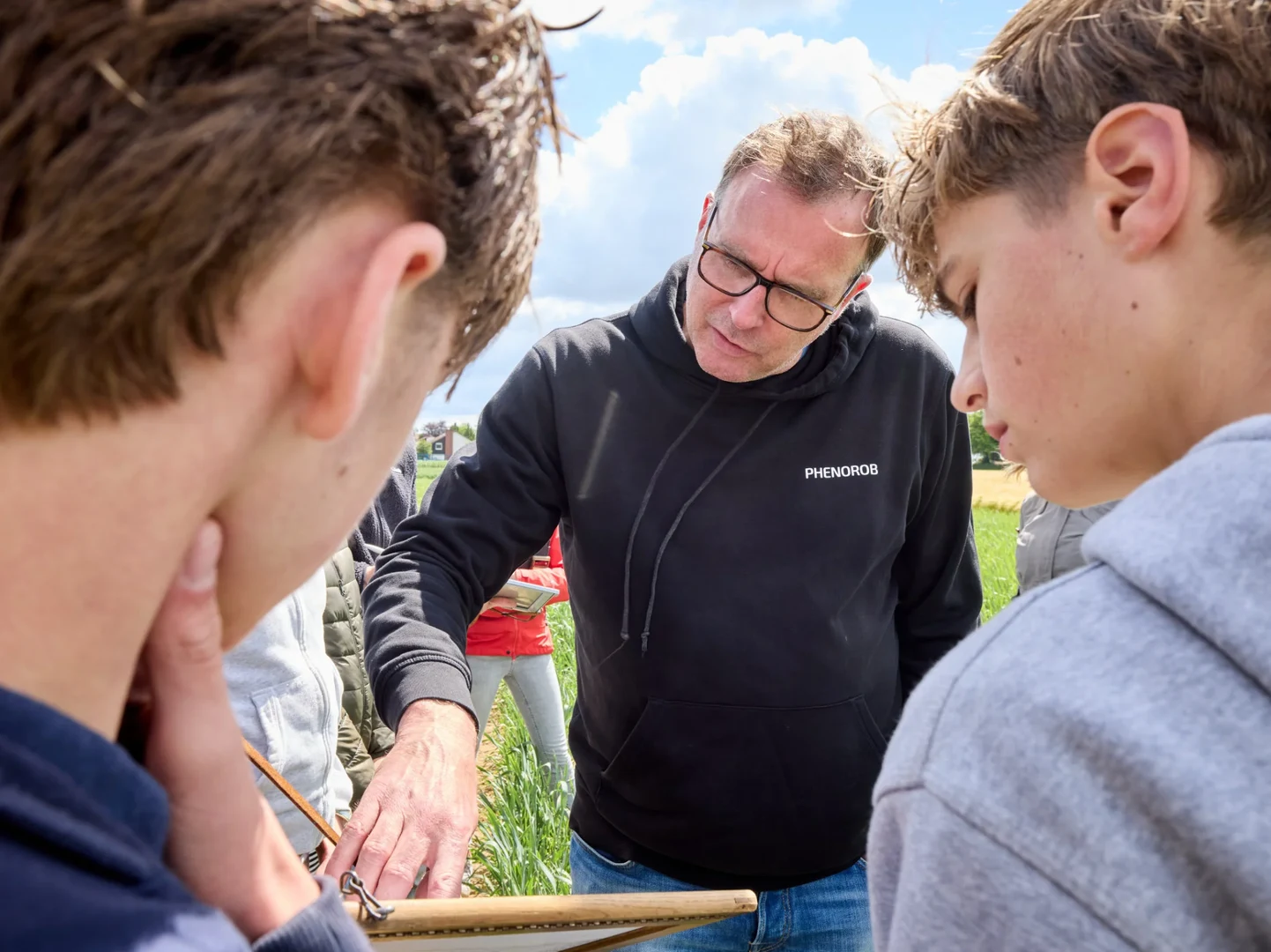


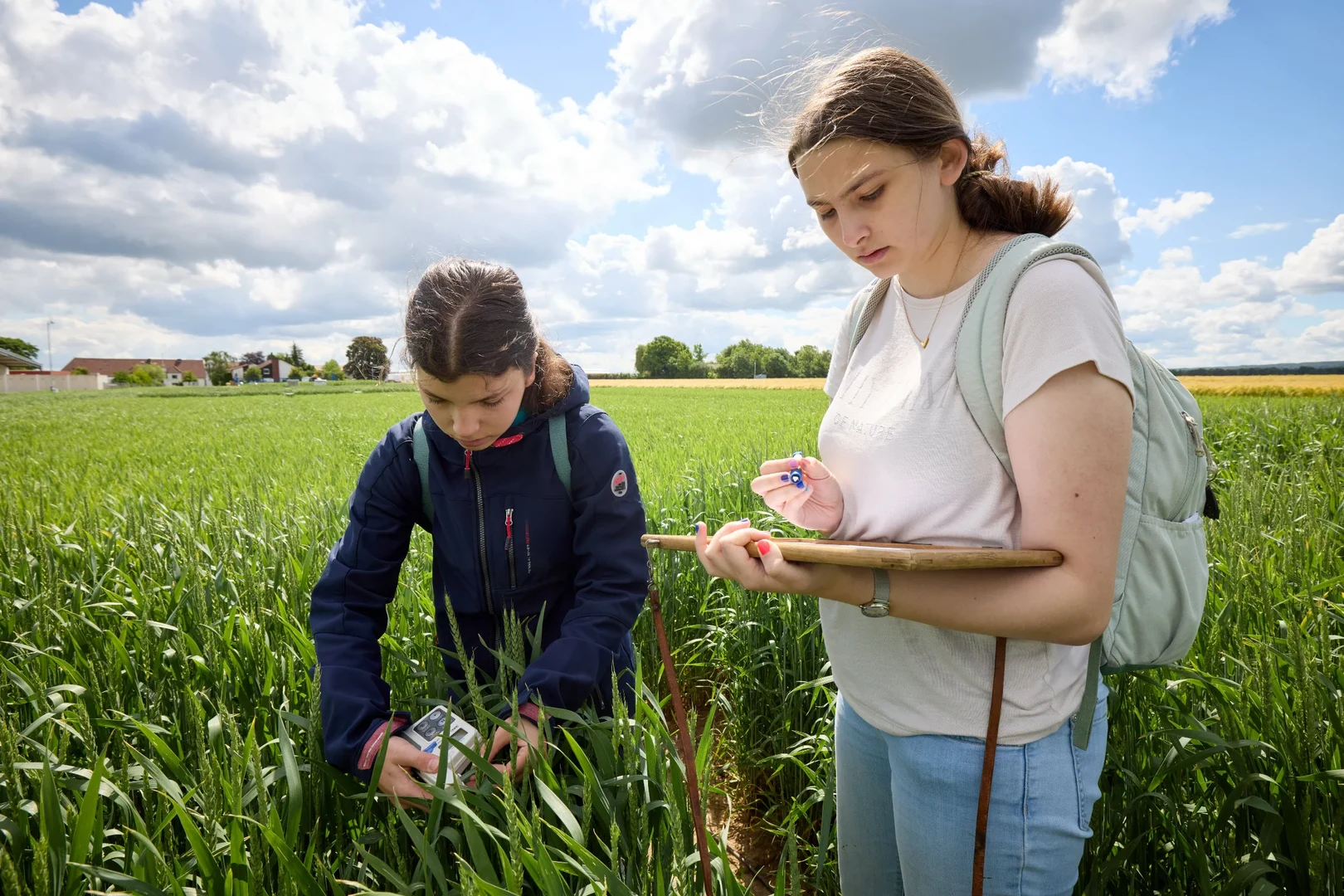
In mid-June, the test fields on Klein-Altendorf Campus witnessed an unusual sight, as some 20 ninth-graders from the Ernst-Moritz-Arndt-Gymnasium combed their way through two fields, brandishing small measuring devices and logging data on the CO2 content of the winter wheat grown there. They then evaluated their data together with Professor Lasse Klingbeil from the PhenoRob Cluster of Excellence. “In our BreedFACE experiment, we’re introducing CO2 into the field artificially to simulate future climate change scenarios,” Klingbeil explains. “This involves investigating the impact of elevated CO2 concentrations on plants’ ability to photosynthesize.”
An authentic insight into science in practice
This school trip forms part of an educational project called “Zukunft auf dem Teller” (“The Future on the Plate”). Organized by the Biology Didactics Section at the University of Bonn in partnership with LizzyNet GmbH, it intends to raise awareness among young people of the challenges involved in sustainable eating and agriculture. “We want to empower young people to reflect critically on future trends,” says Professor Annette Scheersoi, head of Biology Didactics. The project is focusing on questions such as: What implications do our eating and consumption decisions have on the environment and climate? How can we feed a growing global population sustainably? And how can research, innovation and new technologies help? “We want the schoolchildren to recognize that sustainable eating is often tied up with complex questions and conflicting objectives for which there are rarely simple or clear answers.”
School visits to research institutions like Klein-Altendorf Campus form an important part of this strategy, combining questions relevant to society with scientific findings and enabling the young people to gain real-life insights into current research.
Agricultural technology of the future
Even before they came, the schoolchildren had worked hard on topics such as sustainability, food systems and biodiversity in their lessons, and their trip to the campus then gave them the opportunity to see for themselves how theory is being put into practice. Scheersoi and her research associate Jana Schilbert had asked colleagues from the PhenoRob Cluster of Excellence to show the schoolchildren some of the latest developments in agriculture.
Aside from the BreedFACE experiment, the researchers—with Klingbeil at the helm—also demonstrated how drones and robots can be used to record data in the field faster and more objectively. He says: “We’re collecting 3D data, which describes the geometry of the plants, and spectral data, which can tell us more about the state of their health and how well they are working.” Another experiment is studying how mixed cultivation, i.e. growing a variety of crops in the same field, can boost biodiversity and perhaps bring more benefits besides. “In both cases, the approaches and measurement strategies that use drones and robots have the potential to improve data gathering significantly,” Klingbeil explains.
As far as Schilbert is concerned, what makes these kinds of field trip so valuable is the direct encounters with research that they bring: “A visit like this to a research institute opens up learning opportunities for the young people that they’d not have to the same extent in class. They get to experience real test facilities, cutting-edge technical equipment and scientific work processes live and up close, making both research and the technical subject matter tangible and easy to understand.”
In Schilbert’s opinion, it is speaking to researchers that most readily unlocks insights into relevant issues and scientific methods: “Technologies like robotics, sensor systems, digital data logging and automated agriculture can be experienced much more vividly at the actual research site than they can through photos or videos in the classroom.”
Feedback from the schoolchildren themselves has been similarly positive, with the practical work done in the test fields proving especially popular. “I really enjoyed measuring and analyzing CO2 levels in the plants and then seeing the difference between the two fields,” says Marlene. For Lara, meanwhile, it was primarily the technological aspect that she found surprising: “I’d never have thought that robots and drones were already being used in agriculture in so many different ways. I used to think of agriculture as mainly being about tractors and machinery like that.”