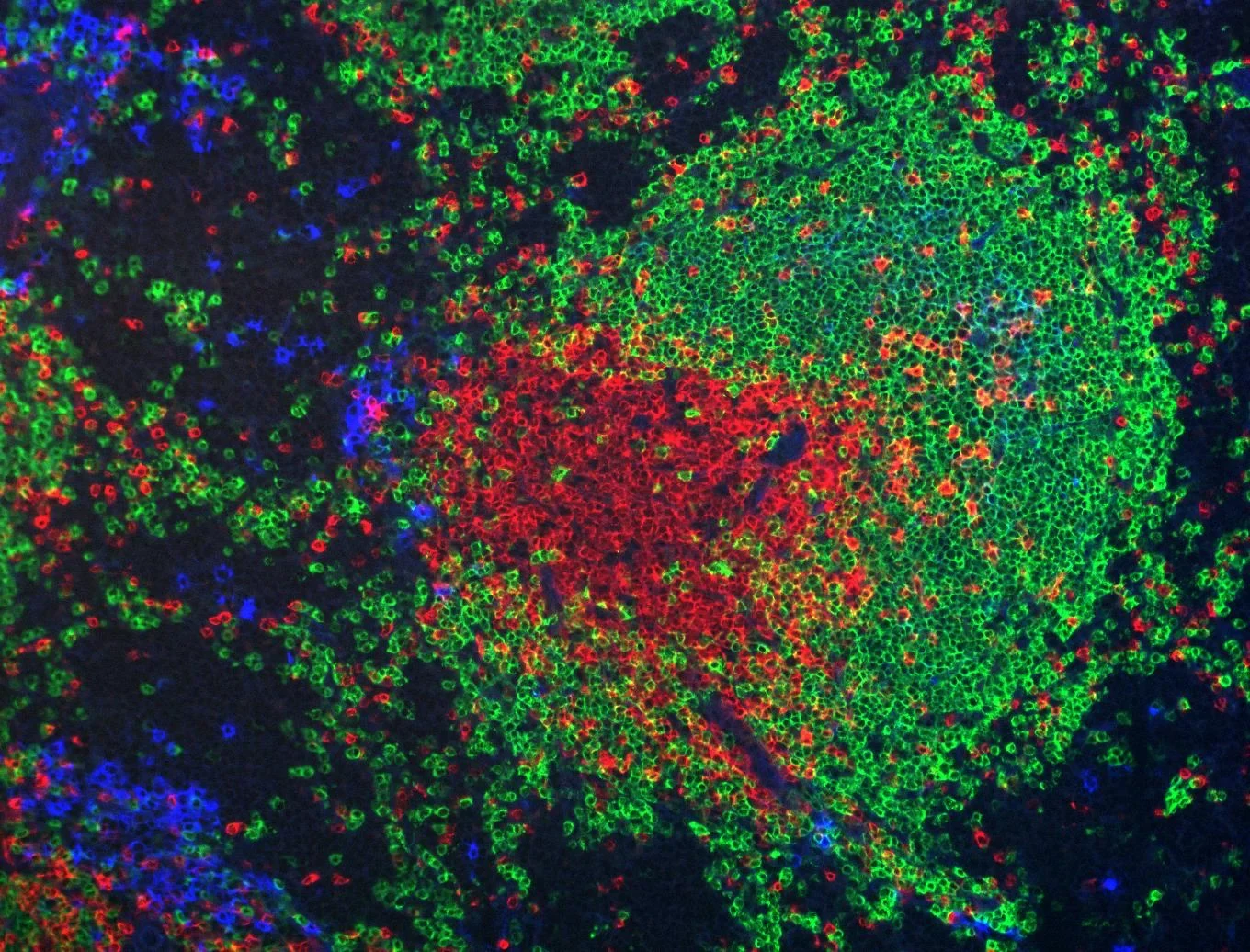



Tfr cells control the development and function of so-called germinal centers in lymphoid organs such as the lymph nodes, tonsils, or spleen. There, they regulate the activity of follicular T helper cells (Tfh cells) and B cells, ensuring that antibody responses remain effective without getting out of control. An imbalance between activating and regulatory immune cells is associated with autoimmune diseases and misdirected antibody responses.
“Tfr cells have been difficult to study until now. With our model, we can now specifically track their development in the laboratory and investigate the molecular mechanisms that control their properties and functions,” says first author Dr. Luisa Bach, scientist at the University Hospital Bonn.
How follicular regulatory T cells develop
For their research, the scientists developed a new in vitro model that allows Tfr cells to be generated from certain CD4+ T helper cells of the immune system. Using this system, they were able to identify key molecular signaling pathways that control the development of these cells.
It turned out that the growth factor TGF-β plays a key role: It is both necessary and sufficient to trigger the characteristic program of Tfr cells. At the same time, the signaling molecule IL-2 influences the development of the cells in an opposing manner. Only the finely tuned interaction of both signaling pathways enables the formation of functional Tfr cells.
Furthermore, the research team identified the transcription factor c-Maf as an important regulator of the differentiation of Tfr cells. If this factor is absent, the cells cannot fully develop the characteristics typical of Tfr cells.
Control of the antibody response demonstrated in the laboratory
The researchers were also able to show that the Tfr cells generated in the laboratory are functionally similar to natural Tfr cells. In cell culture experiments, they suppressed the Tfh-cell-mediated activation of B cells and limited the formation of certain antibody classes.
“Tfr cells are among the most important regulators of the antibody response. The fact that their characteristic properties can now be specifically investigated in cell cultures opens up new possibilities for researching their biological function,” explains corresponding author Prof. Dirk Baumjohann from the Department of Hematology, Oncology, Immuno-Oncology, and Rheumatology at UKB, who is a member of the steering committees of the Cluster of Excellence ImmunoSensation3 and the Transdisciplinary Research Area (TRA) “Life & Health” at the University of Bonn. “This allows us to better understand how antibody responses are regulated and how misdirected immune reactions arise.”
New Tool for Immunological Research
The work provides fundamental insights into the biology of regulatory immune cells and simultaneously offers an important tool for immunological research. The newly developed model will enable researchers to specifically investigate the development and function of Tfr cells and to analyze their role in immune responses in greater detail.