

To mark 200 years since the first such event was organized, Erdmann traces the connections between the University, city society and its celebrated carnival. It is a story that takes in the very first University professors, who got Johann Wolfgang von Goethe excited about the Rhineland-style carnival, covers the revolutionary professor Gottfried Kinkel and the art historian Heinrich Lützel and ends with today’s Rectorate’s receptions, the Forschologicum and the University’s participation in the Shrove Monday parade.
Erdmann believes that no other local university in a German town or city with a strong Carnival tradition has been as closely involved in putting on the celebrations over two whole centuries as the University of Bonn.
University spokesperson Prof. Dr. Andreas Archut spoke with Professor Erdmann about his new book.
Interview with Karl-Heinz Erdmann
Professor Erdmann, you call the University a “constant presence” in the Bonn Carnival. What makes the link between them so special?
The University doesn’t simply sit on the sidelines and watch all the fooling around that goes on. Rather, its people have actively helped to shape Bonn’s Carnival for generations: Professors, students, staff and members of University management have been involved as contributors of ideas, speakers, researchers, hosts and, of course, revelers. And the reverse is also true: Carnival has always held a mirror up to the University. This connection stretches back more or less to the University’s very earliest days.
What traces can be found in the first few years?
Even as long ago as the 1820s, professors from Bonn were among the early supporters of the modern Rhineland carnival. Johann Jakob Noeggerath, a mineralogist, and Christian Gottfried Daniel Nees von Esenbeck, who was a botanist, both corresponded with Goethe. An enthusiastic Nees von Esenbeck told him all about Cologne’s Carnival. In 1825, Goethe would write his poem “Der Cölner Mummenschanz,“ literally “The Masquerade in Cologne.” Academics from Bonn thus had at least an indirect hand in gaining literary recognition for this new form of celebration.
Not long after that, the public carnival was banned in Bonn. Did that also have something to do with the University?
The University did play a role at least in the reasoning given by the Prussian king Frederick William III, who feared that students in particular might hijack the carnival for activities that were critical of his regime or even seditious. Thus the holding of public carnivals was outlawed in 1828, a ban that would last 14 years. This shows the degree of political potential that was accorded to both the University and Carnival. Later on, the then Rector Karl Gustav Bischof would support the Mayor of Bonn in his efforts to get the ban repealed.
You devote a lot of attention to Gottfried Kinkel. Why was he so significant to Carnival in Bonn?
Gottfried Kinkel saw Carnival as a social and political “free space.” Together with his wife Johanna Kinkel and Karl Simrock, who would go on to be a professor of German language and literature at the University, he campaigned for liberty, equality and national unity. They felt that Carnival should stop being merely the preserve of the upper middle classes and start including everyone.
To borrow Kinkel’s very vivid way of putting it, rank, title and class distinctions were set aside beneath the brightly colored cap that was one of Carnival’s hallmarks. His 1843 “Bürgerlied,” or “Citizens’ Song,” was both a convivial drinking song and a political statement and became a firm fixture of Bonn’s Carnival for decades. In his improvised Büttenreden, or humorous speeches, Kinkel also seized his chance to elude the censors and sneak in barbs criticizing the Prussian authorities.
A future Nobel Laureate discovers Bonn’s Carnival
Do any of the historical finds contain a story that you particularly enjoy telling?
One marvelous story is that of Luigi Pirandello, who would go on to win the Nobel Prize for Literature. He started studying Romance philology in Bonn in 1889 and attended a masked ball in the city’s Beethovenhalle, where the clearly not especially talented dancer was led through the ballroom by a “little blue mask.” After removing said mask, he got to know the young woman behind it a bit better. A letter to his sister gives us a very vivid impression of how exuberant and free-spirited Bonn Carnival was felt to be in those days.
Who in particular personifies the link between University and Carnival in the 20th century?
More than anyone else, Heinrich Lützeler. An art historian at the University, he did research into the Rhineland sense of humor but was also a passionate Carnival-goer himself. In 1962, he gave the speech proclaiming the prince and princess of Carnival; in 1973, he presided over a large public meeting in his role as guest master of ceremonies; and, in 1976, he chaired the jury for the themed floats in the Shove Monday parade. He also founded the Großer Rat der Ehrengarde, the grand council for Bonn’s “guard of honor,” and remained its president until his death. He was the perfect combination of scholarly reflection and personal dedication.
Carnival viewed through the lens of research
As well as celebrating Carnival, the University studies it too. What questions are researchers interested in?
You can look at Carnival from many different angles: as a custom that’s evolved over time, as the expression of a regional identity, as an economic factor, as an event put on for tourists and as a space for social integration. The University of Bonn has witnessed seminars, field trips, field-based practicals and final theses about it.
During one such field-based practical in 2008, for example, students conducted the first-ever systematic survey of visitors to the city’s Shrove Monday procession. They also studied the potential of the procession to boost tourism, the city’s marketing efforts for Weiberfastnacht—the Thursday before Ash Wednesday—in its Beuel district and the extent to which Carnival is able to integrate people with a migration background.
“Loss mer fiere un studiere”—the slogan from 2018
Since the 1990s, the University has once again had a particularly prominent Carnival presence. How is this being expressed?
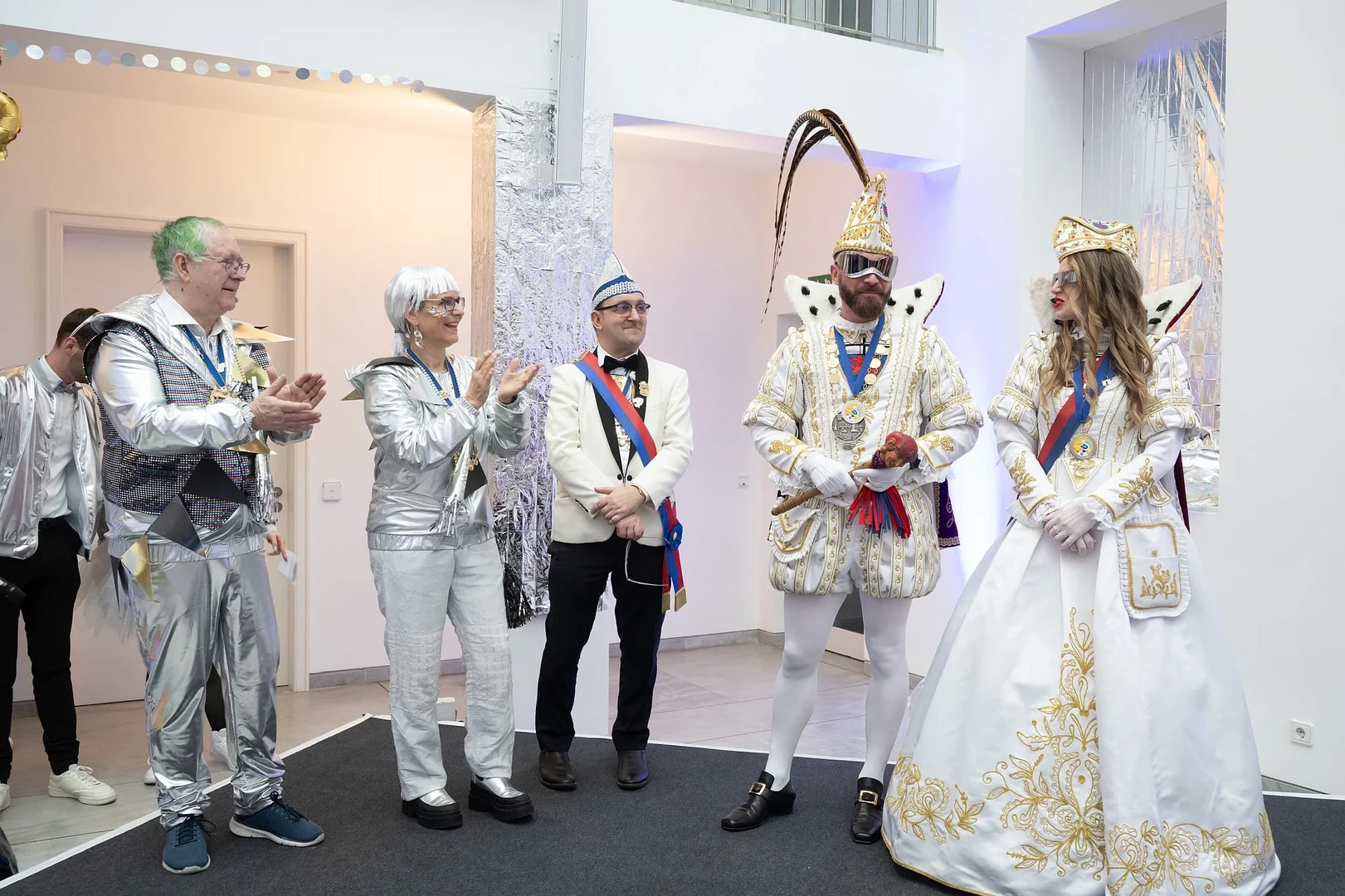
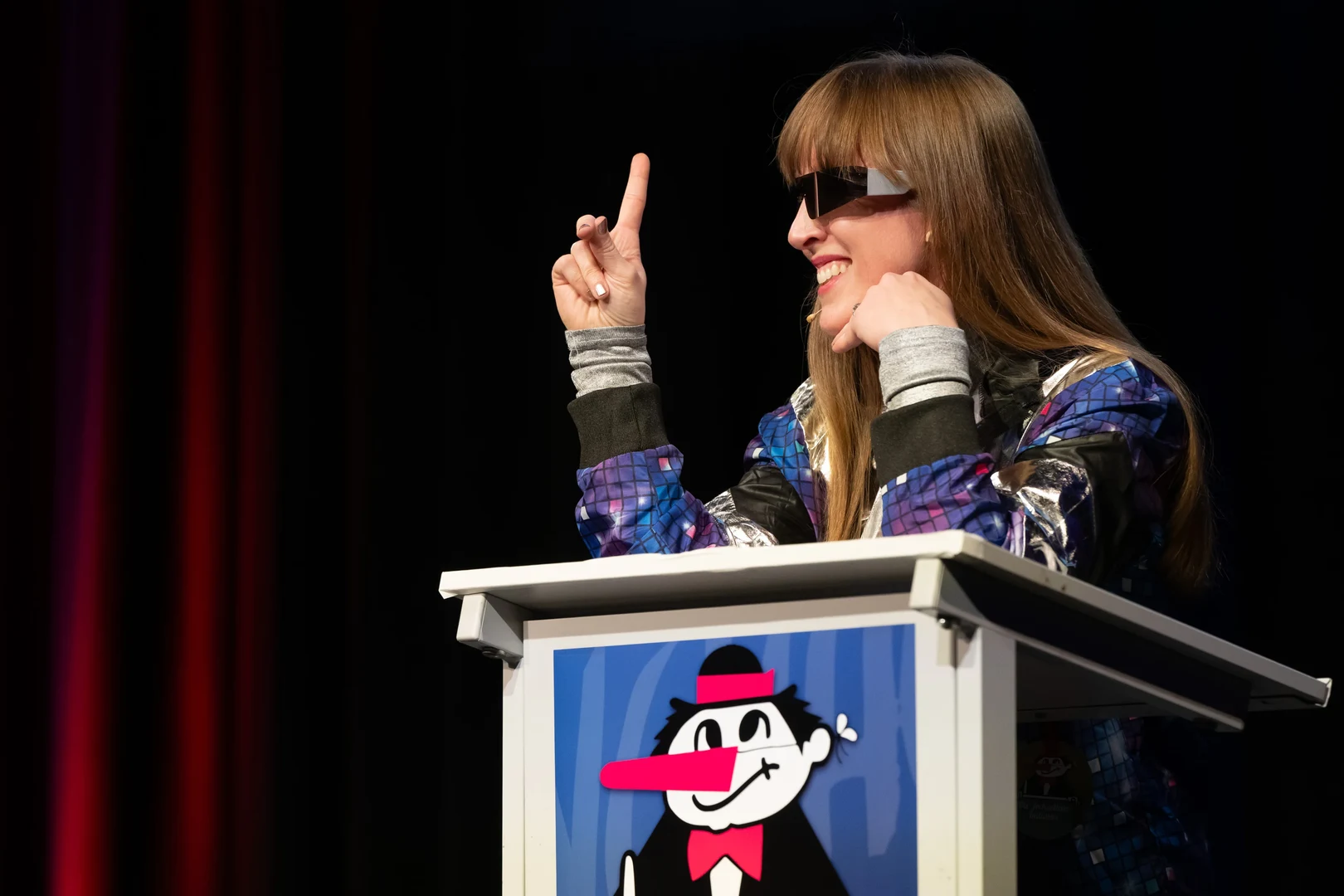
The two have been working closer and closer together since 1992. This includes the University’s receptions at its Rectorate for the prince and “Bonna,” or princess, its regular participation in the Shrove Monday parade since 2012, sending representatives to the Elferrat—the 11-strong “parliament” that proclaims the prince and princess—and the Forschologicum, the Carnival session of Bonn’s research institutions that in recent years has routinely featured Rector Professor Michael Hoch alongside many other speakers from the University.
One particular highlight was the 2018 event, when the University was celebrating its 200th anniversary and Bonn’s Shrove Monday procession its 190th. The slogan “Loss mer fiere un studiere,” roughly “Let’s party and study,” was agreed on together with the organizing committee and perfectly captured the bond between the two.
Science communication outside the lecture halls
Can Carnival also be a form of science communication?
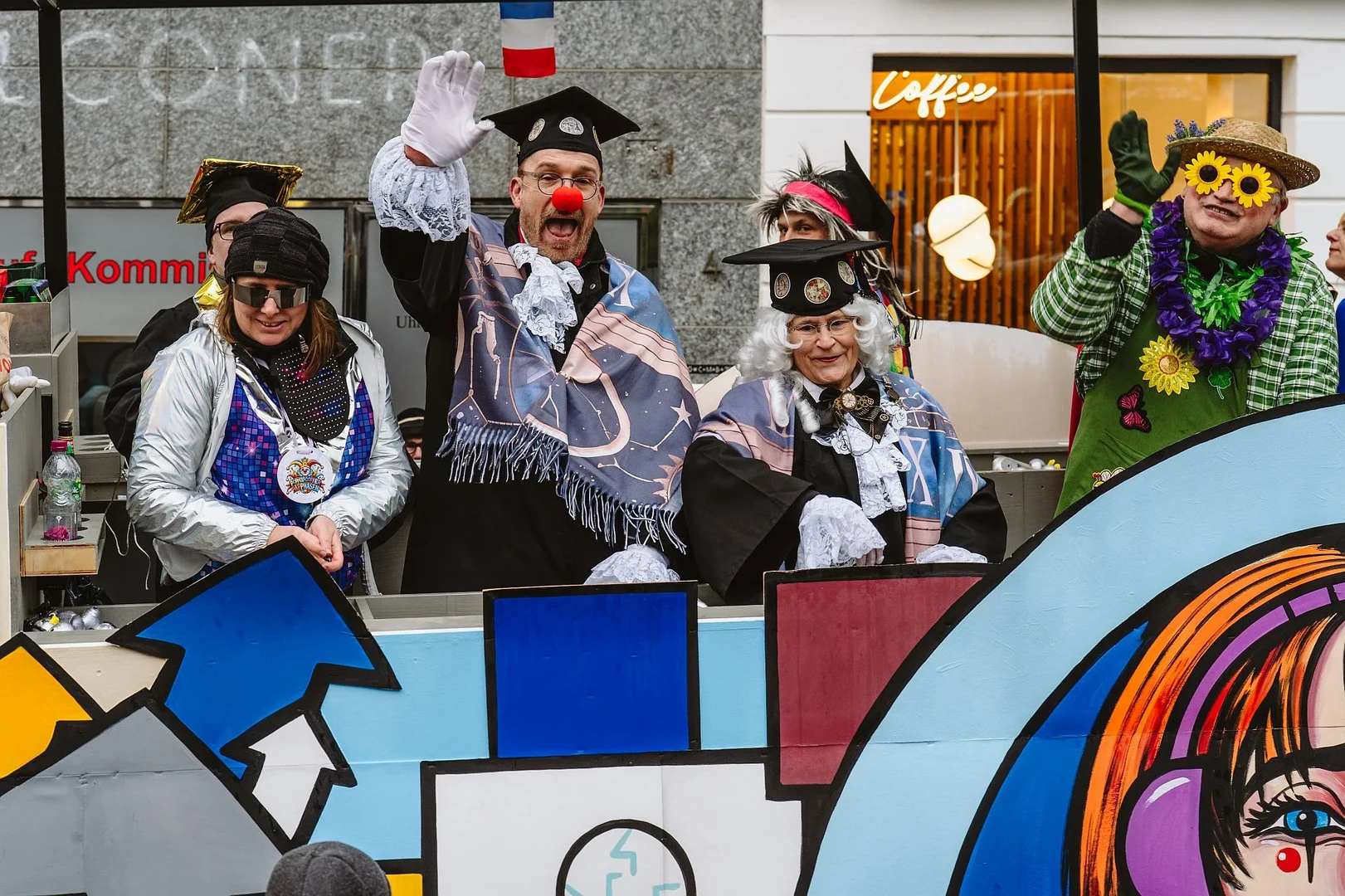
Definitely. Science communication doesn’t always have to happen in a lecture hall or during a panel discussion. Carnival allows people to come together as equals. The Forschologicum sees researchers send up their institutions, politicians and, ultimately, themselves. The University’s Shrove Monday floats tackle hot topics of the day using humorous, easy-to-understand images.
One great example was the 2012 float all about the plagiarism debate, which was straplined “Studiere jeht övve kopiere”, or “Studying beats copying.” The University ducks, which are given a new look every year, have also now become a much-sought-after link between the University and city society.
In 2019, the University also used Carnival floats to celebrate being awarded University of Excellence status. Was that more than just a left-field idea?
It was a powerful symbol. After the Excellence decision was made, the Rectorate—led by Professor Michael Hoch—was joined by researchers and students to parade through central Bonn on Shrove Monday floats. This made it clear that the University did not just see its success as an academic matter that was now done and dusted; it wanted to share this success with the people of the city—and did so using a form of expression that virtually everyone in Bonn would understand.
A route into Rhineland culture
What significance does the link hold nowadays for the University?
A university always forms part of the society that surrounds it, and Carnival offers a particularly accessible opportunity to mix with other people. For international students and other visitors, it can also be a route into Rhineland culture. At the same time, Carnival benefits from the young people, the international perspectives and the diversity that the University supplies.
In other words, it’s not just about having a good time. It’s about a sense of belonging, dialogue and a university’s willingness not to live in an ivory tower. This is precisely why this over-200-year-old relationship is set to endure for a fair while yet.