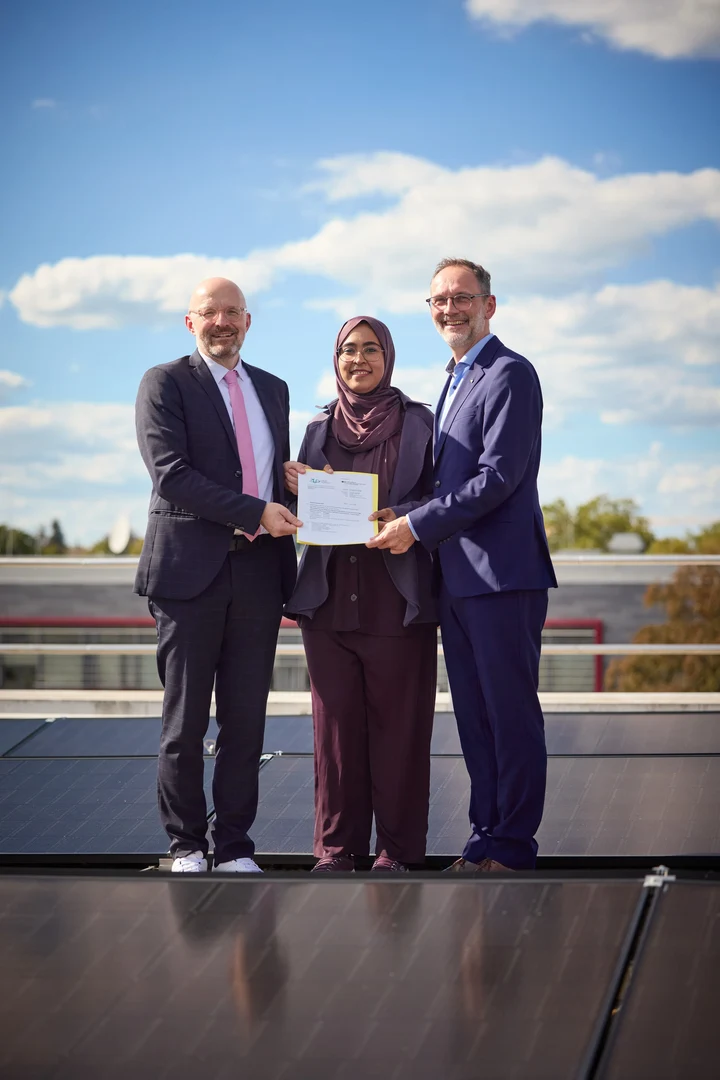


While in Bonn, Kralinski met with the University’s Vice Provost Dr. Holger Impekoven, its new Climate Protection Manager Dr. Ferdous Sultana and other staff from the Vice Rectorate for Sustainability and Central Administration. Following a discussion on the University of Bonn’s climate action and sustainability work to date and its next steps, the group climbed up to the roof of the campus’s lecture hall center, home to the University’s second-largest set of solar panels. Solar power is a key component in its climate action strategy, which is now to be expanded systematically.
An integrated climate action plan for the University
Sultana took up her post as the University of Bonn’s Climate Protection Manager on August 1, 2026, and will be taking the lead on devising an integrated climate action plan as part of the BMUKN-funded project. This is geared toward bringing together all the existing activities, identifying additional potential savings and formulating tangible measures for effective climate action. The two-year project launched in August 2026. It is being funded via the municipal funding directive (Kommunalrichtlinie) from the BMUKN’s National Climate Initiative under funding code 67K26965.
Kralinski presented the formal funding decision for the pioneering project, paid tribute to the University’s commitment to mitigating the effects of climate change and saw first hand what it has already put in place to that end. He said: “Climate action is all about doing tangible things on the ground. As well as engagement from everyone involved, it also needs adequate financial and human resources, and this is precisely where our National Climate Initiative comes in: Our funding is helping stakeholders like the University of Bonn to employ climate protection managers, who are instigating vital climate action projects and running them to a professional standard. Making climate action an integral part of the administration over the long term is a major objective for us at the BMUKN. Climate protection managers come up with ideas, set projects in motion and thus make an active contribution to tackling climate change, saving money and enriching university life.”
Vice Provost Impekoven added: “Climate action succeeds best where individual measures come together and achieve a joint impact. We want to make it the key guiding principle of our campus development and operations, and the integrated climate action plan lays the necessary foundations: We’re dovetailing our activities and setting clear priorities for achieving our objectives.”
Solar electricity from the lecture hall center
The solar panels on top of the lecture hall building face two different directions, enabling them to capture sunlight and generate electricity for longer during the day. And, thanks to the “lotus effect,” the surfaces of the panels more or less clean themselves. The University of Bonn now operates eight sets of solar panels with a maximum total output of nearly 550 kilowatts peak (kWp). In 2025, the existing installations generated some 390,000 kilowatt-hours (kWh) of electricity between them, roughly what 130 three-person households would consume in a year.
Funding
Project title “KSI: Erstellung eines Integrierten Klimaschutzkonzeptes mit Klimaschutzmanagement durch die Rheinische Friedrich-Wilhelms-Universität Bonn – Erstvorhaben” (“Climate Initiative: Preparing an Integrated Climate Action Plan with Climate Action Management by the University of Bonn—Initial Project”)
Source of funds: Kommunalrichtlinie of the National Climate Initiative of the BMUKN
Funding amount: €124,352.00