


The study addresses one of the greatest challenges in sports medicine: anticipating injuries before they occur. Although numerous artificial intelligence (AI)-based models have been developed in recent years, most have significant limitations that make them difficult to apply in professional sports clubs. For instance, they do not consider that the risk of injury increases with longer playing time and greater physical exertion. They also fail to distinguish adequately between minor and severe injuries, such as a torn cruciate ligament, when assessing potential outcomes. Furthermore, the risk scores they generate often do not correspond to the actual probability of injury occurring. They also fail to provide specific recommendations for action, such as whether a player should take a break. Instead of simply creating a more accurate model, the research team developed a new methodological framework that addresses several of these shortcomings.
A new way to understand injury risk
The new approach treats injury prediction as a survival analysis problem. This statistical method calculates the likelihood of a specific event occurring over time; in this case, the likelihood of an injury occurring. This provides a mathematical representation of what experts already know, namely that the risk increases with increased training or competition time. The research team supplements this approach with three additional innovations: First, improved statistical calibration ensures that the calculated injury probabilities correspond as closely as possible to reality. Second, decision theory enables the coaching staff to determine, depending on the specific situation, at what risk thresholds a break is advisable. Finally, the “Rest Benefit Certainty” (RBC) indicator helps to set the desired level of certainty before deciding whether to rest players. Together, these elements turn an abstract probability into a contextualized recommendation that helps professionals assess when it is more beneficial for a player to participate or rest.
Four seasons of data from the women's first team
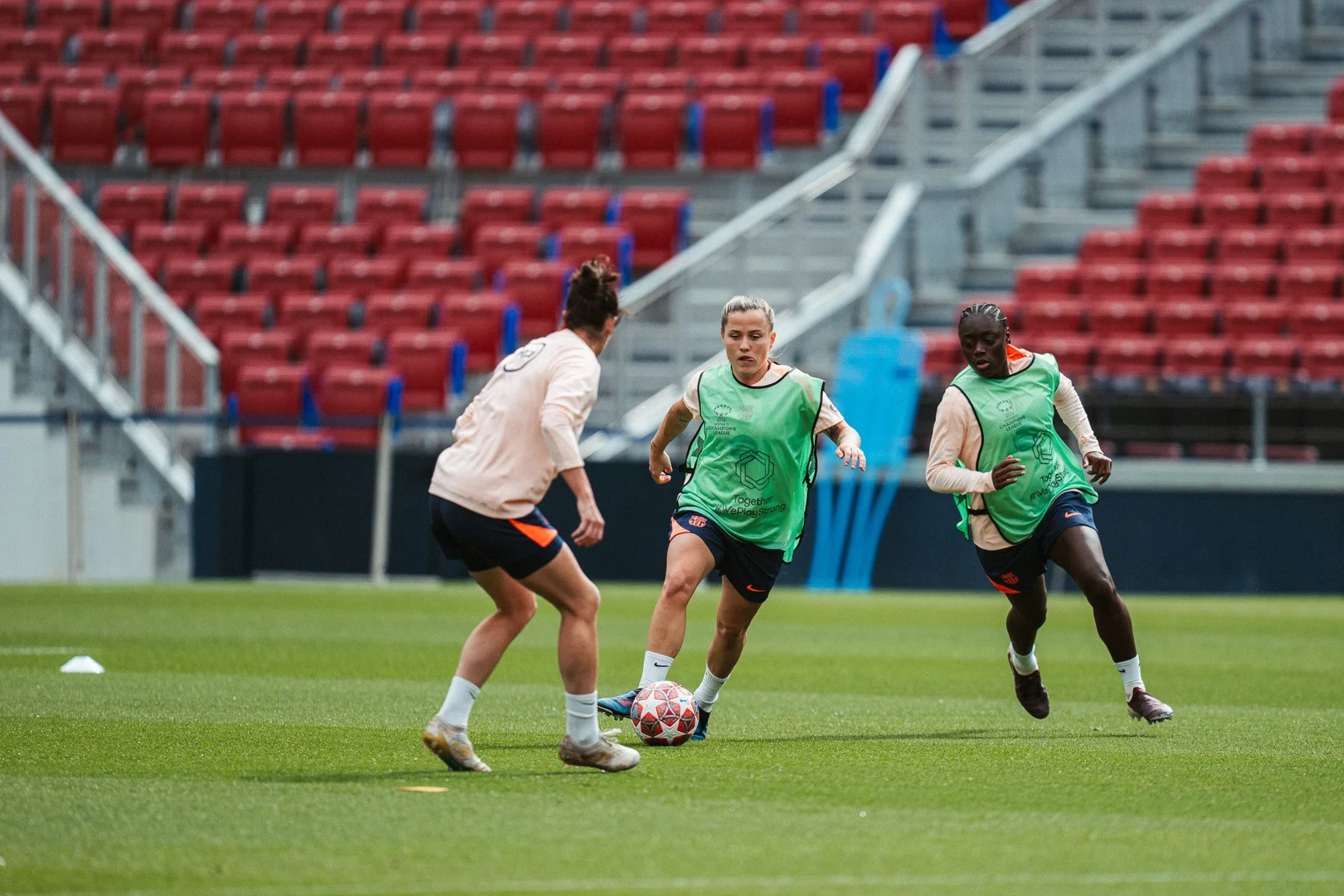
The study is based on one of the most comprehensive longitudinal datasets used to date in publicly available studies on women’s elite football: four consecutive seasons of FC Barcelona Femeni, FC Barcelona’s women’s football team in Spain’s Primera División (2019–2023), featuring 34 players, nearly 14,000 daily observations, and 83 non-contact musculoskeletal injuries. The data includes GPS information, training load, minutes played, competitions, international appearances, and the duration of injuries.
A much more reliable injury-risk detection system
The study results show that models based on survival analysis are more effective than the traditional machine learning algorithms that were previously used for injury prediction. In particular, higher estimated injury probabilities are more frequently associated with actual injuries, while lower probabilities tend to correspond to injury-free cases.
Thanks to improved statistical analysis, the new methodological framework provides more reliable information about injury risk. This makes it easier for the medical team to interpret the results. It also rectifies an issue with earlier models, which tended to underestimate the actual risk of injury. Statistical calibration also corrected the tendency of the models to underestimate actual risk, making the resulting probabilities much more reliable and interpretable for the medical team.
When the team tested the system using previously unseen data from a new season that had not been used for model training, it became apparent that the cumulative downtime from correctly predicted injuries exceeded the number of days incorrectly classified as injury days. This suggests that such a model can help reduce injuries and ensure that more players are available throughout the season.
Cumulative fatigue, the strongest predictor
The analysis shows that the most important predictor is the distance accumulated over the previous 21 days, followed by high-speed running intensity and same-day accelerations and decelerations. This result reinforces the idea that cumulative fatigue is the main mechanism associated with non-contact injury risk.
"Unlike previous approaches, this framework makes it possible to identify, rank and calibrate the factors associated with injury risk with statistical rigour, and to quantify the contribution of cumulative fatigue. Above all, it offers a new scientific perspective on a complex phenomenon," says Juan R. González, a researcher at ISGlobal who also serves as scientific advisor to Made of Genes.
"The methodological challenge was twofold: to represent how risk accumulates with exposure while also contextualising the resulting probabilities so that they can be interpreted according to the relevance of each situation. Incorporating decision theory makes it possible to adapt risk thresholds to each sporting context and turn predictions into a useful tool to support professional decision-making," explains Manuel Huth, first author, from the University of Bonn.
From research to the pitch and beyond
The potential reaches well beyond elite football: as wearable sensors are now widely used not only by professional athletes but also in amateur sports and physically demanding occupations, the same approach could support injury prevention far beyond the football pitch.