


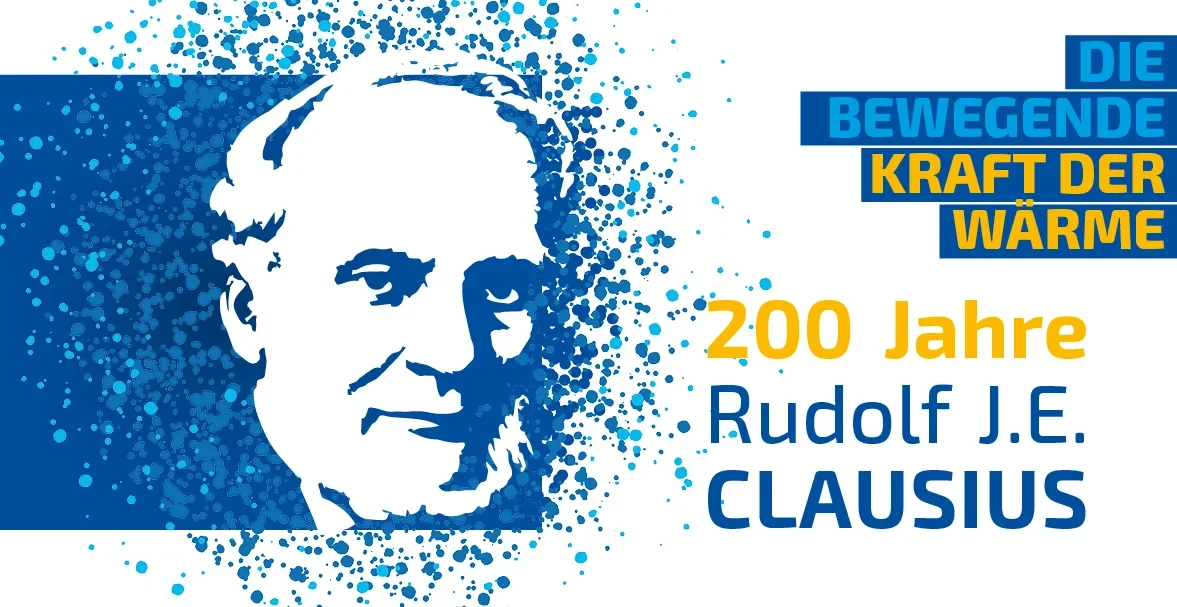
The physicist Rudolf Clausius is one of several prominent natural scientists who were active at around the same time, including Helmholtz, Kirchhoff, Kelvin, Bunsen, Joule and Maxwell. His discoveries had a far-reaching impact, not only for what we know about how heat and energy generation work but also for our understanding of information and biological processes. Even now, the laws of thermodynamics continue to describe some of the fundamental rules of nature that afford us a firmer grasp of how the world works. They also play a role in some of what are currently the hottest topics in science, including climate research and quantum physics.
At present, however, little is known about Rudolf Clausius the person; no biography of him as ever been penned, and many original sources from his personal life have been lost. To shed a little light on the matter, Johannes Orphal from Karlsruhe Institute of Technology has spent over 30 years collecting documents and secondary information relating to Rudolf Clausius. In his lecture, to be delivered shortly after what would have been Clausius’ 200th birthday, he will provide an insight into his findings and paint a picture of Clausius’s life and works.
It will not just be Johannes Orphal’s talk that will invite the audience to indulge in some time travel, however, as he will be followed by the team from the Physics Show, who will bring Rudolf Clausius and a few of his colleagues to life in the form of a short stage play featuring live experiments. The performance, to be led by Professor Herbert Dreiner from the University of Bonn, is a collaboration with Bad Honnef Center of Physics and the German Physical Society.
All the details at a glance:
The anniversary lecture series takes place at 5:15 pm on January 13. Anyone who is interested can follow a livestream of the lectures. See https://www.uni-bonn.de/en/research-and-teaching/research-profile/transdisciplinary-research-areas/tra-matter/200-years-rudolph-clausius?set_language=en for all the relevant information.
The event is being held jointly by the Departments of Chemistry and Physics/Astronomy together with the University’s Building Blocks of Matter and Fundamental Interactions Transdisciplinary Research Area (TRA) in cooperation with Bad Honnef Center of Physics and the German Physical Society.