
28. October 2025

New method developed for the precise production of human neural circuits in the laboratory New method developed for the precise production of human neural circuits in the laboratory

Researchers at the University Hospital Bonn and the University of Bonn are reconstructing neural networks in the laboratory and investigating new mechanisms of signal transmission in the brain

How do the circuits of the human brain work – and what happens when they are disrupted? To investigate these questions, researchers at the Eye Clinic of the University Hospital Bonn (UKB) and the University of Bonn, together with colleagues from the University of Münster and Harvard Medical School, have developed an innovative platform that allows the function of neural networks to be studied in a targeted manner. The results have now been published in the journal ACS Nano.

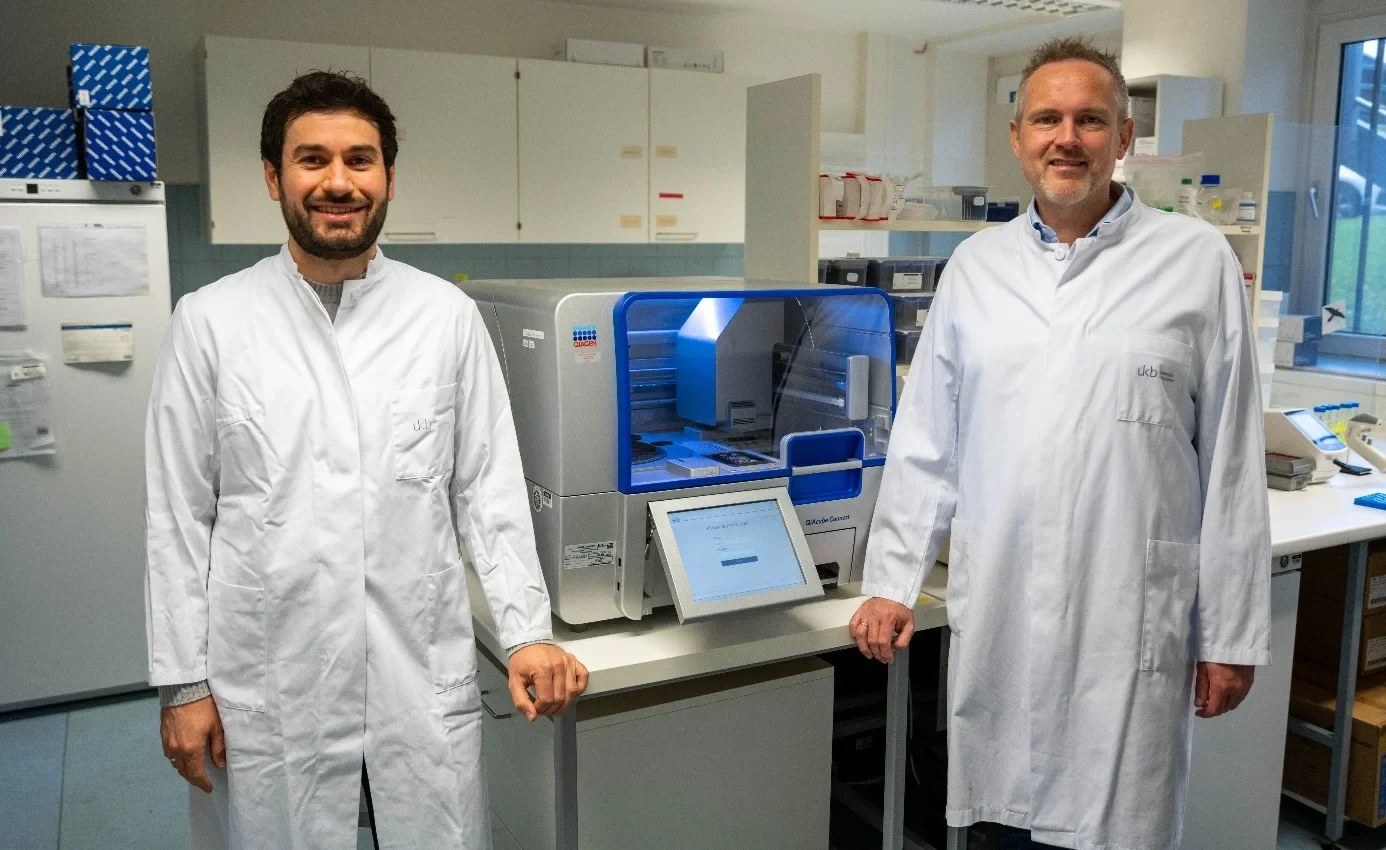
Doctoral student Johannes Striebel and Prof. Dr. Volker Busskamp
Doctoral student Johannes Striebel and Prof. Dr. Volker Busskamp - from the University Hospital Bonn (UKB) are developing a novel technology with the SNAP (Single-Neuron Network Assembly Platform) platform that allows human neural networks to be constructed and studied in a targeted and reproducible manner for the first time. © Picture credits: University Hospital Bonn (UKB); Alessandro Winkler
Download all images in original size The impression in connection with the service is free, while the image specified author is mentioned.
Please fill out this field using the example format provided in the placeholder.
The phone number will be handled in accordance with GDPR.

Prof. Dr. Volker Busskamp, biotechnologist and research group leader at the UKB Eye Clinic, member of the ImmunoSensation² Cluster of Excellence and the Transdisciplinary Research Area (TRA) ‘Life & Health’ at the University of Bonn, and his team have developed a novel technology that allows human neural networks to be constructed in a targeted and reproducible manner for the first time. The method, called Single-Neuron Network Assembly Platform (SNAP), makes it possible to position nerve cells with single-cell precision and examine their electrical signals. This opens up a completely new approach to researching fundamental processes in the brain – and potentially also diseases such as epilepsy or cardiac arrhythmia.

Targeted neural circuits instead of random networks

Until now, in vitro models of the brain have often been based on randomly formed cell connections, which severely limits their reproducibility. The SNAP method, on the other hand, combines 3D-printed microfluidic channels with state-of-the-art laser and soft lithography technology. The individual cells are positioned in the channels with microscopic precision using a micropipette and a micromanipulator. The axon growth of the nerve cells can also be specifically controlled, resulting in clearly defined and reproducible neural networks. This allows neurons to be positioned exactly and electrical activity to be measured precisely.

‘With SNAP, we can design neural circuits from scratch,’ explains Busskamp. ‘This allows us to study networks with specific properties and to record processes that were previously difficult to access experimentally.’

First direct confirmation of so-called ephaptic coupling

One focus of the study was the investigation of ephaptic coupling – i.e. the interaction between neurons via their own electrical fields, independent of synaptic contacts. Such effects have previously been described mainly in theory, but could hardly be proven experimentally. With SNAP, direct experimental evidence of ephaptic coupling in a controlled human neural circuit has now been obtained for the first time. ‘The decisive factor was being able to control the cells at the single-cell level,’ explains Johannes Striebel, doctoral student and first author of the study. "That sounds trivial, but it is extremely challenging from a technical standpoint. It was only through this precision that we were able to show how electric fields influence signal transmission between neurons." It was found that this form of electrical communication influences the speed and timing of neural signals. Ephaptic coupling probably plays a role not only in the brain but also in the heart muscle and could be involved in diseases such as epilepsy or cardiac arrhythmia.

New opportunities for basic research and disease models

The platform allows the integration of different cell types and the precise observation of individual neurons, including optogenetic stimulation. It can be used both for basic research into information processing in the brain and for modelling disease-specific changes.

In the long term, SNAP could also be used in drug research or in the development of functional disease models. Due to its high sensitivity to synaptic antagonists, the method is particularly suitable for the analysis of neuroactive substances.
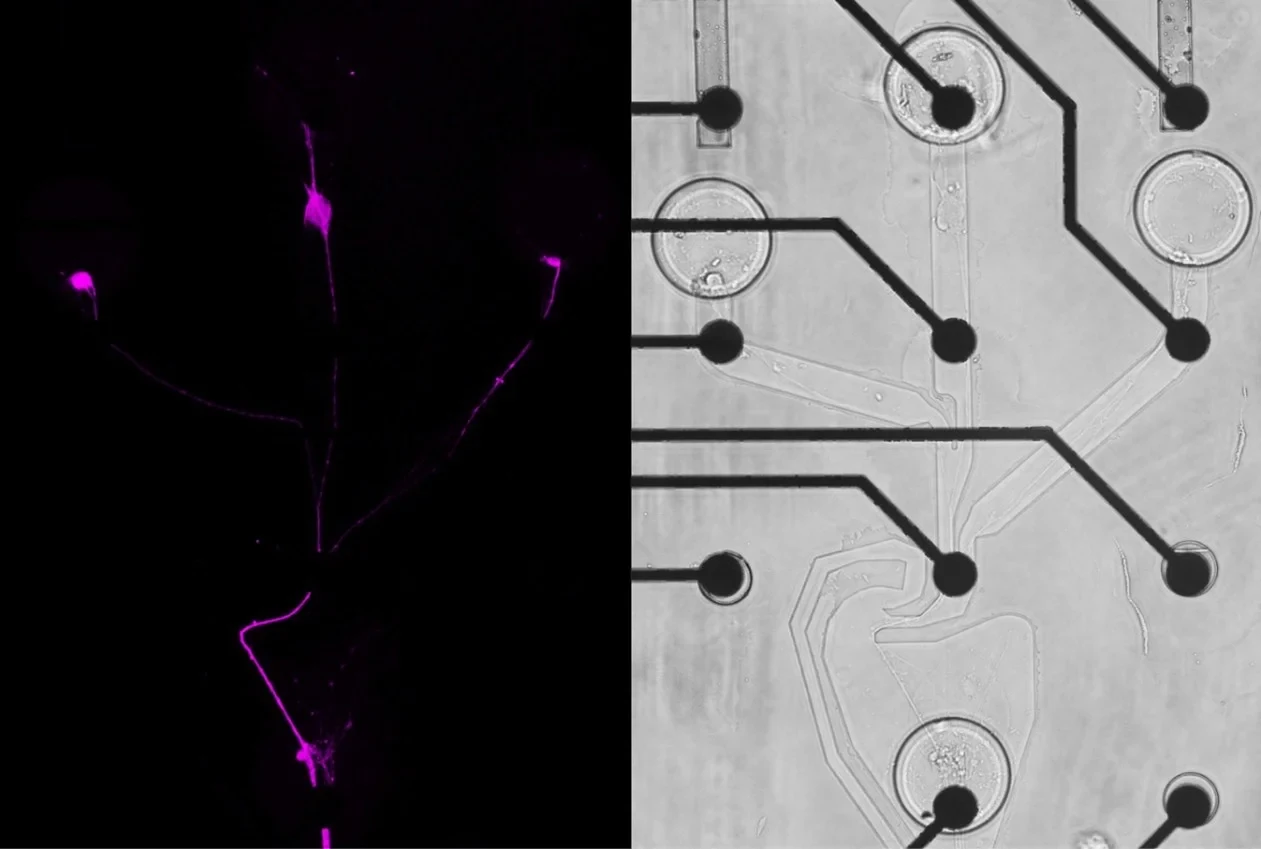
Fluorescence (left) and bright field image (right)
Fluorescence (left) and bright field image (right) - of an artificially generated neural network with electrode structures for measuring nerve signals. © Picture Credit: University Hospital Bonn / Johannes Striebel

The underlying project, Functional Synthetic Human Neural Circuits by Prof. Dr. Volker Busskamp, has been funded with around 1.5 million euros since 2014 as part of a Freigeist Fellowship from the Volkswagen Foundation. This programme supports exceptional researchers who work at the interfaces of established disciplines and pursue innovative, high-risk research projects.

Busskamp's project investigated how the human brain functions in health and disease. To this end, the researchers combine neuroscience, stem cell research and bioengineering to artificially replicate functional neural circuits. Neurons are specifically generated from adult stem cells and connected to form reproducible networks, into which disease-causing mutations can also be introduced. This allows neurobiological mechanisms and potential therapeutic approaches to be researched precisely – right up to the vision of biological computers that process information as efficiently as the human brain.

Johannes Striebel et al.: Reproducible Human Neural Circuits Printed with Single-Cell Precision Reveal the Functional Roles of Ephaptic Coupling, in: ACS Nano, October 2025; DOI: https://doi.org/10.1021/acsnano.5c11482

Prof. Dr. Volker Busskamp
Eye Clinic of the University Hospital Bonn
ImmunoSensation² Cluster of Excellence and Transdisciplinary Research Area ‘Life & Health’ at the University of Bonn
Tel: +49 228 28713687
Email: volker.busskamp@uni-bonn.de

Wird geladen