

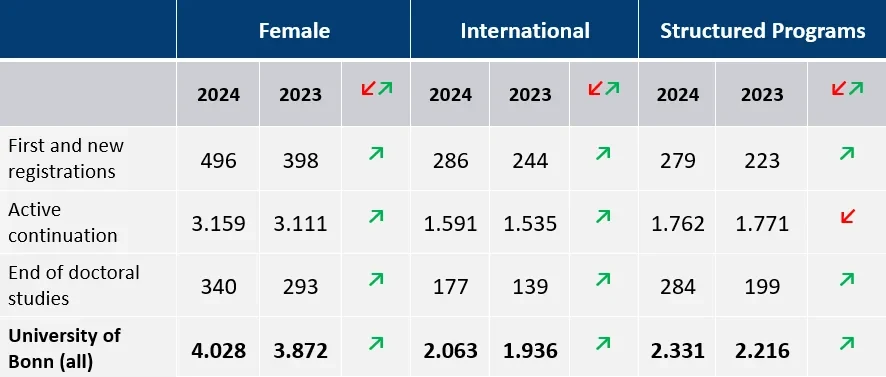
More first-time registrations, fewer dropouts, and an increase in doctoral degrees compared to the previous year - these are the encouraging results of the University of Bonn's doctoral statistics. A total of 890 people began their doctoral studies here in 2024, representing an increase of 16 percent. This upward trend shows that interest in further academic qualification remains high - despite growing demands and a somewhat tense situation on the academic job market.
Internationality is also on the rise: 27 percent of doctoral candidates in 2024 were foreign nationals, which corresponds to around 1,870 people. Among those who began their doctoral studies in the same year, this proportion was as high as 31 percent, which is 4 percent above the national average.
As in previous years, women make up the majority of doctoral candidates at 54 percent, which means that the University of Bonn is also above the national average of 49 percent. Particularly encouraging: for the first time since doctoral candidate statistics were first collected in 2017, more women than men successfully completed their doctorates (50.5%). Overall, the number of doctoral degrees awarded rose from 587 to 674.
A look at the distribution of subjects at the University of Bonn reveals clear differences in the distribution of doctoral students: most are registered in human medicine and health sciences, with 2,400 people (36%). This is followed by the mathematics and natural sciences with 1,700 (26%), the humanities and social sciences with 1,500 (23%), and agricultural, nutritional, and engineering sciences with 570 (8%).
These current figures underscore how dynamically the doctoral landscape in Germany is developing. For universities and research institutions, this development provides an opportunity to observe, reflect on, and specifically promote their own trends.