


The exhibition is also serving as a pilot for the “Open Museum for Open Science for an Open Society” project and is showcasing the diverse nature of the University’s teaching and study collections. With its focus on provenance research, it is also acknowledging the current need for transparency and openness in museum collections and demonstrating the major research potential harbored by these institutions. The exhibition in P26 marks the first time that 25 different University of Bonn institutions—museums, collections, archives and libraries—will have joined forces.
It will show off all the many facets of provenance research, including its practical side, in order to engage in dialogue with interested visitors about some exciting, surprising and unusual stories of people, objects and collections from the University of Bonn.
Might the Namibian cowpeas be colonial in origin?
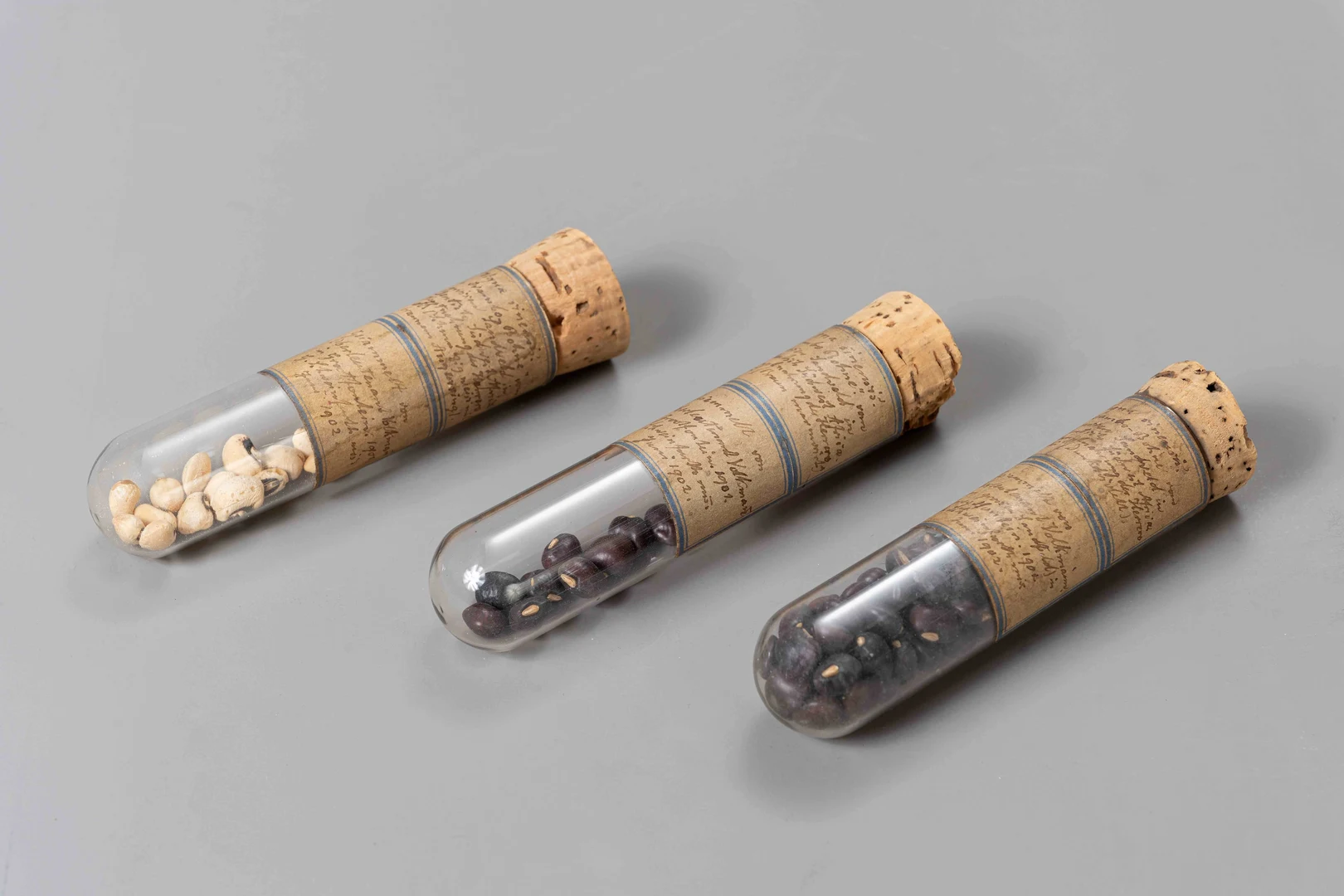
For example, anyone making their way through the exhibition in P26 will learn the story of the Namibian cowpeas. Specimens of this basic foodstuff of sub-Saharan Africa were added to the collection of the former Agricultural University in Poppelsdorf some time after 1902, and this historical collection was handed over to the Botanic Garden in 2015. While preparing for this exhibition and for digitizing the collection, custodian Dr. Cornelia Löhne decided to take a closer look at the peas.
“According to the labels,” Löhne explains, “a Lieutenant Colonel Richard Volkmann collected the ‘Ovambo peas’ in 1901 in what was then German South-West Africa. Volkmann was traveling around Germany’s colonies at the time and writing reports for publication in the ‘Deutsches Kolonialblatt,’ the country’s official colonial gazette. Thus we also have a record of some bartering that went on with members of the local communities. These landed Volkmann with ‘a pile of grain and peas,’ in his own words, including these cowpeas. Additional research has revealed that this Richard Volkmann went on to become an active participant in the persecution and genocide of the Herero and Nama peoples.”
The exhibition has been prepared by its three curators—Alma Hannig, Naomi Rattunde and Elizabeth Stauß—working alongside researchers from museums and collections and their directors as well as 30 master’s students of different subjects, who have done their own research into the stories behind individual objects.
The exhibition was developed and designed in partnership with the scenographers at chezweitz.
It can be viewed in P26 from October 23, 2024 to March 31, 2025; admission is free. Group guided tours can be arranged on request. Special guided tours and workshops are offered for schools.
Contacts:
Alma Hannig MA, ahannig@uni-bonn.de
Naomi Rattunde MA, rattunde@uni-bonn.de
Elizabeth Stauß MA, estauss@uni-bonn.de