

Text: Professor Mariacarla Gadebusch Bondio and Birgit Ulrike Münch
Color corrections
It all started out with pastels. A number of images around the new kind of SARS-CoV-2 virus spreading throughout China and South Korea showed cheerful, light colors in a certain harmless fragility like something nearly incorporeal that would quickly burst like a soap bubble. Viral epidemics have been recurring at increasingly shorter intervals in the last few decades (AIDS/HIV: 1981, SARS: 2002/3, MERS-CoV: 2013, Ebola: 2014, ZIKA: 2015, SARS-CoV-2: 2019). As a result, viruses have been a frequent subject of photojournalism, thus flowing into our collective visual memory. Pictures of and about the SARS virus have been appearing all over the place as medical illustrations, on magazine covers for example. But unlike SARS-CoV, which early on was visually rendered in an aggressive red with intense yellow, the novel virus was initially depicted in pink, light blue and milky yellow. This would then change over the weeks following, the color scheme changing before a darker background reflecting the increasing gloom around the medical reporting once the WHO upgraded its initial classification of COVID-19 as a “Public Health Emergency of International Concern (PHEIC)” to a “pandemic outbreak” on March 12. The color scheme employed in illustration changed to reflect the gravity of the situation as infection spread around the world, the virus from the Coronaviridae family now generally appearing in gray with orange-red offshoots.
On blinking real-time maps the world is seen to become gradually ill as red points multiply to form swaths across the increasingly vulnerable-looking earth. As man recedes into seclusion, nature is resurgent, jellyfish, for example, returning to the waters around Venice. Reporting features colorful graphs with ascending curves tracing the numbers, guaranteed accurate by Johns Hopkins University, the Robert Koch Institute and other prominent organizations. With the figures changing day-to-day or even hour-to-hour, expert epidemiologists are called upon to discuss the statistics in relative and absolute terms, with projections and forecasts. In early March, meta-research scholar John Ioannidis of Stanford University speaks of an “evidence fiasco” in the pandemic response, citing the events on the Diamond Princess and going on to relativize the potential risks in a speculative way. This sparks heated debate as usually it is virologists who are considered by the public to be the appropriate experts to consult on this medical-scientific issue. Emergency room doctors and anesthesiologists are considered to be the most relevant hands-on medical practitioners.
“Faces of an Epidemic”—seen and unseen
The April 16, 2020 issue of the New York Times Magazine featured a Photo Portfolio of the COVID-19 epicenter New York. Photographer Philip Montgomery, winner of the LEAD Award for Best Photographer in the Documentary category (2016), had made a photo documentary of the COVID-19 crisis while visiting several hospitals around the city in the first week of April. The chosen cover photo showed a doctor and two assistants intubating a patient in the emergency room of Queens Hospital Center.
Fig.: New York Times Magazine, Cover, April 16, 2020.
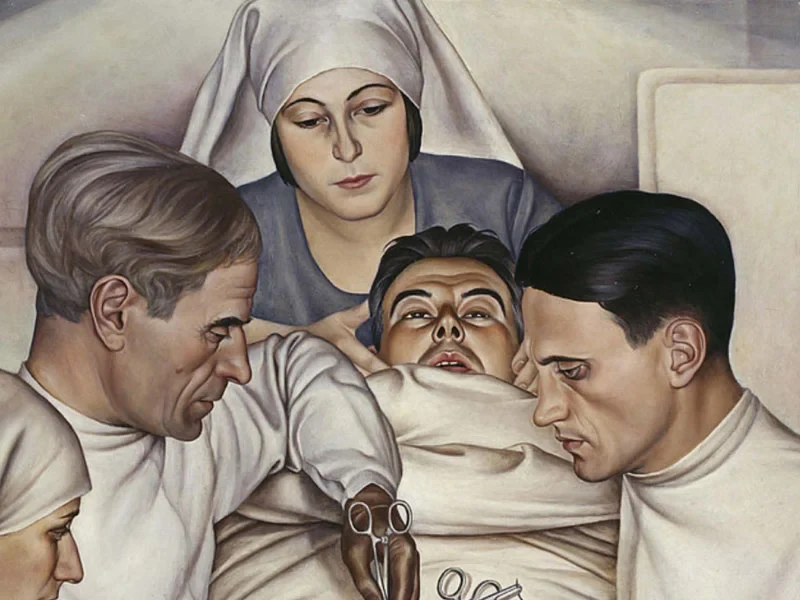
The photography in the issue evoked associations with pictures of surgery and dissections like those seen in the classic anatomical cabinet shows of the 17th century. In particular, Montgomery’s cover photo very much recalls Christian Schad’s famous 1929 painting “Operation”, shown at the Städtische Galerie in the Lenbachhaus and Kunstbau München (125.4 x 95.5 cm). In the triangular arrangement of the people involved in the intervention the viewer may be reminded of the iconographic setup of the painting which the cover shot plays upon.
Fig.: Christian Schad: Operation (1929, 125.4 x 95.5 cm, Städtische Galerie in the Lenbachhaus and Kunstbau München
In Montgomery’s photography however, the patients’ faces are never shown. In Schad’s deliberately arranged appendectomy painting, the nurse anesthetist holds the patient’s head up toward the viewer, whereas in Montgomery’s work the patient is a faceless non-individual. What’s more, the two subjects appearing with the photographer remain both faceless and genderless, due to the protective clothing they wear. Schad had been allowed to observe an appendectomy performed by a surgeon friend, which, as he noted in his writing, fascinated him for how “manual action and manual grasp are interlock with nearly mathematical precision.” In both photo and painting, protected hands working in concert appear in the foreground. Montgomery, who had made a name for himself in 2018 with a portfolio titled “Faces of an Epidemic,” on victims of the opioid painkiller crisis, no doubt had his reasons for not showing the individuality of the intubated body, including patient privacy concerns. The center of the photo is occupied by the hands of doctor Dr. Barry Todd Smith and his assistants, which cast a significant shadow like in Rembrandt’s famous painting “The Anatomy Lesson of Dr. Nicolaes Tulp” (1632, 170x216 cm, Mauritshuis, The Hague). The lack of patient individuality in the photography, contrasting with the operating table depictions, is aligned with the diffuse fashion in which the newly emerged COVID-19 pathogen and the resulting illness were being depicted, so as to avoid, above all, showing the faces of infected persons. This differs from many other disease depictions throughout the history of mankind, such as Raphael’s iconographic plague painting of a crying infant still struggling to suckle at its dead mother’s breast. The painting thereby communicates how the plague affects all age groups, snuffing out human life with swiftness.
Fig.: The Plague: Nicolas Poussin: The Plague of Ashdod, around 1630, Paris, Musée du Louvre.
COVID-19 is primarily detectable on the molecular level, while the pathological effect manifests in the lungs in a gradual process. A CT scan will reveal ground-glass opacity in the lungs indicating increased local fluid accumulation in the lung tissue, otherwise filled with air. In some cases, mainly younger COVID-19 patients will exhibit a brownish or purplish tinge to the skin. In initial studies, physicians like Joshua Zeichner of Mount Sinai Hospital in New York and dermatologist Sebastiano Recalcati of Alessandro Manzoni Hospital in Lecco, Italy have thus started referring to the phenomenon of “Covid skin.” While some sufferers of the disease have been recognizable by such external symptoms, looking back we see that what distinguishes COVID-19 patients in general is how they remain in many ways faceless and anonymous. Anyone lying prone in a respirator mask and protective clothing is unrecognizable, and therefore anonymous. The gear renders doctors and nurses faceless too. In scenes of emergency rooms, crowded hospitals and intensive care units we see people, but none of them are identifiable as individuals.
In the media, images of lungs are often used to symbolize COVID-19, recalling the many ways in which tuberculosis was visually referred to in the past. One parallel magazine cover shows a lung X-ray in a manner that recalls the picture of lungs grasped by a clawed hand that appeared on public education posters on pulmonary tuberculosis in 1949 with the slogan: “TB is a threat—if detected early, tuberculosis is curable!” (originally exhibited at the German Hygiene Museum in Dresden, now in Berlin, P90/0331). Early AIDS photography, in contrast, frequently showed the progressive deterioration of bodies, which were mostly still quite young and attractive. One of the first major exhibitions on art and HIV was held in New York in 1989 bearing the metaphoric title “Against Our Vanishing.” A photo by Therese Frare of David Kirby dying from the disease in the care of his family emerged as one of the most iconic “Faces of AIDS,” which was published in LIFE magazine in 1990 and displayed as a large colorized poster by fashion brand Benetton two years later.
Fig.: David Kirby’s Final Moments, Therese Frere: David Kirby dying; his father, sister and niece with him, black and white photography, 1990.
The photo impactfully humanized what had been thought of as a disease suffered only by “others”, thrusting the issue into the societal mainstream. The brown and purple spots and nodules symptomatic of Kaposi’s sarcoma functioned symbolically as a pars pro toto, iconically opening the door to further direct public showing of the disease in film and photography. Of particular note is the dramatic scene in the movie Philadelphia (1993) when litigant Andrew Beckett identifies himself in the courtroom as an infected person. No defining images of COVID-19, in contrast, have yet emerged. Finger-clipped oximeters at patients’ intensive care beds, ventilators and oxygen cylinders to ease the horrid shortness of breath ... these are the markers of the disease.
Anonymous heroes
What metaphors are associated with COVID-19? During the SARS pandemic in 2002-2003, images of faces half-covered by a mouth-and-nose mask often had aggressive, warlike connotations suggesting that the Asian virus represents a foreign invasion of the (Western) body. The February 1, 2020 issue of SPIEGEL magazine even played on “Yellow Peril” racial stereotypes, showing an Asian man dressed in red with a gas mask and smartphone with the scapegoating title of “Made in China.” Before long, the images shown became more everyday in nature, depicting people busy with disinfecting, measuring temperature and using test kits—in parallel with images of deserted cities. The use of war metaphors for illness, first explored in detail by Susan Sontag in 1977, appears to have only occurred in a few instances with COVID-19. War metaphors remained on the margins, both in pandemic narratives, like the exemplary speech given by French President Macron before imposing lockdown on March 16, and in visual discourse. The arguments advanced for containing infection risk and introducing restrictive prevention measures were informed by the evident powerlessness of medicine and government to effectively confront the virus. With the virus spreading at random across the world, first here then there, blaming, stereotyping and tough talk were time-wasting luxuries that few could afford. Rather, what was and is called for are patience, responsible action, recognition of others’ sacrifice and solidarity across all levels of society. It became clear who was truly keeping the system going and who was displaying solidarity by patiently observing the rules—as communicated by the compelling monumental image, based on a design by Franco Rivolli, of a dottoressa cradling Italy in her arms like a baby put up on the facade of a hospital building in Bergamo. An oppressive calm before the storm was captured in shots of spacious, yet-empty hospital wards with countless beds at the ready, and a magazine image where a doctor peeks through into a field-hospital tent and asks “Are we ready?” (SPIEGEL, March 14, 2020). On an auditory level, the pandemic has been characterized by things like clapping to applaud the dedication of healthcare workers and serenading them with music from balconies above in a show of solidarity. But also the eerie silence of traffic-free cities, so that the chirping of birds became increasingly noticeable and seemed louder, before a backdrop of clear skies with no airplane contrails.
The faces of helpers and helplessness
Another harsh aspect of the facelessness of COVID-19 is how death itself has remained unseen, as the sick die alone, unwitnessed by loved ones. This is in stark contrast to the famous AIDS-death photo of Kirby, which showed how those dying from a disease still very much subject to social stigmatization at that time were able to depart while surrounded by their family. It was in the time before Kirby’s passing that AIDS meant a lonely death, like COVID-19.
In New York, refrigerated trucks wait outside of hospitals, and forklifts for handling corpses are now a normal sight in everyday life. Forty years having passed since such things were last seen in New York and other cities around the world, it all came about unexpectedly. Just like HIV patients at Saint Vincent’s Hospital in Manhattan, known as “ground zero of the AIDS epidemic” had to die in isolation from their relatives back in the 1980s, right now this very minute we have the exact same situation. The word “compassion”
stems from the Latin “compati”, consisting of “pati” or “to suffer” and “com” or “together or with”. As a feeling of deep pity for another’s suffering, we approach death through compassion in our society, yet compassion requires a certain distance. This point was made by cultural theorist Thomas Macho in a study titled “Metaphors of Death,” who said the dead are the very quintessence of “otherness”—an otherness that permeates the skin of the body social. This explains why complicated rituals are needed to integrate what has become other back into society. As the absolute negation of being and societal participation, death represents a “zero point” for Macho, which needs reintegrating.
Victims of COVID-19 are forced to die in isolation because the public health situation has become an out-of-control crisis,
creating an atmosphere of general powerlessness encompassing us all. The realization that an uncontrollable virus can have such a drastic existential impact is deeply unsettling in our secularized Western society of the 21st century, which prizes dignity and even self-determination in death enough to ensconce them in law. The images of blue body bags laid out in refrigerated trucks in New York and of countless identical stretchers in military convoys in Bergamo are emblematic of how the pandemic response has de-individualized its victims. COVID-19 radically differs from the pre-modern plague and cholera epidemics and from the modern-era Spanish flu in that the individual is subject to isolation, in abrogation of his or her rights.
In a look back at the faces associated with the pandemic, these prominent virologists would have to be mentioned: Anthony Fauci of the US, Jérôme Salomon of France, Fernando Simón of Spain, Christian Drosten, Lothar H. Wieler and Hendrik Streeck of Germany. The faces of pandemic science are still predominantly male, as they have been since the early days of HIV journalism. The portrait of ophthalmologist and Covid casualty Li Wenliang (10/12/1986 - 2/7/2020), now seen widely across social media in sketch form, will remain an iconic pandemic image for the Chinese and the rest of the world.
Fig.: Wenliang, Dr. Li Wenliang, graphite pencil drawing of a photograph. Photo: Mvolz/Wikipedia, own work, CC0).
Dr. Wenliang was one of the first to issue a warning ... and his voice was silenced. His face—that of a doctor at first, then as an infected individual—momentarily broke through the wall of victim anonymity upheld by Chinese reporting. The face of a doctor-become-patient speaks volumes about the seriousness and scope of the pandemic, criticism of its handling, standing out from the prevalent facelessness of the infected.
About the authors
Professor Mariacarla Gadebusch Bondio has been Director of the University of Bonn Institute for Medical Humanities since February 2017. Contact: gadebusch.bondio@uni-bonn.de
Professor Birgit Ulrike Münch has been Professor of Art History at the University of Bonn since October 2016.
Contact: bmuench@uni-bonn.de
The two scholars have collaborated on topics including skin as an existential experience, forgotten diseases and the aestheticizing of diversity.
Signs of life: keeping up the conversation!
Division 8, University Communications, is publishing a series of articles titled “Signs of life—keeping up the conversation!” devoted to sharing personal impressions of the fight against COVID-19 at the University of Bonn and the impact the pandemic has had on our lives. The series reflects the University of Bonn’s commitment as an educational institution to participating in public discourse throughout times of crisis, for the benefit of the University community. Articles written by University of Bonn staff and students are published on this website in no particular order, revealing different perspectives that can serve as a springboard for conversation, a source of useful tips or simply food for thought. If you wish to contribute an article, please contact University Communications at kommunikation@uni-bonn.de.