


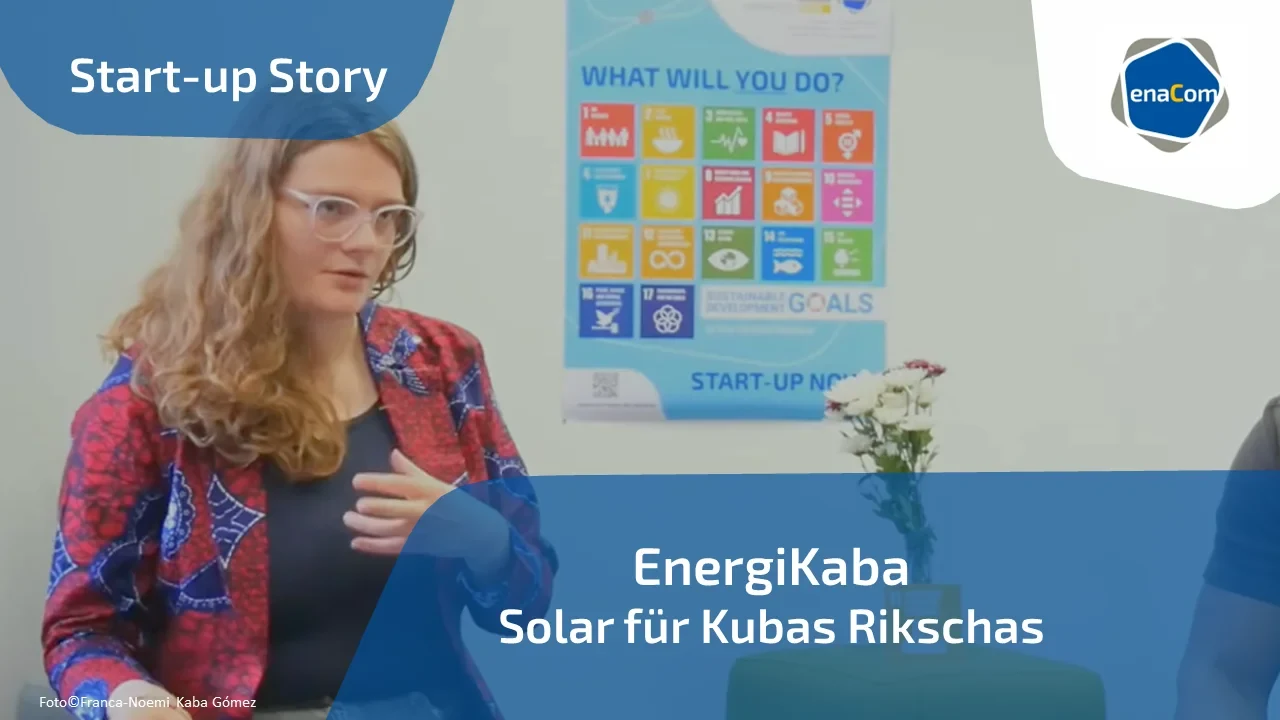
Where did the idea for EnergiKaba come from?
EnergiKaba grew out of our initial experiences with my Cuban father-in-law’s electric rickshaw. We purchased it in 2024 to secure a sustainable income for our family. We quickly realized the potential of the transportation sector in Cuba, but also its massive problems. Electric rickshaws, in particular, depend on a steady supply of electricity. The frequent and irregular power outages mean lost income almost every day, as well as constant stress for drivers.
What is your business model?
We are Havana’s first solar charging station, which means we primarily offer battery charging for electric vehicles. Electric rickshaws can park here overnight and are connected to our battery storage system. This way, we guarantee a 100% charge even early in the morning, when commercial drivers (in passenger transport) start their shifts. During the day, we primarily offer charging services to private individuals, as electric scooters, motorized scooters, and rickshaws are among the most common modes of transportation in Cuba. In addition, we also offer spare parts, tools, work clothes, and even drinks and snacks. In the future, we plan to expand our services to include repairs and modifications (e.g., the installation of solar panels on rickshaw roofs). Our vision is to become a full-service center—the first point of contact for all matters related to electric mobility.
How does the transition from a public-interest idea to a business work?
Our goal is to make the basic service—that is, vehicle charging—available to as many people as possible. In this area, we operate (almost) purely on a break-even basis. However, with all our additional services, which we offer at local market rates, we generate a profit that can be reinvested in the company’s growth. This means we can quickly expand our capacity (e.g., the solar system). Furthermore, we plan to acquire large corporate clients in the future; for example, there is a fleet of small electric buses that circulates in certain neighborhoods. As an infrastructure partner, we can benefit mutually from these private companies.
Renewable energy is a very relevant topic right now. To what extent does your start-up offer new perspectives on this?
In Havana, the transportation transition is already a reality: well over half of all vehicles are electric. The transformation to a “green” society is therefore unfolding in a completely different way than in Europe. If we succeed in powering electric vehicles with decentralized, renewable energy, Havana could become a model for transportation in many other regions with similar conditions.
Your start-up has two locations: one in Cuba and one in Bonn. How do you coordinate and organize the start-up?
With lots of video calls—sometimes even at times when you really don’t want to be dealing with business matters anymore! However, we also have clearly defined areas of responsibility; for example, the Cuban team handles all interactions with government agencies and permits exclusively. In this context, it’s extremely important to rely on the expertise and judgment of the team there so we don’t get bogged down in discussions about project goals and milestones that don’t reflect the reality on the ground.
How can people support your start-up?
Our crowdfunding campaign is underway! We’ve already financed two-thirds of our pilot hub with our own funds, and we’d like to raise the remaining 5,000€ with your support. We deliberately chose crowdfunding over a commercial loan because otherwise we’d have to massively increase the cost of the shipments (by Cuban standards). For our campaign, we’re collaborating with various Cuban freelancers and a small local company, as well as the German company Solarrepublik, and we’ve put together a whole range of pretty awesome rewards (no stickers or jute bags!). Check it out!
What role did the Transfer Center enaCom play in your idea generation and development?
enaCom played a major role: During the 2025 Start-Up Summer School, I put our idea into (German) words for the first time. Together with the team at the time, we built the first business model from the ground up in just 5 days. Our pitch convinced the jury, and they recommended that I apply to the exist-Women program. I was actually accepted, and I notice almost every day how much the program motivates me and helps me stay on track. So it’s truly incredible how far we’ve come since then!
Click here to visit the EnergiKaba website.