

How would you describe the aim of your project to your niece or nephew?
I am developing a holographic augmented-reality display, similar to smart glasses, that uses holograms to control light before it reaches the eye. For example, instead of a virtual arrow, letter, or image simply appearing in front of you, the display shapes the light so that the virtual object looks more naturally placed in the real world. Because the light is shaped before it enters the eye, this approach can also help us explore how displays could be adjusted for people with different eyesight.
What did you find particularly interesting about this research question?
What interests me most is that the eye is not just a passive camera receiving an image. In a holographic display, the light continues to propagate through the cornea, pupil, and crystalline lens before forming an image on the retina. This means that the display and the eye become one coupled optical system. That opens an exciting possibility: instead of correcting vision only with external lenses, we may be able to include aspects of a person’s visual correction directly in the hologram.
Which aspects/activities of your research did the Argelander Grant make possible?
The Argelander Grant made it possible to move from a conceptual idea to an experimental laboratory demonstration. It supported the development of a first holographic augmented-reality bench system, including hologram generation, optical see-through reconstruction, and preliminary tests of depth-dependent image formation. It also enabled scientific exchange with optics collaborators at the TECNOPTO Research Group, Miguel Hernández University of Elche, Spain.
What are the most significant results or insights you gained?
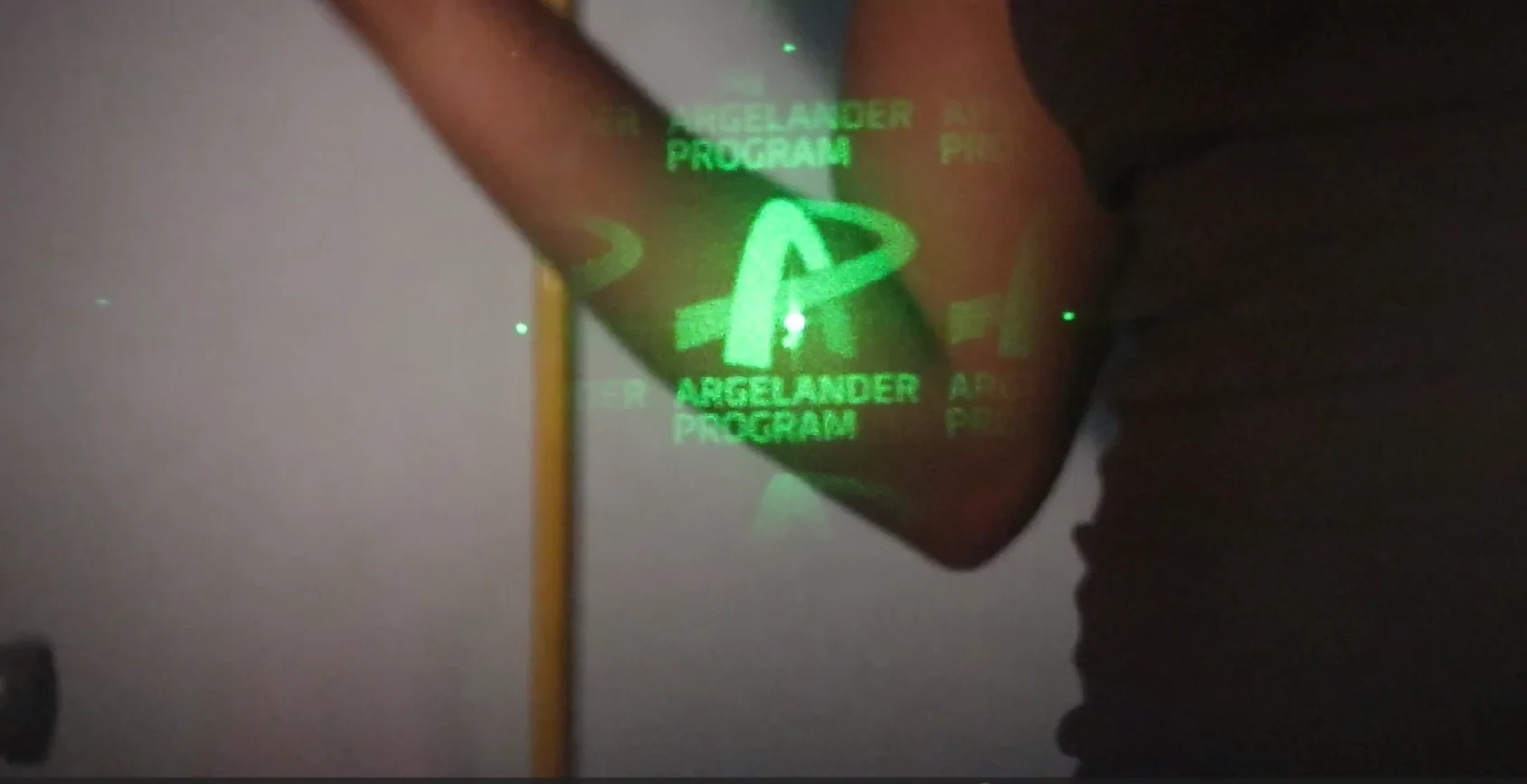
The most important result was demonstrating that holographic images can be generated and observed in an optical see-through configuration. The experiments showed that holographic reconstruction can be combined with direct visual observation of the real environment, which is an important step toward augmented-reality applications. A key insight was that while the prototype successfully demonstrates the principle, further work is needed to improve viewing flexibility, image stability, and user-specific optical adaptation.
What is the societal relevance of them?
The work contributes to the development of more adaptive and personalized visual technologies. In the long term, holographic near-eye displays could support augmented-reality systems that are more comfortable, more natural to view, and potentially adjustable to individual visual needs. This may be relevant not only for future consumer AR devices, but also for ophthalmic visualization, vision assessment, and patient-specific optical correction research.
What is your current/next project about? Will it build upon the results from your current project?
My next project, Holographic Near-Eye Display for Augmented Reality and Patient-Specific Vision Correction (HoloCorrect-AR), will build directly on these preliminary results. The aim is to develop a more advanced holographic near-eye display platform for augmented reality and vision science. The project will investigate how holographic light fields can be controlled more flexibly and how future systems could be adapted to individual visual needs, for example in relation to refractive errors such as myopia or astigmatism.
What has the Argelander Grant meant for your scientific career?
The Argelander Grant has been an important step in establishing my independent research direction. It allowed me to develop preliminary results for a new project at the interface of holography, optical engineering, and vision science. It also strengthened my international collaboration network and provided the foundation for a larger independent grant proposal. For my career, it has helped me move from contributing to optical systems toward leading my own research programme.
Thank you for the interview. We wish you all the best and every success for the future!