


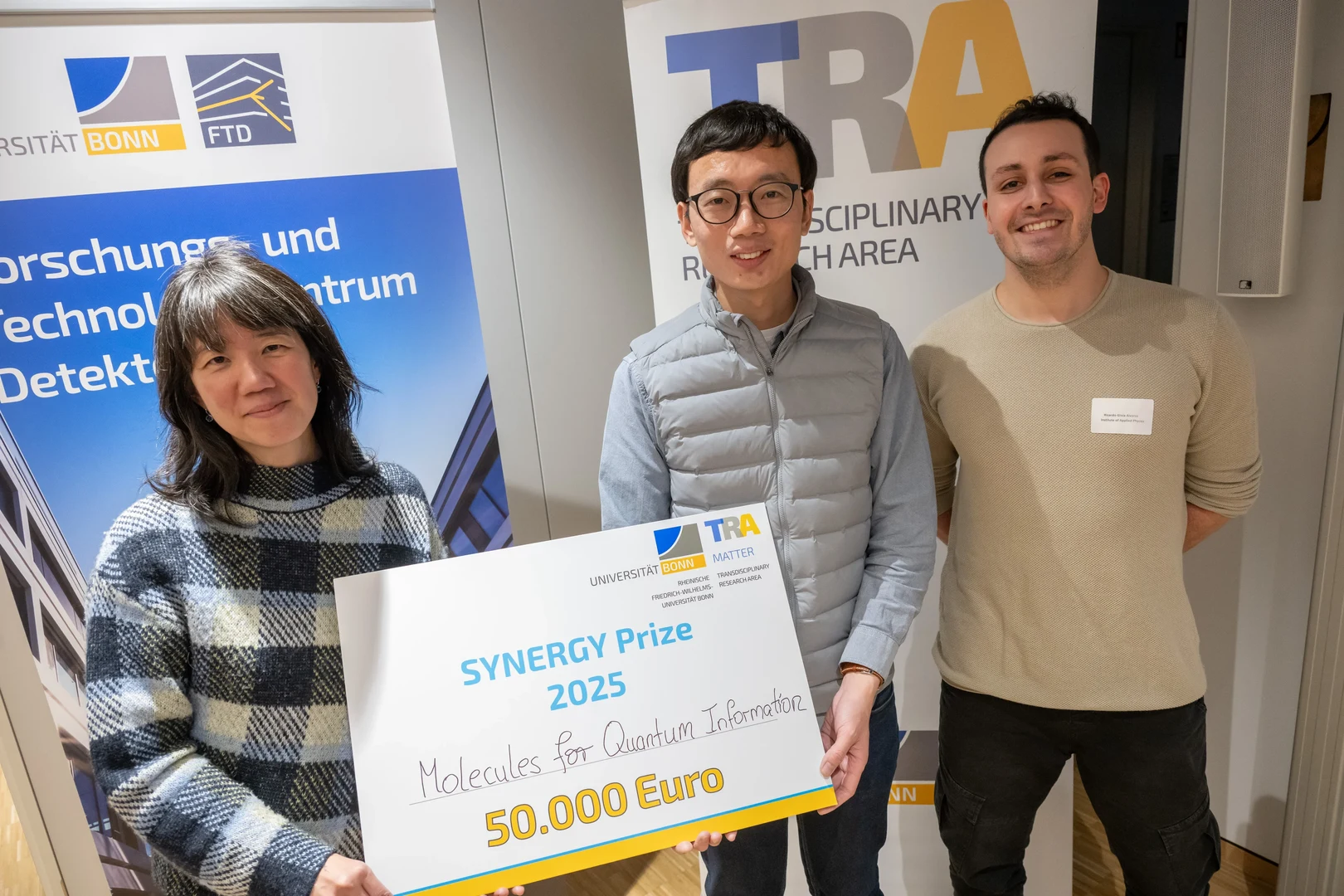
Using molecules as building blocks for quantum computers
The victorious team is studying how single molecules can be used as qubits, the smallest units of information inside quantum computers. Unlike in conventional quantum computers, which are based on atoms, ions or superconducting circuits, molecules are capable of making more stable, more versatile qubits thanks to their wide variety of internal energy states. And the team is now planning to devise a new experiment to this end together with some students.
Assistant Professor Daqing Wang explains: “This is all about combining light and spins. We want to show that we’re able to use light to measure the spins of molecules, stimulate them and influence them in a targeted way.” The team boasts expertise drawn from the fields of both physics and chemistry. Besides Wang, it is made up of Professor Moritz Sokolowski, Professor Connie Lu and Professor Nikolay Kornienko as well as the early-career researchers Dr. Yang Wang, Dr. Hanna Hinrika Cramer, Tianyu Fang, Ricardo Alvarez and Pauline Lemp. Together, they are working on an approach that will drive science forward while also helping to train the next generation of quantum molecular scientists.
Synergy Bubbles provide a stage for bold ideas
In July 2025, TRA Matter called for the founding of Synergy Bubbles. Prof. Sebastian Neubert, spokesperson for TRA Matter, explains: "Synergy Bubbles enable small-scale teams to try out innovative ideas quickly and fine-tune them on a conceptual level. They bring professors, postdocs and doctoral students together and promote interdisciplinary dialogue."
The topics range from molecular quantum information and astrochemistry to applications of artificial intelligence for astrophysics to an interdisciplinary network of researchers at the interface of physics, philosophy, and the history of science, as well as a project in microbiology, pharmacy, and chemistry for fighting cancer.
With the Synergy Prize, TRA Matter supports these early, exploratory ideas in testing their creative hypotheses and thus laying the groundwork for larger research projects.
“Matter Connects” fosters dialogue beyond subject boundaries
The annual “Matter Connects” symposium assembles researchers from the natural sciences, mathematics, computer science and related disciplines. Alongside project presentations, the event also featured talks on recent developments in the ML4Q, Dynaverse and Color meets Flavor Clusters of Excellence and a poster session designed to encourage networking and new partnerships.