


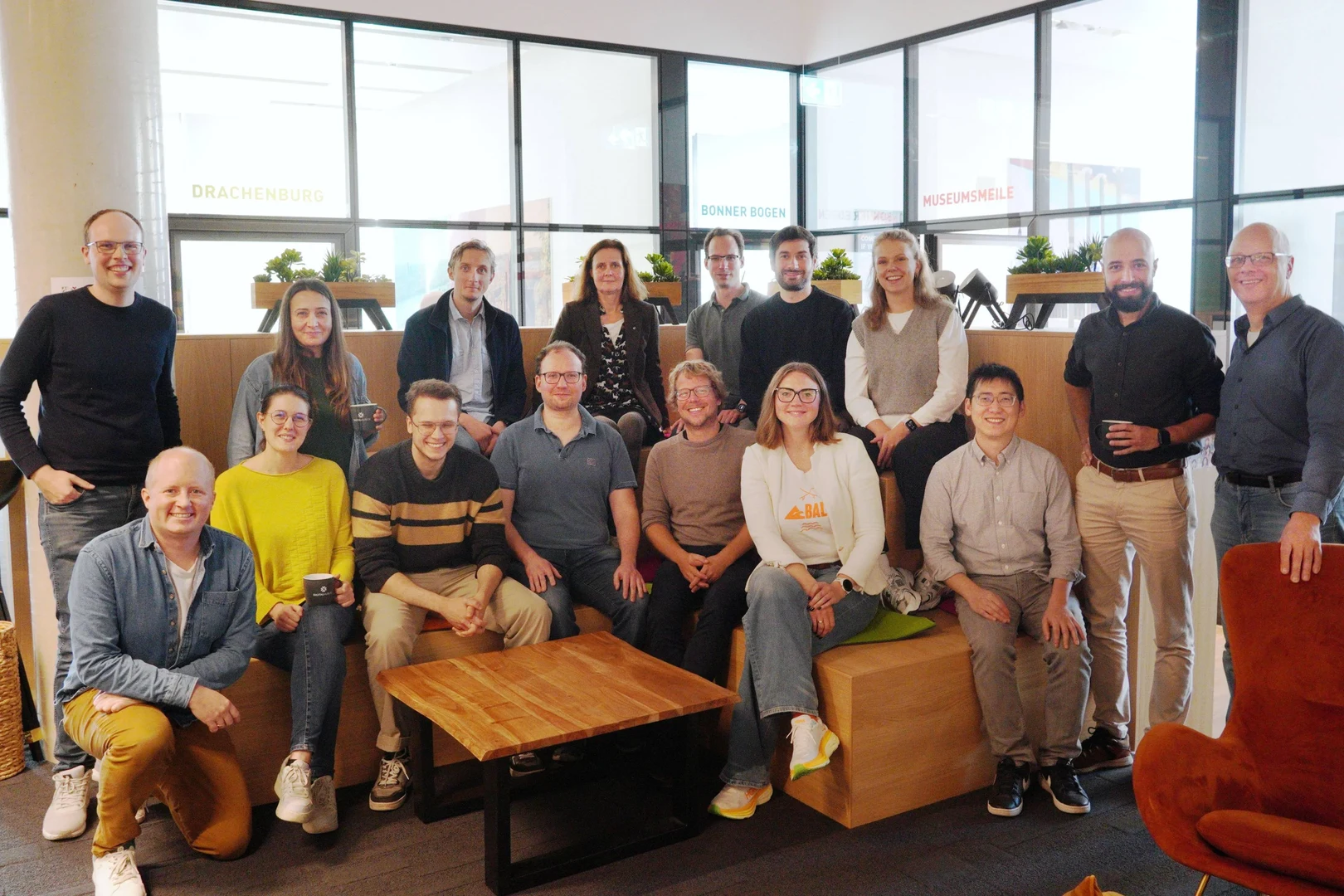
The seven funded projects
An important focus of GO-Bio initial is the promotion of approaches that promise innovation in diagnostics. In the “CervixTest” project, researchers led by project manager Prof. Dr. Ines Gütgemann from the Institute of Pathology are improving the diagnostic test system for the detection of cervical cancer. Together with Dr. Thomas Mayr, also from the Institute of Pathology, and Prof. Dr. Alexander Mustea, Clinic for Gynecology and Gynecological Oncology, they are developing an alternative test procedure that detects viral and endogenous RNA molecules from conventional cervical smears – i.e., from cell samples taken from the cervix – more reliably and easily. Until now, cell samples have been examined in several stages for changes and, among other things, for cancer-causing human papillomaviruses (HPV). These tests too often result in false positive or false negative results, which can be avoided with the new test procedure.
Similarly, the “GestaltMatcher” project is exploring diagnostic possibilities, in this case for rare genetic diseases. Led by Dr. Tzung-Chien Hsieh and Prof. Dr. Peter Krawitz from the Institute for Genomic Statistics and Bioinformatics, the project uses artificial intelligence to identify facial abnormalities that differ from a normal facial shape. Based solely on a photo of the person, the AI can detect anomalies that indicate rare genetic diseases, which will simplify diagnosis for doctors in the future.
Projects dealing with the development of innovative therapeutic options have also been selected. The “ColdEx” project encompasses the work of Dr. Christine Wuebben and Prof. Dr. Gunther Hartmann from the Institute of Clinical Chemistry and Clinical Pharmacology and deals with the development of an innovative nasal spray for activating the antiviral immune defense and preventing viral respiratory infections. This is based on the use of an immunostimulatory RNA that is recognized by the body as a warning signal for a viral infection and activates the body's own antiviral defense mechanisms. The RNA developed for this purpose is intended to provide preventive protection against viral respiratory infections such as COVID-19 in the future.
Alopecia areata (AA), also known as circular hair loss, is an autoimmune disease that leads to sudden hair loss. Currently available therapies are limited in their effectiveness, safety, and/or affordability. Using genetic and clinical data from a large cohort of AA patients, researchers at the Institute of Human Genetics have discovered a new drug target. Based on this discovery, the “Cure4HAIR” team, Dr. Buket Basmanav, Dr. Nicole Cesarato, Dr. Per Hoffmann, Dr. Carina Mathey, Prof. Dr. Regina Betz, and Prof. Dr. Markus Nöthen, is developing a new effective and safe treatment for AA. The group is also working on a personalized medicine tool that supports therapy decisions and can thus shorten the course of treatment for patients.
The funded projects also include approaches for treating epilepsy. The “EpiTher” project is focused on developing new active substances to prevent futureresistance to currently available therapies. One challenge in developing antiepileptic drugs has been the high proportion of patients who develop drug resistance to antiepileptic agents. The project, led by Prof. Dr. Heinz Beck and Dr. Kunihiko Araki (both from the Institute of Epileptology and Cognitive Sciences), focuses on the group of drugs that work by blocking voltage-dependent sodium channels. Based on the discovery of a cell biological mechanism for drug resistance, a cell culture-based test system was developed to enable the future development of new active substances that circumvent the resistance mechanism.
Dr. Arthur Jordan, Dr. Marcel Bausch, and Prof. Dr. Rainer Surges from the Clinic and Polyclinic for Epileptology want to improve the diagnosis and treatment of epilepsy with their “PearNet” project. They are developing a body sensor network that people with epilepsy can wear discreetly and comfortably. The sensors continuously monitor epilepsy symptoms over a long period of time—even outside of typical hospital settings—in order to optimize monitoring, diagnostics, and therapy management. Relevant biosignals are recorded under natural, everyday conditions and analyzed using artificial intelligence. Even individual disease patterns are taken into account. In the long term, this could allowearlier detection of epileptic seizures, more thorough monitoring when necessary, and better control.
Another innovative project is “ReRetina” by Julia Pawlick, Johannes Striebel, and Prof. Dr. Volker Busskamp from the Eye Clinic. The team can produce human photoreceptor cells in a laboratory setting and use them to advance research and the development of therapies for retinal diseases, such as age-related macular degeneration (AMD). As diseases such as AMD have only been researched to a limited extent, they are incurable. AMD is a consequence of the declining performance of special photoreceptor cells in the human eye, known as cone photoreceptor cells (cone PRs). Thanks to years of research in Prof. Busskamp's laboratory, this novel process can produce these cone PRs in large quantities in a short time. The goal is to further develop this technology for curing AMD using those cells as a cell therapy.
Innovation consulting at the university
"We are particularly pleased that seven applications from Bonn were approved in this round. The largest number of GO-Bio initial projects funded simultaneously at the University of Bonn and the UKB to date demonstrates innovation potential and enthusiasm. The funding will help all teams to further explore their exploitation options and translate their research results into applications," explains Sandra Speer, head of the Transfer Center enaCom. enaCom provided advisory support for the applications together with the transfer team of the Faculty of Medicine. The innovation advisory services support all members of the university and the UKB in realizing their ideas.
About the GO-Bio initial funding initiative
The GO-Bio initial funding initiative is aimed at researchers with innovative ideas that have not yet been realized in concrete form. During the two-stage process, these ideas are to be developed conceptually and translated into concrete applications. In the one-year “Sondierungsphase” (“exploratory phase”), ideas are developed, implementation strategies are devised, and important partners are identified. In a second selection process, projects are again selected for the “Machbarkeitsphase” (“feasibility phase”), in which the concrete feasibility of the idea is to be demonstrated over a period of up to two years. Further information on GO-Bio initial is available on the funding initiative's website.