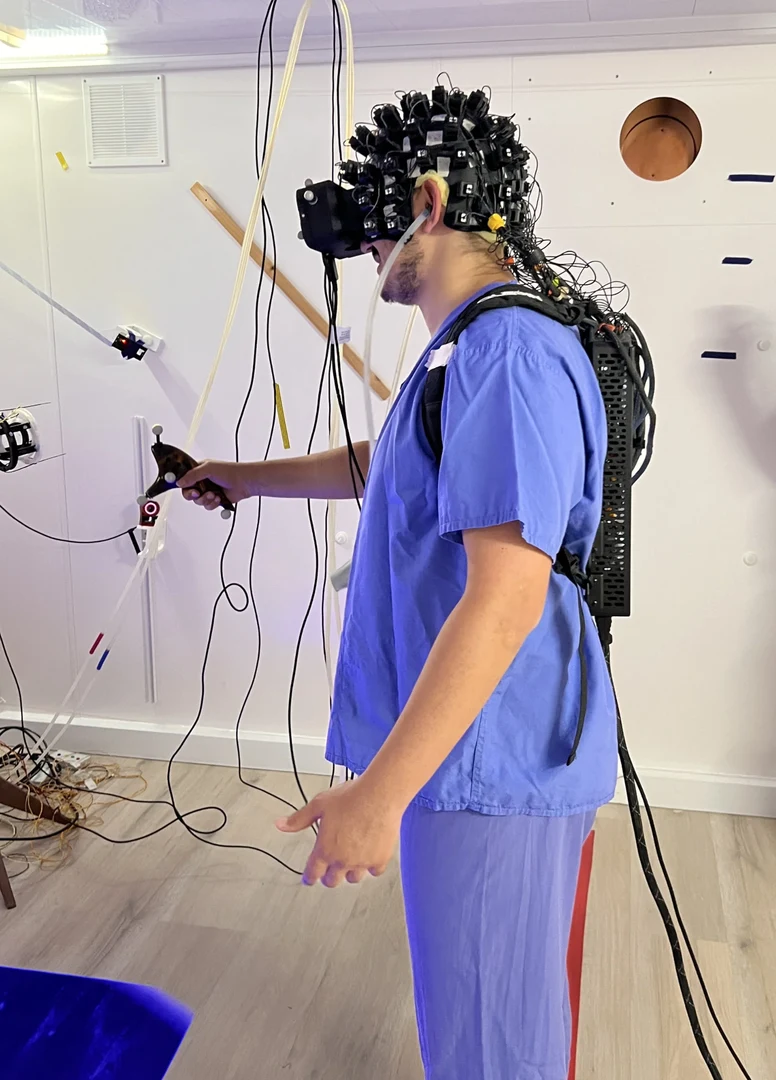


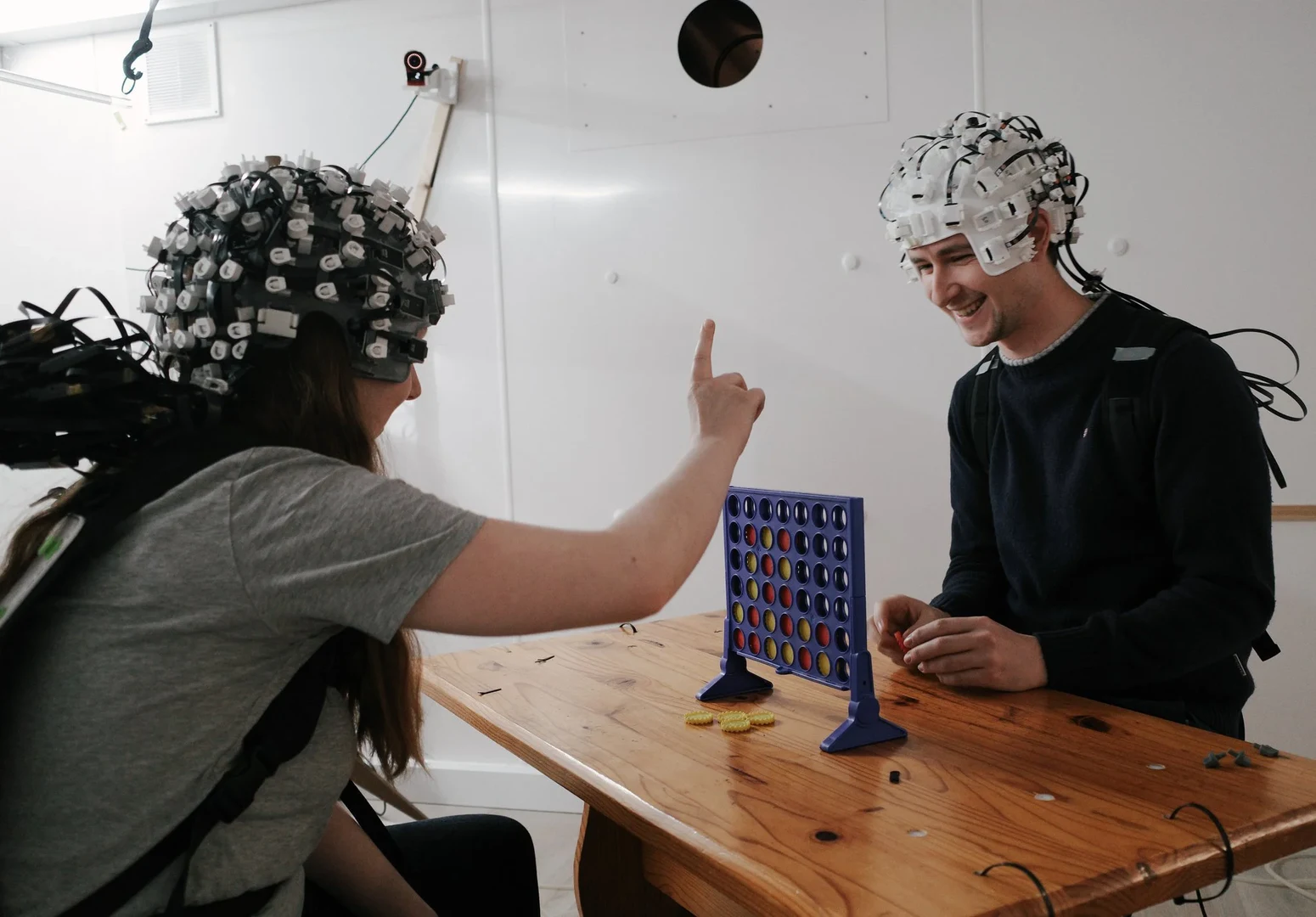
The novel and cutting-edge OPMEG research infrastructure will be built in the basement of the Life & Brain building on the campus of the University Hospital Bonn. Active brain cells produce tiny electrical currents that form magnetic fields. A helmet equipped with sensors is used to measure these magnetic fields. The brain scan is carried out in a shielded booth measuring several square meters to ensure that the measurement results are not falsified by external influences such as the Earth's magnetic field.
“In contrast to conventional imaging methods such as magnetic resonance imaging or traditional magnetoencephalography, the patient can move during the scan,” says Prof. Dr. Dominik Bach to explain the benefits of this method. “It also delivers much more precise measurements compared to EEG.”
Measurements in virtual reality
OPMEG can measure the brain waves of the person being examined while they are moving. It can thus handle the involuntary movements of people with illnesses such as epilepsy or Parkinson’s disease. The researchers use the images to look for characteristic rhythms of the brain. They can also scan the brain waves of healthy people while they are carrying out intentional movements such as spatial navigation tasks or when trying to escape in simulations of dangerous situations. Prof. Bach and his team have just developed OPMEG-compatible VR glasses that are able to simulate real environments in virtual reality.
This type of brain scan lasts up to one and a half hours on average. The test subject wears an imaging helmet and at the same time is hooked up to various other sensors – such as a heart rate monitor or motion sensor – depending on the study. The person than enters the booth and is given several game-based tasks to complete in order to stimulate certain areas of the brain. The test person can move around freely in the magnetically shielded booth and importantly is also able to sit down and relax to take a break. A member of the project team in an anteroom equipped with several screens monitors the data collected during the scan, which is later evaluated by computer.
Sensors use quantum effects
“OPMEG allows us to combine brain imaging with behavioral and motion studies,” says Bach. “This was either not previously possible or only possible with a far lower data quality.” Other applications for this technology include examining mild traumatic brain injuries or strokes and developing brain-computer interfaces. The centerpiece of this infrastructure are around 100 sensors that can measure tiny magnetic fields in the human brain – which are around one thousand times weaker than the Earth’s magnetic field – with the aid of quantum effects.