


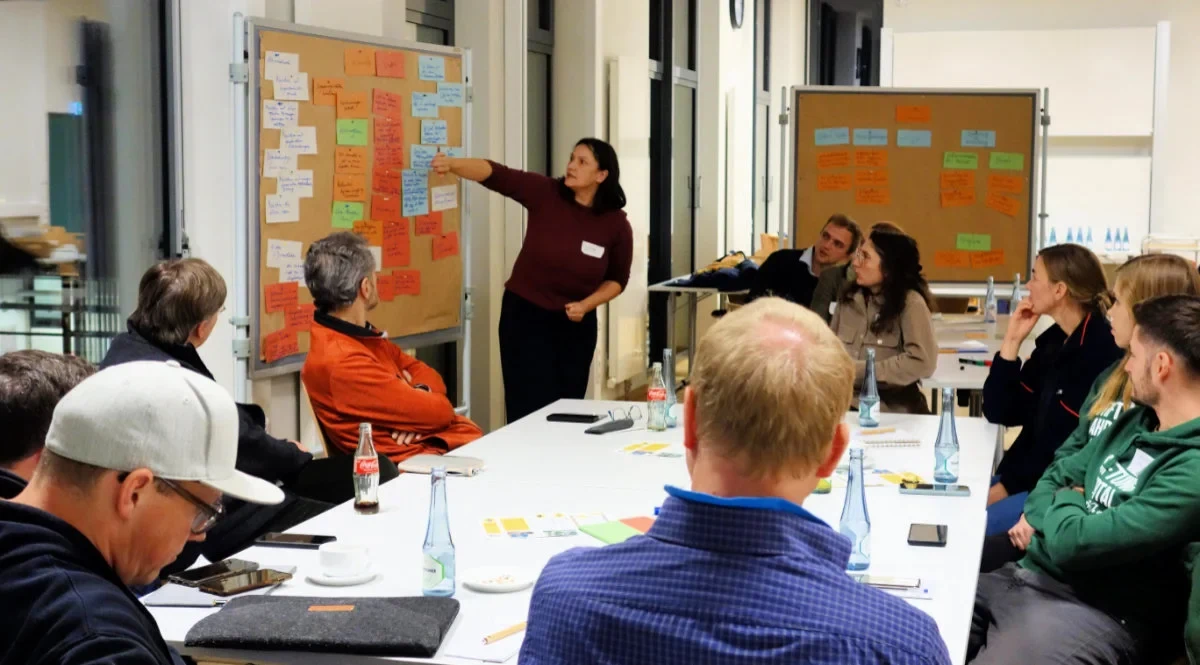
A workshop featuring 37 representatives from the spheres of social and health care, politics, administration, aid organizations and the social sciences was held in Remagen recently. The event had been organized by the University of Bonn’s SOZIAHR project and the “Wissenschaft für den Wiederaufbau” (WfDW) network with support from the association Zukunftsregion Ahr e.V.
At the workshop, project coordinator Susanne Bell introduced the new SOZIAHR research project, which will tackle the social, economic and administrative challenges facing climate resilience in the Ahrtal and provide scientific support to the developments of the next few years.
Armeen Kolians from the Workers’ Samaritan Federation (ASB) began with a report about the door-to-door surveys that he himself had done on the support needed in the region and about the ASB’s wide-ranging social engagement in the Ahrtal. He stressed the importance of providing for oneself and of solidarity in an emergency: “Welfare is not just a job for the state!”
With the psychological impact of the devastating floods another relevant factor, Frank Rost and Claudia Rieckhoff from the local Traumahilfezentrum trauma relief center explained how the disaster had left a permanent mark on many people. “The Ahrtal is just not the same as it used to be,” is a phrase that Rieckhoff often hears when talking to the people affected.
A number of key problem areas were identified in the debate that followed: the wellbeing of individuals, supporting vulnerable groups, social cohesion, and the underlying legal and organizational conditions for aid organizations and associations. Groups with a diverse makeup were then formed to take a closer look at these areas and discuss what specific next steps should be taken and how these could be supported by research in the social sciences.
The workshop provided an opportunity to take stock of the current situation, analyze the prevailing needs and forge links between the various institutions involved. Four more workshops—on vulnerable groups, social cohesion, personal wellbeing, and aid organizations and associations—are set to be held next year, while there are also plans for a survey of Ahrtal residents as well as further studies and project proposals.
Institutions involved:
Workers’ Samaritan Federation (ASB), Arbeiterwohlfahrt Ortsverein (AWO) Bezirksverband Rheinland e.V., Federal Institute for Research on Building, Urban Affairs and Spatial Development (BBSR), Caritasverband Rhein-Mosel-Ahr e.V., Diakonie Schuldnerberatung, Fluthilfe Ahr e.V., Helfer-Stab gGmbH, Koblenz University of Applied Sciences, Hoffnungswerk e.V., Institut für qualifizierte Innovationsforschung und -beratung (IQUIP), Malteser Hilfsdienst e.V. – Fluthilfe HRS, Deputy Victims’ Commissioner in the state government of Rheinland-Palatinate (RLP), Hönningen local council, Rech local council, Quartier³—Hönningen local council, Regionalteam Bethel für Diakonie Katastrophenhilfe, Spenden-Shuttle e.V., Bad Neuenahr town council, Stiftung Ahrtal e.V., Traumahilfezentrum (THZ), University of Bonn/German Institute of Development and Sustainability (IDOS)
More information on the SOZIAHR project: https://www.geographie.uni-bonn.de/de/forschung/arbeitsgruppen/ag-hoerschelmann/forschung/flutkatastrophe-im-ahrtal