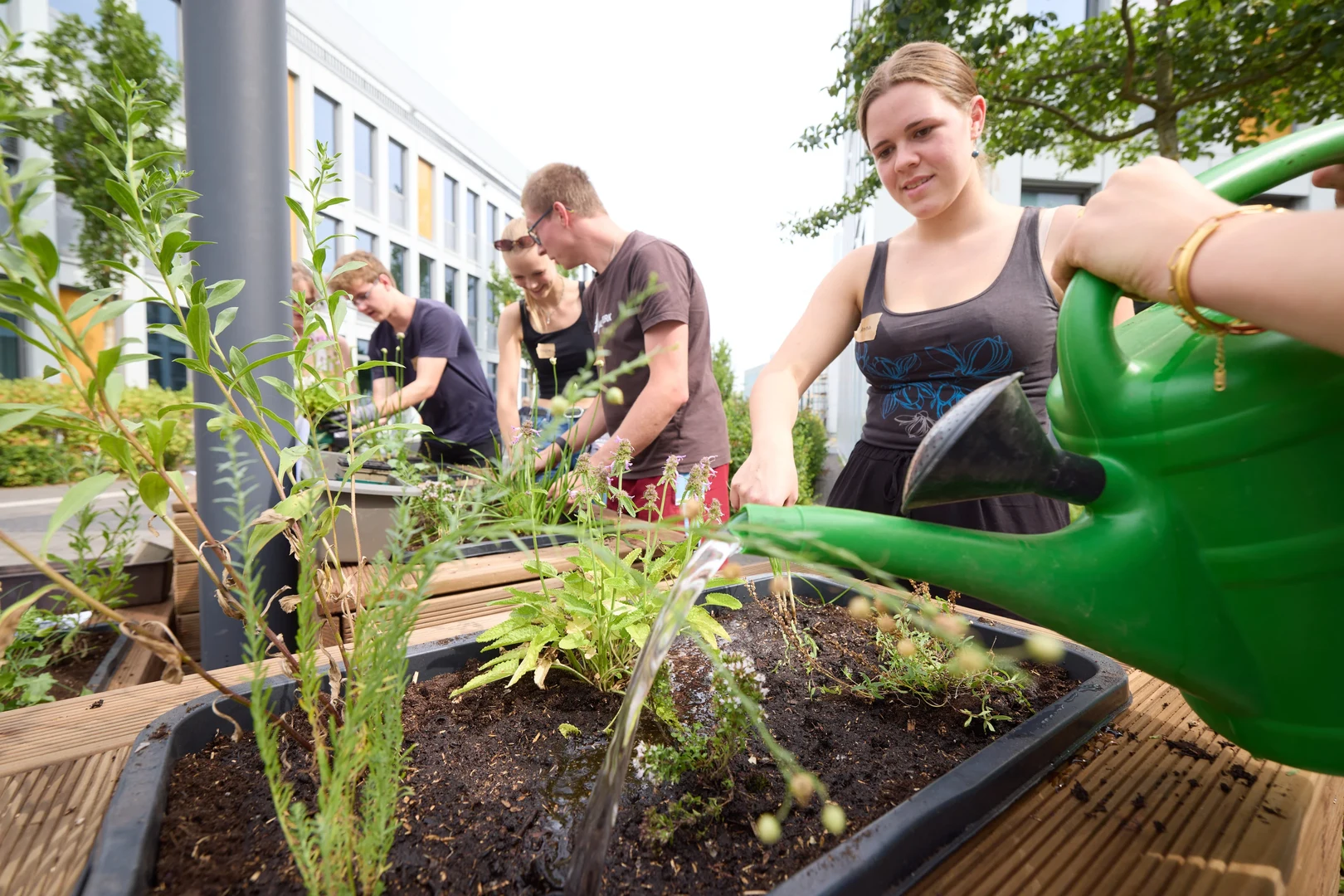


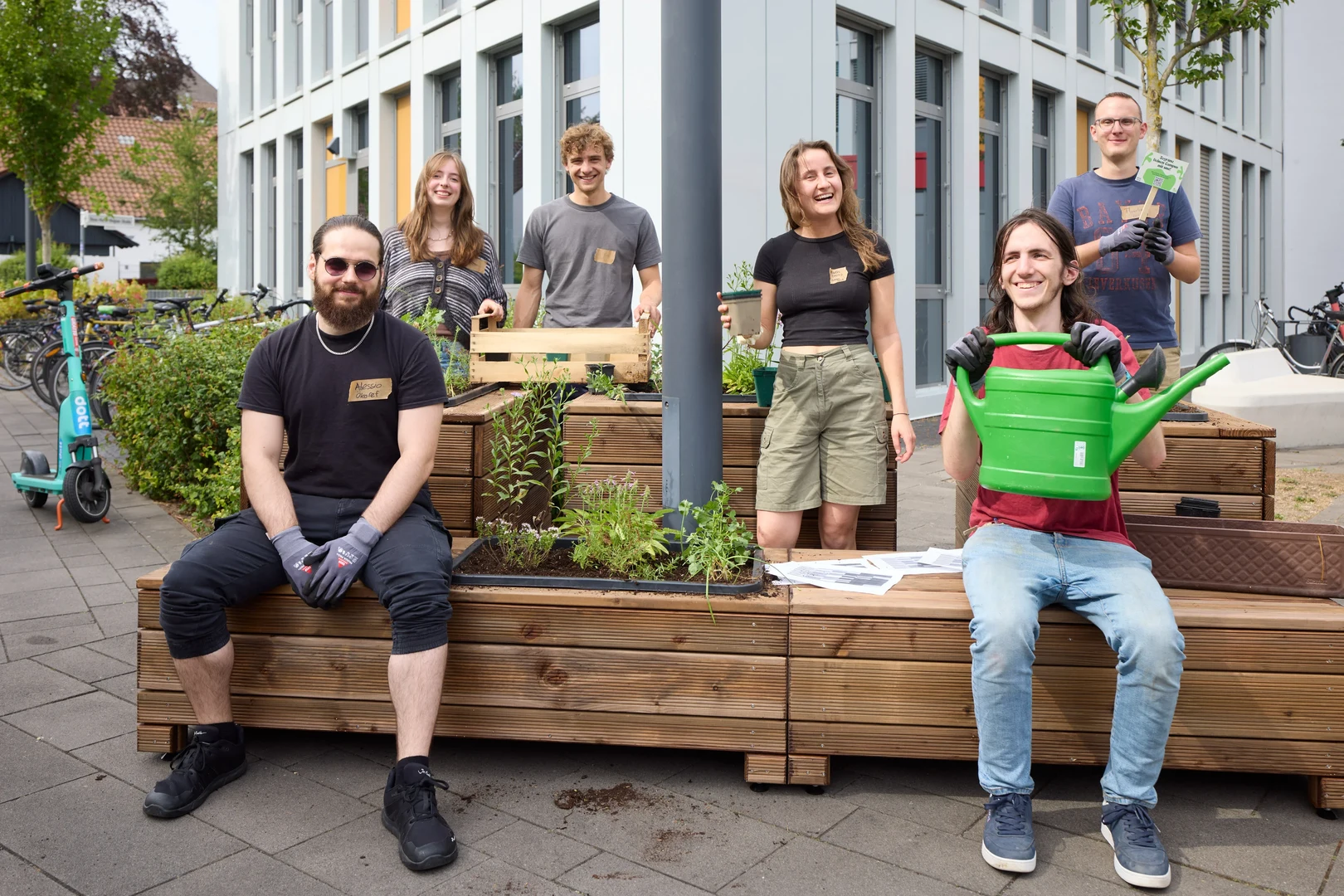
In a visible sign of students’ commitment to sustainability, four green islands have recently popped up at Poppelsdorf Campus—seating areas interspersed between raised beds of flowers and herbs. The bed boxes were placed between the CP1 lecture hall center and the computer science center, roughly 100 meters from the CAMPO-Mensa cafeteria, as part of a student initiative. “Most of Poppelsdorf Campus is concreted over and severely lacking in greenery. On top of that, there are few inviting places for students to sit for a while. The project thus kills two birds with one stone,” as Kathrin Demel of the University of Bonn Green Office pointed out.
Funding available for sustainability ideas
The student councils, the eco department of the General Students’ Committee and the Green Office cooperated closely with students to make it all happen, developing plans for the green islands which they then submitted to the Sustainability Funding Pot in a proposal. The Funding Pot was allocated to provide financial support for sustainability-related ideas spearheaded by University staff and students. As soon as the funding application was approved, the University carpentry shop got busy making the elements. When finished, students then filled the beds with soil and did the planting. Some 30 volunteers met at Poppelsdorf Campus to help plant nearly 100 shrubs and ground-cover plants, assisted by the University's greenspace landscaping team. Maja von Oppenkowski, one of the members of the Student Council for Agricultural Sciences who took part in the project, commented: “The results are really pretty; I think the green islands make the campus more attractive.”
The green elements fulfill multiple objectives at once:
• Promoting biodiversity: Ten native plant species, including perennial flax, chives and summer asters, provide food and habitats for wild bees, butterflies, beetles and many other insects.
• Helping improve the climate: Water evaporation from greenspaces has a cooling effect on the surrounding area, and they bind particulate matter and CO₂, creating a more pleasant microclimate.
• Promoting relaxation and well-being: Studies show that greenspaces reduce stress and promote concentration—which is ideal for learning environments like Poppelsdorf Campus.
Kathrin Demel: “The project promotes biodiversity on campus and student engagement with sustainability at the same time—two important elements of the University of Bonn’s sustainability strategy. If this pilot-like project is successful, the idea may be implemented at other campus locations as well.” Staff and students, including student council members, are invited to adopt green seating areas and maintain them over the longer term.
Contact:
University of Bonn
Green Office
Email: greenoffice@uni-bonn.de
Web: https://www.uni-bonn.de/de/universitaet/ueber-die-uni/nachhaltige-uni/green-office/gruene-inseln