


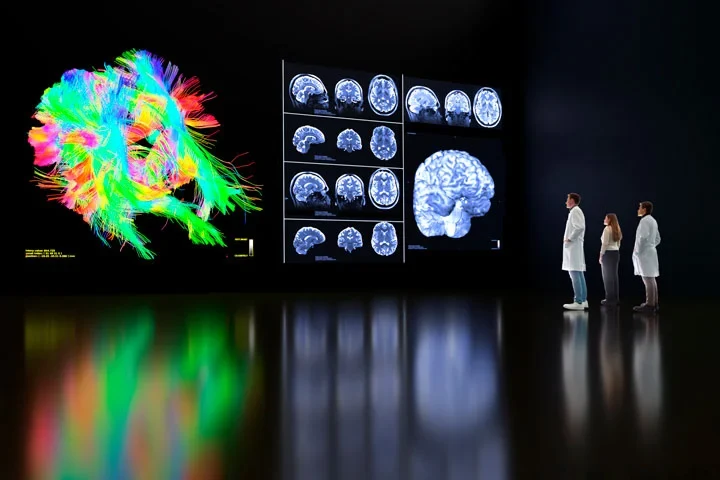
Epilepsy is one of the most common neurological disorders, but despite medication, about one-third of all people with epilepsy continue to have seizures. About half of this group could be treated with epilepsy surgery, in which the seizure focus is surgically removed. However, many patients cannot be helped because epilepsy surgery is not considered an option or the seizure focus cannot be found.
Intelligent interaction system optimizes care
A research team at the Clinic for Neuroradiology at the UKB led by PD Dr. Theodor Rüber has now received over half a million euros from the German Federal Ministry of Education and Research (BMBF) as part of the BMBF program “Start interaktiv” to develop an intelligent interaction system for people with epilepsy and their caregivers. Together with Dr. Tobias Bauer and Annalena Lange, Theodor Rüber uses epi-center.ai to navigate the patient journey of people with epilepsy, coordinate online networking with epilepsy centers, and use artificial intelligence to help specialized teams in epileptology, neuroradiology, and neurosurgery clinics locate the source of seizures.
A prime example of interdisciplinary collaboration
PD Dr. Rüber, who is also managing director of the Center for Medical Data Usability and Translation (ZMDT) at the University of Bonn and the UKB, plans to set up a data trust for the secure storage and use of patient data for the implementation of epi-center.ai.
This is made possible by the transdisciplinary collaboration between researchers from the medical and law faculties, as is the case at the ZMDT. “epi-center.ai in general, however, is a prime example of interdisciplinary collaboration,” says Prof. Alexander Radbruch, Director of the Clinic for Neuroradiology at the UKB and Director at the ZMDT. "This is a project that is positioned at the intersection of the UKB's clinics for neuroradiology, epileptology, and neurosurgery, as well as the ZMDT.
Hybrid technology
Prof. Rainer Surges, Director of the Clinic and Polyclinic for Epileptology at the UKB, adds: "Thanks to epi-center.ai, people affected by epilepsy can be supported through all phases of pre-surgical diagnostics right through to surgery with a wide range of digital applications. I particularly like how epi-center.ai complements, rather than replaces, the relationship between patients and their caregivers. This creates a hybrid network between patients, caregivers, and technology.“
Technologies for health and quality of life
This is entirely in line with the BMBF's ”start interaktiv" program, which aims to strengthen the innovation potential of start-ups in cutting-edge research on interactive technologies for health and quality of life. To this end, opportunities for the establishment of start-ups by suitable research teams are to be promoted at an early stage and in a targeted manner at universities. Funding is provided for innovations in interactive technologies for health and quality of life at universities or research institutions in the form of individual projects. The focus is on promoting innovative research and development work to increase the maturity of current results.