



Any organization needs processes in order to thrive, and process management is a way to improve them—as Stefanie Freyberger knows well: “Process management is a systematic approach to designing, optimizing and managing workflows within an organization.” She heads the Organizational Development team, which is part of Human Resource Development, Organizational Development and Health Management and has been responsible for establishing and driving process management at the University since 2022.
Talking with Freyberger and Process Manager Tatjana Fuchs, what might sound somewhat dry soon takes on a completely different tone: this is about people and how they work together. “Our colleagues here at the University use and follow countless administrative processes every day,” Fuchs says. “We want to keep on making these better and making it easier for people in different teams to collaborate.”
So how does the team go about it? “We steer central process management, improve standards, methods and templates, and support digitalization processes and high-priority process optimization projects,” Freyberger explains. The team also gives other organizational units the skills that they need to manage their own processes by delivering training, providing opportunities for networking and sharing methodological expertise. The support given is flexible and can take the form of process advice, project management or simply acting as a sparring partner. “The goal is always to embed process management as a default way of working across the board—to weave it into the organization’s DNA, if you like.”

Achieving reliable, highly practical results through participation
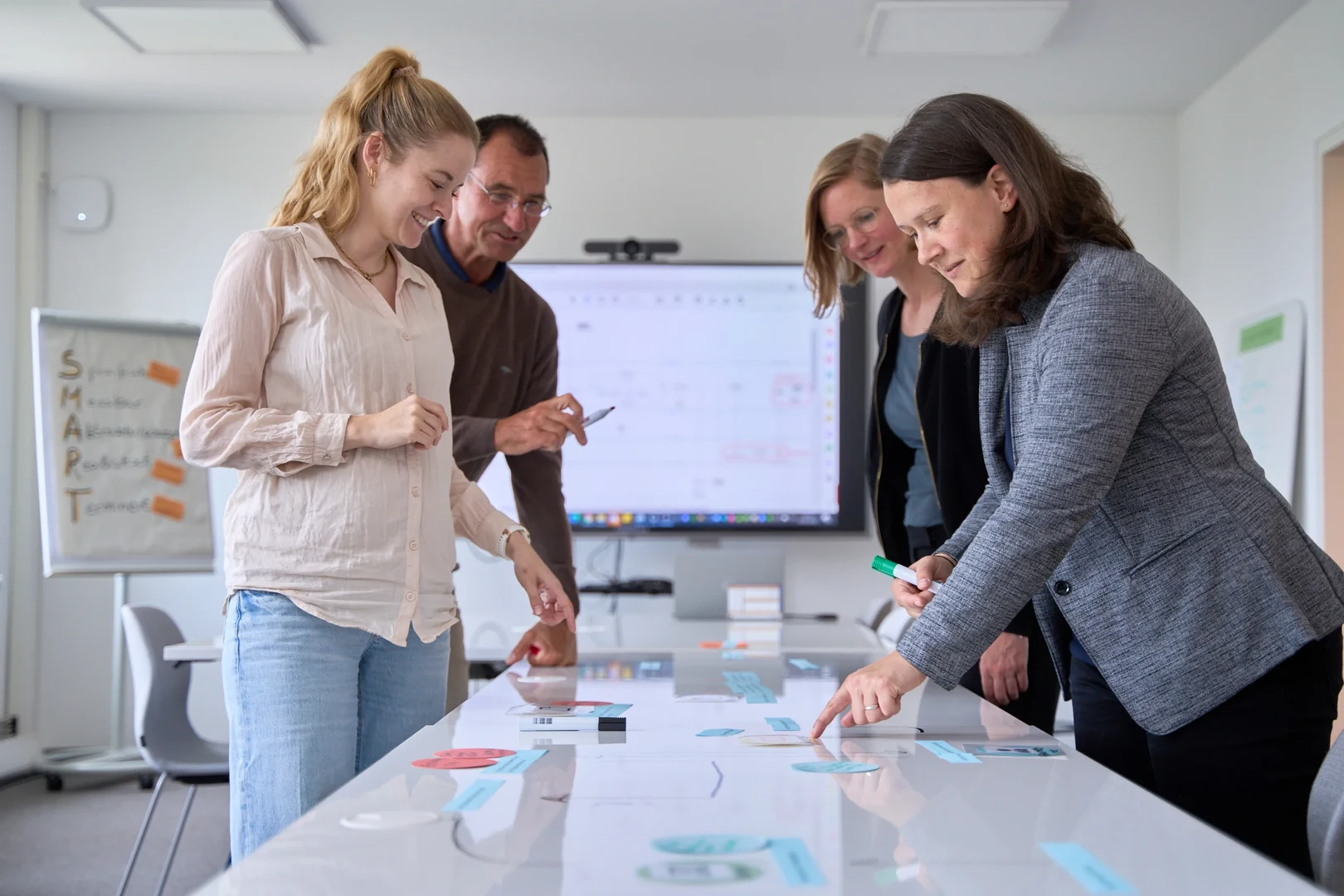
Jennifer Hartmann describes how methodological process management expertise can empower other teams. She leads a project at the University of Bonn that is digitalizing the administrative steps for the Erasmus+ Programme, Europe’s largest exchange scheme for students and staff. Instead of relying on paper, PDFs and emails as has been the case to date, all data is to be logged on a central online platform in the future. Process Consultant Alina Albrecht has been supporting the project and makes up the four-strong Organizational Development team alongside her colleague Rolf Packmohr. “Over several workshops, Alina helped everyone involved to take the workflows used for the various subjects—which up to that point had been extremely heterogeneous—and standardize them without losing sight of key differences between individual academic disciplines,” Hartmann recounts.
These workshops were just one part of a truly participatory process. “Ultimately, the people affected—the participants—are the experts in their processes,” Fuchs points out. The workshops are often the first time that colleagues from different teams find themselves sitting together and asking one another questions like “What do we need from one another?” “Is there a better way to do things?” Plus: “Optimized processes will only open the door to successful digitalization and transformation if they’re accepted,” Freyberger emphasizes. “Getting the participants involved is crucial to securing this acceptance.” Fuchs adds: “Making participants feel actively involved also makes for much more high-quality solutions. The results this gives us are both reliable and highly practical.”
The team also uses process management for teambuilding exercises. “It lets you clarify duties, responsibilities and decision-making channels,” says Fuchs. Combined with teambuilding methods, therefore, Organizational Development lends support with restructuring measures, teams that have seen rapid growth, or unanswered questions—while also embedding process-oriented thinking more strongly across the University.
Jennifer Hartmann’s overall assessment is positive: “We’ve managed to make the process much more streamlined, and it now runs on the International Office’s online platform.” Something that has been particularly valuable, she says, has been combining the process consultant’s methodological skills with her own expertise in digitalization and Erasmus+. Working together, they have come up with ideas for workshops, which they have then prepared and followed up. This has taught them how to standardize and optimize processes and, above all, “how we manage to get the people involved fully behind the end result,” Hartmann adds.
Process management as a strategic tool
The team has also trained her in working with BIC Process Design—a process management tool used across the University—and in the modeling language BPMN 2.0. This has enabled Hartmann to consolidate her existing knowledge and given her the tools that she needs to use process maps to coordinate features and the design of the platform. Has it been a success?
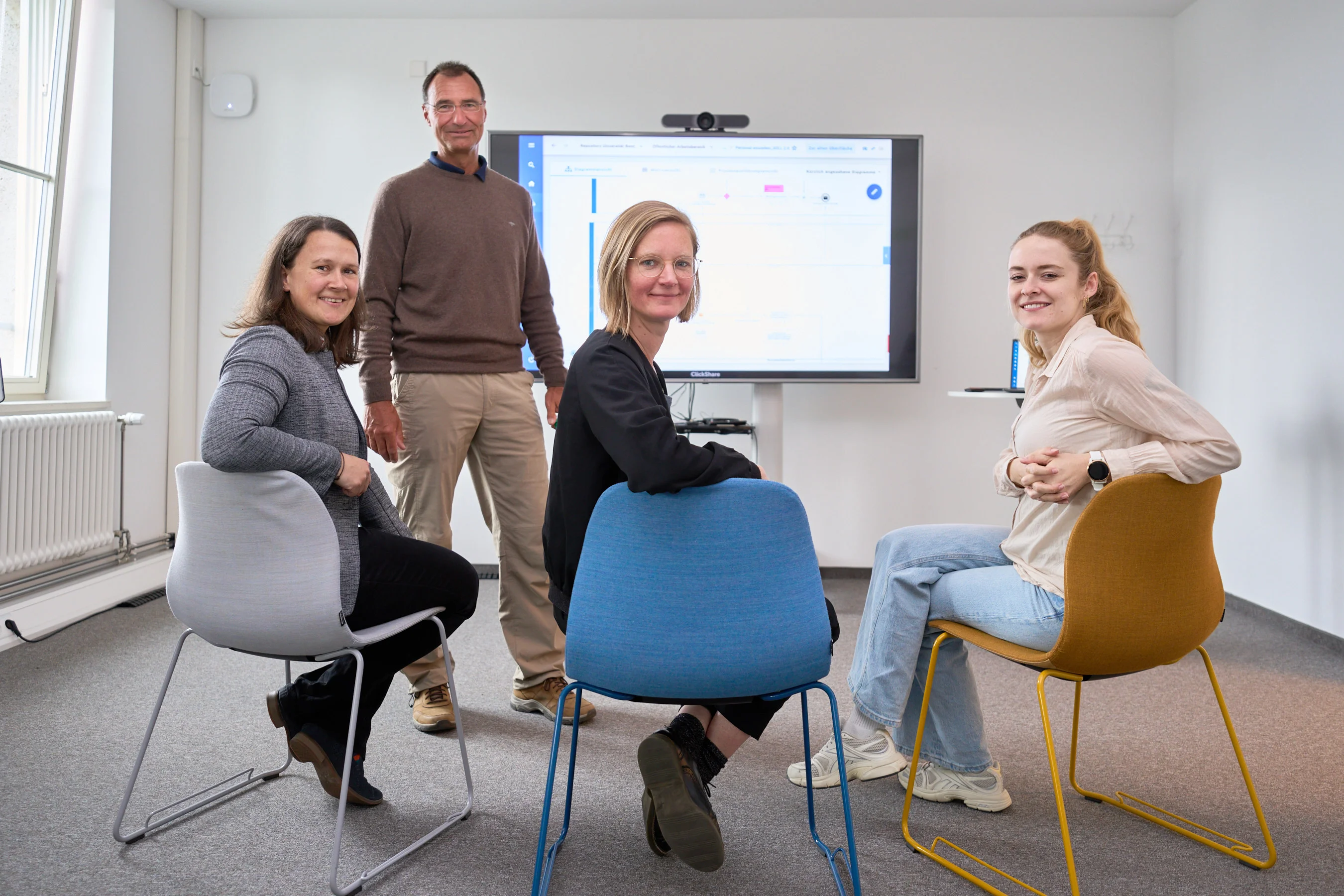
“Our satisfaction survey says it all,” she reveals. Staff who handle applications for semesters abroad rate the user-friendliness of the new process as an 8.6 out of 10. Two-thirds feel that their life has been made much easier, especially in subjects that receive the bulk of the 600 applications made each year. And Hartmann herself? She wants to put her process management knowledge toward more projects in the future. This is an example of successful empowerment, Freyberger says: “In this way, by giving people support and the skills they need, we’re producing a steady stream of multipliers for process management at the University of Bonn.”
The success of the Erasmus+ platform reflects one of the team’s core principles: process optimization first, digitalization second. “Optimized processes let you harness the full potential of digital solutions and achieve tangible improvements,” Freyberger explains. “And that’s important, because a poor analogue process won’t get any better just by being made digital.”
How does the University of Bonn compare with other higher-education institutions when it comes to process management? “If the annual meeting of higher-education institutions in North Rhine-Westphalia is anything to go by, we’re in a strong position—in terms of standards, using it in projects, getting it established and building skills for it,” Fuchs reports. “Other well-placed institutions are using similar methods, and we share many of the same success factors.”
One of these is the backing of top management. Provost Holger Gottschalk sees process management as a vital instrument in the further strategic development of the University as an organization: “Process management is one effective key to addressing the challenges of digitalization, rising service orientation, consolidation of responsibilities and the scarcity of skilled workers. Here at our University we’re actively pursuing this as a goal, led by the Organizational Development team.”
Summing up, Freyberger says: “Needless to say, these are very firm foundations for us to build on—we’ve got a clear course ahead of us.”