


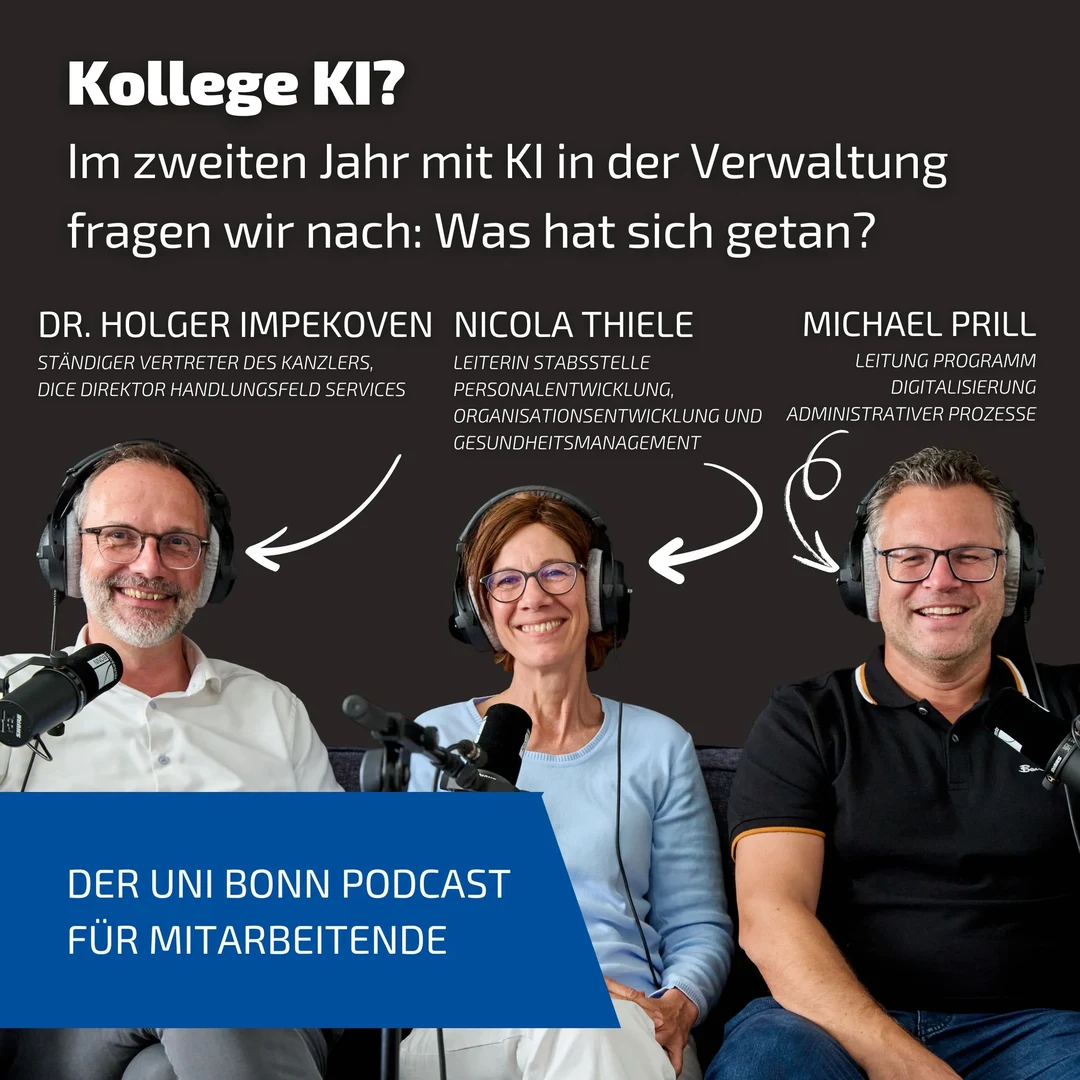

1. How has the work of the central administration been transformed through AI?
Holger Impekoven: “A crazy amount of things have happened at all levels — within the AI models, but also within the University itself. The Rectorate's AI Think Tank, which among other things is looking at the use of AI in research, instruction, and administration, has made a number of recommendations, including for the central administration. The most important milestone was the pair of AI days that established a common framework for approaching the topic. We founded the Communities of Practice, which help employees talk to one another about application scenarios and benefit from each other's experiences. We created ‘Kilian’ as a secure sandbox for experiments and started with organized training. There’s one thing in particular we were trying to convey: It’s OK to test, it's OK to make mistakes. We’ve given a lot of thought to transparent change processes as a way to alleviate fear among administrative employees. The COP has proved a good instrument for this.”
2. What’s different about COP meetings?
Michael Prill: Perhaps the dynamic, playful approach is what sets the Community of Practice apart. It brings together people with different levels of knowledge for two or three hours to test out various AI tools and talk about their experiences. From ChatGPT to voice-over tools like Elevenlabs, or SAP's proprietary tools or image generators—something new each time. It's fun, practical in nature, and helps people get past their concerns. We perpetually welcome new faces and have found that our in-person meetings, the “AI workshops,” are especially popular, which is why they are now being held every two months. And it's not just new AI tools, but also the application cases that can be bundled and harnessed. We're actually starting to observe positive changes in the learning behaviors of many participants.”
3. What training is being offered for employees, and how are these offerings perceived?
Nicola Thiele: “We’re slowly getting past the misconception that AI is somehow just a fad. It’s going to change the nature of what we work on and our job responsibilities. Which is why we’ve developed various formats to help everyone find the right entry point. There are beginner courses for those who are interested but inexperienced, and advanced courses for those with prior knowledge. New training formats are being added and tools are being explored together. The workshops are continuing, the dialogs are getting deeper, and the opportunities are growing. All are welcome to take an active part in the development, and experience how AI can make everyday life easier. The training sessions aren’t just introducing people to the software and the tools. When we talk about AI, we're talking about a major transformational project. That is also reflected in what we offer, focusing on qualifications that promote collaboration and co-creation, and which bring forward "AI literacy” and attitudinal change within the organization.
4. What good things can employees expect for the future?
Holger Impekoven: “AI is here to stay. And it's going to change how we work. Some tasks will grow easier, such as knowledge management becoming easier to access in the service portal. And we continue to work on the infrastructure. We’re up to ‘Kilian‘ auf mixtral:8x7b -Basis’, which has established a proof of concept that AI can work in compliance with privacy laws. We’re thrilled that these tools will soon be available across the University through the KIWIS projects, without interfering with the ongoing project from University IT and BZH.
Think Tank KI - Part of the Digital Strategy
The University of Bonn’s Digital Strategy sets out the measures and structures required for its digital transformation. And the AI Think Tank is one of the structures that make up its new areas in research and teaching, where scientific experts are addressing the growing relevance of AI use across the whole of academia. The Think Tank is devising a number of step-by-step strategic recommendations for the Rectorate as to how the University can keep up with the rapid pace of development.