


According to some estimates, more than one third of the world’s harvest would be lost to weeds, pests and diseases every year without crop protection. “On the other hand, the abundant use of synthetic pesticides can be damaging to human health and ecosystems,” emphasizes Prof. Dr. Niklas Möhring.
The researcher, who heads the Production Economics Group at the University of Bonn, assesses goal conflicts and trade-offs at this research frontier. Together with 13 colleagues spread across a total of six continents he has been working in this latest study on one important question: What would happen if farmers around the globe were to switch over to sustainable pest management measures?
Integrated pest management, cultivation of resistant varieties
Integrated pest management practices include, for example, the cultivation of resistant crop varieties, diverse crop rotations or planting hedges around the edges of fields in which natural predators are able to multiply. “Unfortunately, locally adapted, alternatives practices are often not available and will require more research,” says Möhring. “Agricultural systems also vary and it is often not possible to transfer the results of a field study, for example, in Germany to other parts of the world.”
Therefore, there is often uncertainty about whether sustainable pest management could be successfully implemented in a particular region, or what the resulting trade-offs, for example, between environmental goals, yields and economic losses for the farmers could be. “We thus decided to survey local experts to find out what they thought the opportunities and risks associated with such a transformation would be,” says the researcher.
What do local experts think?
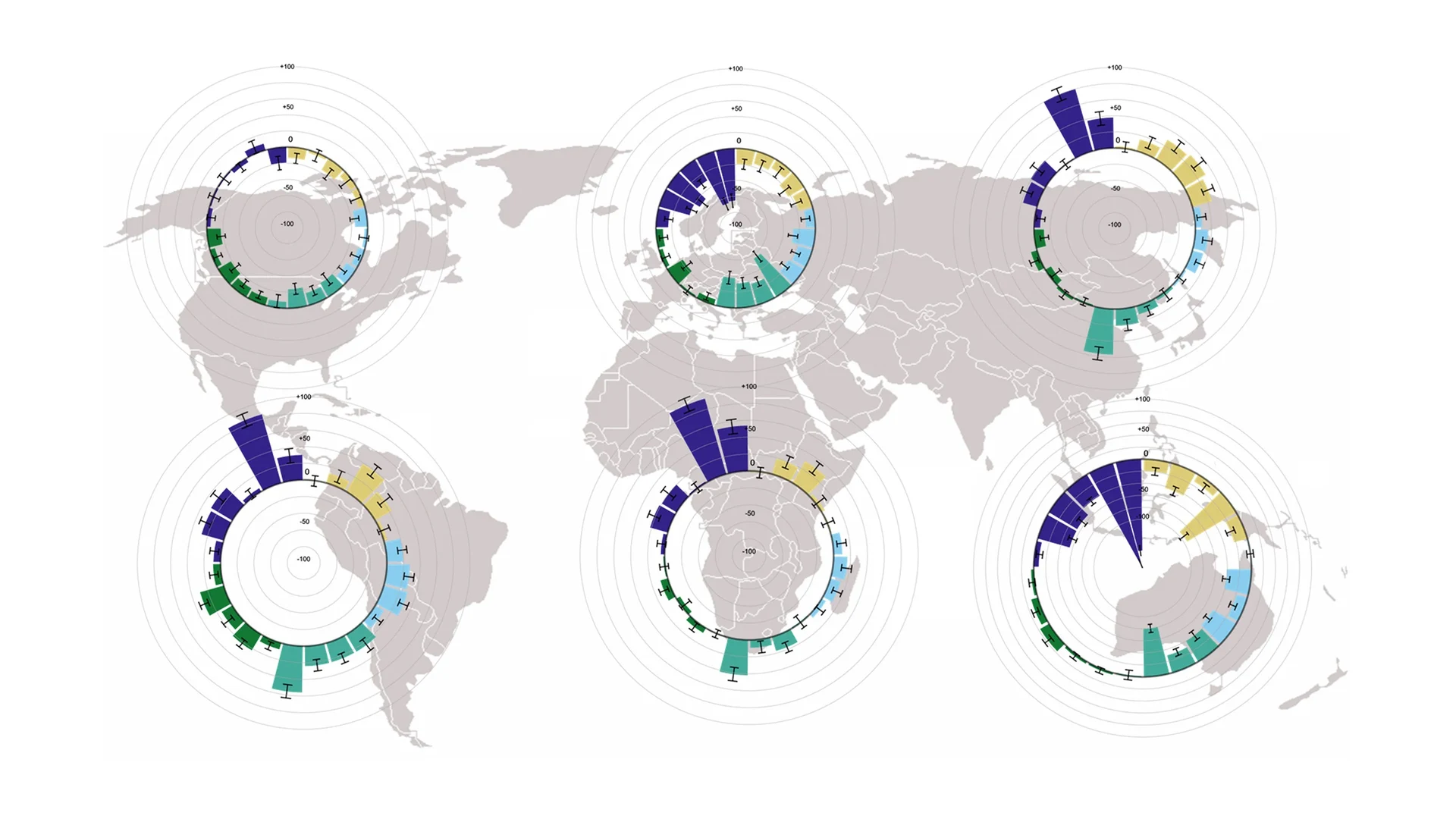
The researchers developed a comprehensive survey on the potential consequences when switching over to sustainable pest management. The possible effects were split into five areas: Impacts on the environment, health, food security, the economic situation of the farmers and social equality and security (which includes, among other things, the working conditions for the farmers and their workers).
In total, 517 experts with an intimate knowledge of the agriculture in a specific region responded to the survey. The respondents were selected to provide a wide range of perspectives based on their expertise in different disciplines, ranging from ecology, to economics or toxicology. “In this way, we wanted to obtain a balanced range of opinions about this complex question,” says Möhring.
Environmental and health benefits
The experts’ expectations did indeed vary depending on their origin and type of expertise. Overall, they expected a transformation to sustainable pest management to have a positive effect – at least in the long term. They expected particularly strong improvements at an environmental level, for example, for water pollution or biodiversity. This was true irrespective of the region and discipline. It similarly applied to expected effects on human health.
However, there were big differences in the expected economic impacts. In North America, Europe and Australia, the same number of experts expected positive impacts as negative impacts on the income of farmers - at least in the short term. In contrast, the experts for Asia, Africa and South America tended to believe that this transformation would also offer an economic opportunity. The respondents for these continents also believed that the transformation would have a more positive impact on local access to safe food than the experts for North America, Europe and Australia.
Sustainability has its price
“Despite these differences, the experts were surprisingly optimistic overall,” says Möhring, who is also a member of the transdisciplinary research area “Sustainable Futures” and the PhenoRob Cluster of Excellence at the University of Bonn. “This does not mean, however, that the switch to sustainable crop protection would be free. However, higher short- to mid-term costs could pay off in the long term. Generally, it will be key that we support farmers during this transformation by offering them, for instance, tailored and effective alternatives for crop protection and appropriate support mechanisms.”
However, this study was only based on opinions of a range of experts and it remains to be seen whether their forecasts are realistic. “Among other things, we will need to carry out more local studies across various regions in which we can try out sustainable pest management strategies and systematically research their effects,” Möhring explains.