


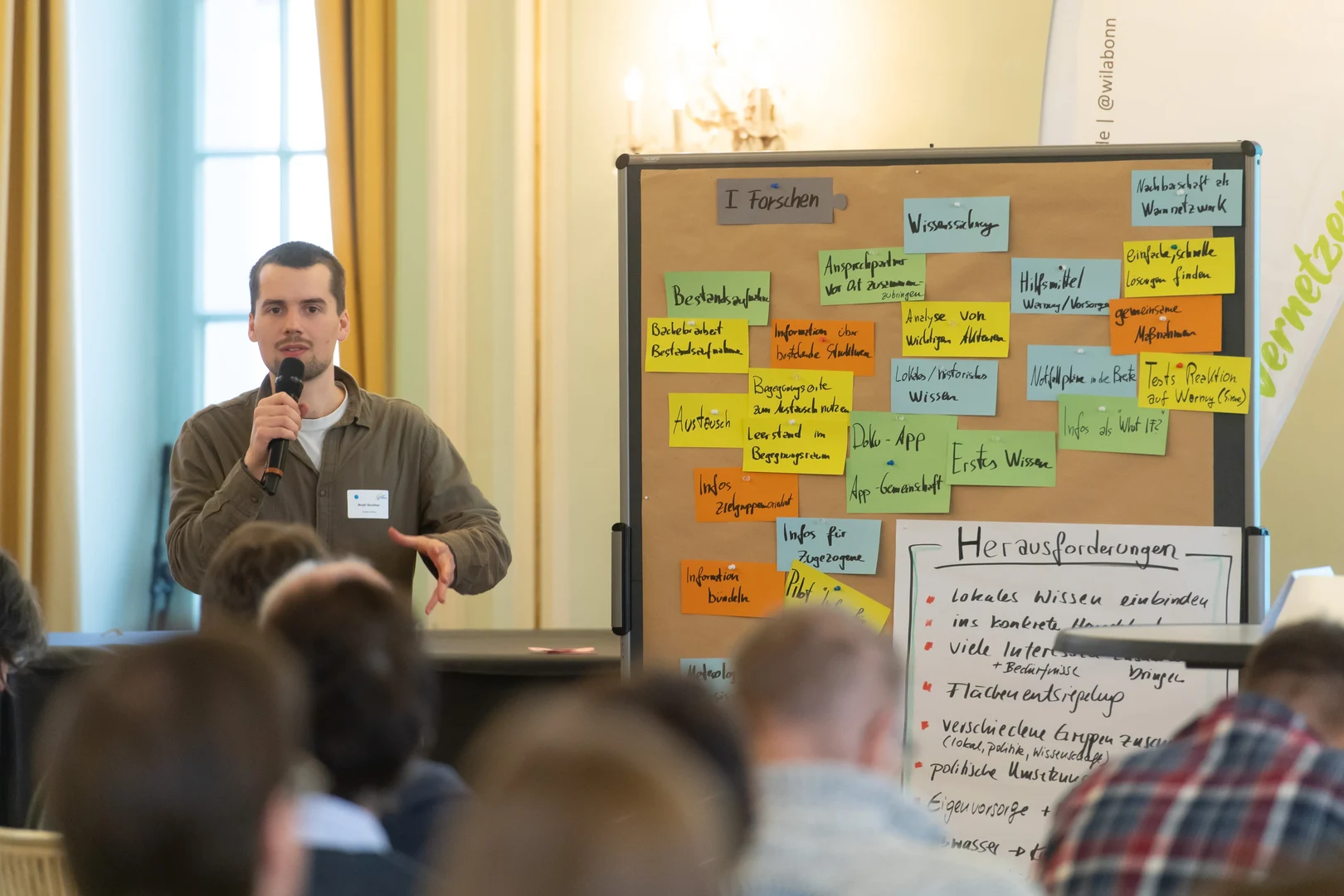
How can we bring about a sustainable transformation in towns, cities and communities? A set of new guidelines devised by the Wissenschaftsladen Bonn (WILA Bonn) and the University of Bonn has the answers. Its core message is that sustainable solutions will only succeed if the academic and scientific community, local authorities and civil society pool their experience, knowledge and views on issues such as climate resilience, biodiversity and livable urban design.
Working together on an equal footing
The guidelines were born out of the StadtKlimaWandeln (“Transforming the Urban Climate”) project, which was funded by the Stiftung Umwelt und Entwicklung Nordrhein-Westfalen environmental and development foundation. Over the course of two and a half years, the partners joined forces with Bonn city council to trial ideas for how cooperation between researchers, administrators and the general public could work, e.g. when dealing with heavy rainfall or disputes over land.
What made the partnership unique was that the University of Bonn and WILA Bonn each contributed their individual perspectives, drawn from academic and civil-society practice respectively. Thus the guidelines incorporate a wide range of experiences, challenges and potential solutions for local transformation processes.
Students building bridges
Students played a key role, coordinating, moderating and guiding dialogue and the overall process involving the various stakeholder groups from the academic and scientific community, the city authorities and civil society. This was done as part of service learning seminars supported by the University of Bonn and WILA Bonn. Professor Annette Scheersoi, Vice Rector for Sustainability at the University, says: “The very fact that the University, the local authorities and civil society are so different actually proves a unique strength when everyone’s prepared to learn from and with one another.”
The courage to try new things
“We want to give higher-education institutions, communities and civil-society stakeholders, but especially students, the opportunity to see for themselves how much of an impact they can have by working together, e.g. on adapting to climate change or promoting biodiversity at a local level,” adds WILA project manager Brigitte Peter.
Franz August Emde, Managing Director of the Stiftung Umwelt und Entwicklung Nordrhein-Westfalen, sees StadtKlimaWandeln as a role model for future projects: “We’re big fans of this highly practical, multi-perspective approach. The guidelines have the potential to inspire a lot of people to get involved and actively help to shape change in their towns and cities.” The Stiftung Umwelt und Entwicklung Nordrhein-Westfalen provided support to the StadtKlimaWandeln project.
To download the guidelines:
The guidelines are entitled StadtKlimaWandeln – gemeinsam nachhaltig! (“Transforming the Urban Climate—Sustainable Together!”) and can be downloaded for free from https://www.service-learning.uni-bonn.de/bilder-1/veranstaltungen/stadtklimawandeln/leitfaden_stadtklimawandeln-gemeinsam-nachhaltig.pdf/@@download.
Visit https://www.service-learning.uni-bonn.de/en/startseite for more on service learning at the University of Bonn.