


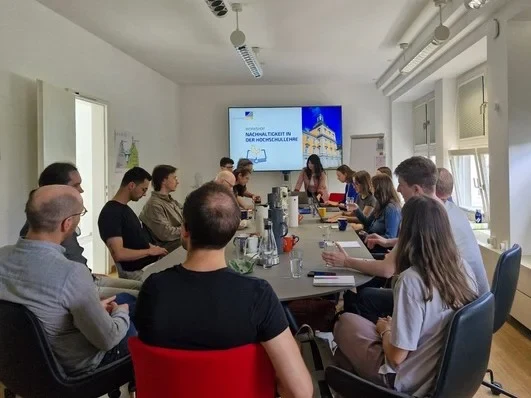
How can sustainability be actively promoted through university teaching? What ways of learning might teaching staff and students have in mind? What skills will students need in order to shape a better society? And by what methods can teaching staff promote acquisition of these skills? These were the questions addressed in an interactive workshop series at the University of Bonn attended by students, teaching staff and experts from UNESCO and other outside organizations. The goal: to develop ideas and proposals for enhancing sustainability in higher education—in terms of content, methodology and structure.
The three workshops were devoted to exploring topics and considering skills and didactic approaches for university teaching that prepares students to play a contributing role in sustainable social development. In a co-constructive process, participants shared their varying perspectives and expertise, discussing visions, approaches and directions for making higher education more sustainability-oriented.
Professor Annette Scheersoi, Vice Rector for Sustainability: “I am very pleased with the outcomes, which will keep the process of transforming our University moving forward. Co-constructive, participative processes have uncommon potential, as we have once again clearly seen in this case.”
Teaching sustainability requires spaces for co-creative working
Prerequisites for sustainability-oriented teaching were first identified; these include well-founded knowledge about the climate and biodiversity crises and an understanding of the complex, interlocking nature of sustainable development goals. It emerged that spaces for co-creative working and inter- and transdisciplinary collaboration are essential for sustainability-oriented teaching. Transformative teaching and study settings are characterized by collaborative work on complex problems. Scientific and academic expertise delivers support that enables innovation, promotes collaborative skills and trains systemic thinking.
The workshop series is part of a broad institutional transformation agenda that includes teaching. This is in line with the University of Bonn’s Sustainability Strategy, which requires that all students are to be empowered to deeply engage in sustainability issues. Additionally, teaching staff are to receive support in developing and implementing contemporary sustainability-oriented teaching, via continual professional development, for example, or by creating forums for collegial dialogue.